
European lawmakers have advanced a redesign of the bloc’s sustainable-finance disclosure regime, replacing widely misunderstood classifications with clearer product labels.
The proposal promises less paperwork and more useful information for investors, but safeguards around transition finance remain contested.
Its final shape could influence fund governance far beyond Europe, including products and capital channels serving African markets.
Parliament Pushes Sustainability Labels Toward Clarity
The European Parliament’s Economic and Monetary Affairs Committee has backed a broad compromise to simplify the Sustainable Finance Disclosure Regulation, moving the European Union closer to a product-labelling system that helps investors understand what a fund is actually trying to achieve.
The committee adopted its position on 10 September 2026 by 37 votes to nine, with four abstentions.
- Its mandate is expected to be announced at Parliament’s October plenary session before negotiations with the Council of the EU and European Commission.
The reform also covers rules linked to packaged retail and insurance-based investment products and would repeal the existing detailed SFDR delegated regulation.
Three Labels Replace Confusing Disclosure Categories
At the centre of the proposal is a shift away from the current Article 8 and Article 9 classifications.
- Those provisions were written as disclosure categories, yet markets increasingly used them as quality labels.
- That gap confused retail investors, complicated product distribution and created opportunities for greenwashing.
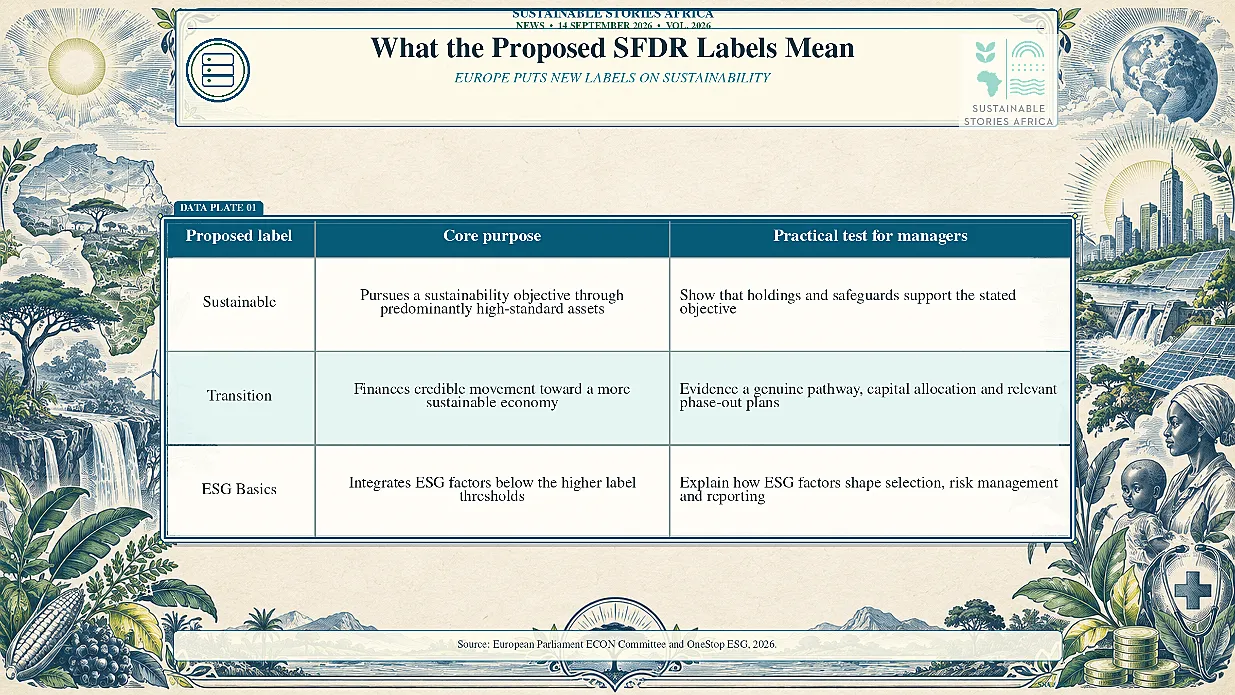
The emerging framework uses three labels:
- Sustainable, for products pursuing a sustainability objective and investing mainly in assets meeting high standards.
- Transition, for investments supporting credible movement toward a more sustainable economy.
- ESG Basics, for products integrating environmental, social and governance factors without meeting the higher thresholds.
The approach is intended to concentrate disclosures where they are most useful and reduce repetitive templates that can overwhelm consumers without improving decisions.
- It would also draw a firmer line between products carrying an approved sustainability label and products that merely mention ESG characteristics.
- That distinction should make product names, marketing and investor documents easier to compare, although detailed technical criteria will determine whether the promise is fulfilled.
Lead lawmaker Gerben-Jan Gerbrandy said the compromise keeps the regulation’s goal intact while making the means more effective for consumers and efficient for businesses.
For asset managers, however, simplification will not mean a simple relabelling exercise.
- Existing Article 8 or Article 9 funds may need fresh portfolio tests, governance changes and revised marketing language.
Transition Rules Carry Credibility Risks
The most sensitive debate concerns fossil-fuel exposure.
- Parliament’s position may allow some companies expanding fossil-fuel activities into Transition-labelled products if they demonstrate a credible strategy and invest more in taxonomy-aligned activities than in new fossil projects over a rolling three-year period.
- Companies using coal for power generation would also face a phase-out safeguard.
Eurosif welcomed stronger product-level adverse-impact indicators, clearer warnings for uncategorised products using ESG information and the restoration of selected entity-level disclosures.
It nevertheless warned that a professional-investor opt-out could fragment the market, and the absence of dedicated social criteria and a clear “do no significant harm” safeguard could weaken investor confidence.
African Finance Should Read Europe Carefully
Although the regulation applies in Europe, its consequences will travel.
- African issuers, project sponsors and asset managers seeking European capital may encounter new questions about transition plans, biodiversity exposure, emissions data and the credibility of sustainability claims.
- Funds marketed across borders could also change their mandates as the labels settle.
African regulators need not copy the EU model wholesale.
- They can learn from its central lesson: disclosure categories become market signals whether lawmakers intend that outcome or not.
- Labels should therefore be understandable, supported by measurable thresholds and adapted to local asset classes, including infrastructure, private markets and transition finance.
Clear Rules Must Protect Real Outcomes
EU negotiators should preserve useful simplification while closing loopholes that allow isolated green spending to obscure a company’s wider capital allocation.
Financial institutions should begin mapping existing products against the proposed labels, testing data gaps and reviewing every sustainability claim before the final rules arrive.
Path Forward – Clarity Must Travel Together With Credibility
The next stage should produce labels that ordinary investors can understand and professional investors can trust, with proportionate safeguards across asset classes.
For African market participants, early preparation means strengthening transition plans, impact data and product governance so access to European sustainable capital rests on evidence rather than branding.
Culled from: European Parliament Committee Backs Simplified Sustainable Finance Disclosure Rules