The Kunming-Montreal Global Biodiversity Framework commits countries to halt and reverse biodiversity loss through 23 targets for 2030 and four long-term goals for 2050.
Its promises cover ecosystem restoration, conservation, pollution, business disclosure, harmful subsidies and finance.
For Africa, where nature supports livelihoods and development, the test is whether global ambition produces accessible funding, stronger institutions and rights-based delivery on the ground.
Nature Agreement Sets A Global Deadline
The world’s central biodiversity agreement has transformed nature loss from a broad environmental concern into a delivery agenda with dates, numbers and responsibilities, requiring governments and businesses to show measurable progress by 2030 rather than rely on distant promises.
Adopted at the fifteenth Conference of the Parties to the Convention on Biological Diversity in Montreal in December 2022, the Kunming-Montreal Global Biodiversity Framework sets 23 action-oriented targets for 2030 and four goals for 2050.
- Its mission is to halt and reverse biodiversity loss fairly, while conserving and sustainably using nature and sharing benefits from genetic resources.
Thirty By Thirty Anchors Wider Change
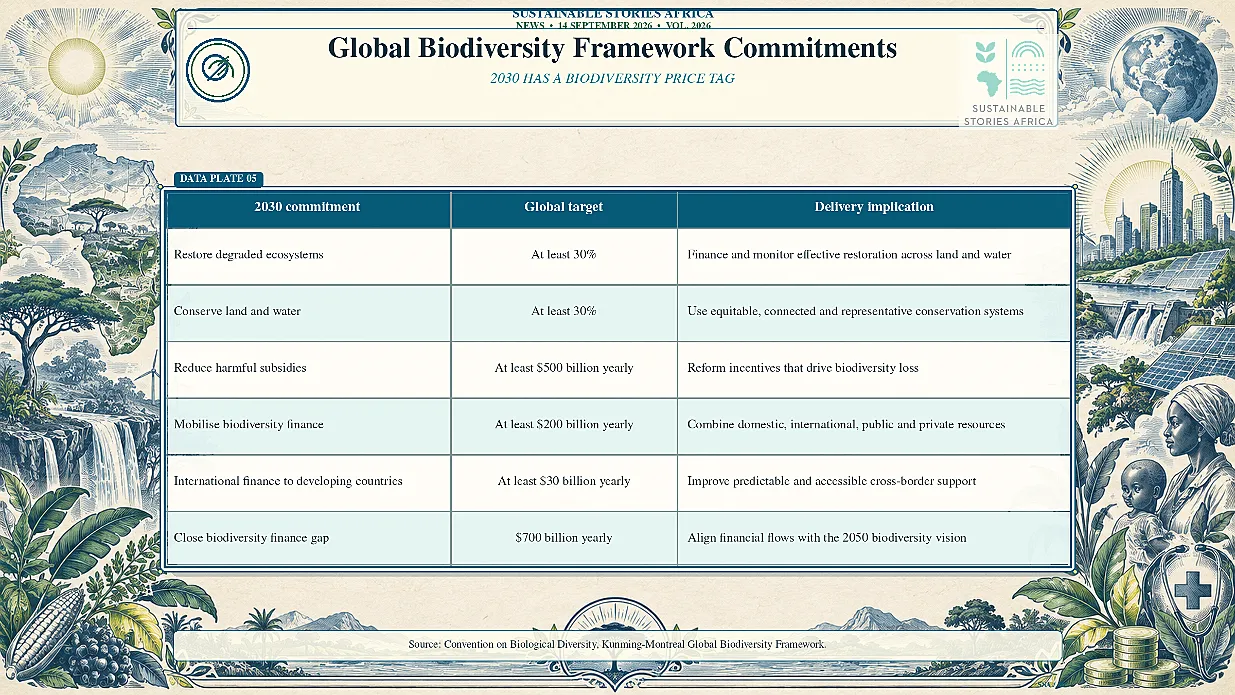
The best-known commitments require at least 30% of degraded terrestrial, inland-water, marine and coastal ecosystems to be under effective restoration by 2030, and at least 30% of land, inland waters and seas to be effectively conserved and managed.
The text also calls for biodiversity-inclusive spatial planning that brings losses in areas of high biodiversity importance close to zero.
However, the framework extends far beyond protected areas.
- It seeks to halve excess nutrient losses, cut overall risks from pesticides and highly hazardous chemicals by at least half, reduce introductions of invasive alien species by at least 50%, work toward eliminating plastic pollution and halve global food waste.
For African communities, these targets meet daily economic realities.
- Fisheries, forests, soils, pollinators and water systems are not abstract natural assets; they support food, jobs, health and resilience. Poorly designed conservation can restrict livelihoods, while effective and equitable conservation can protect them.
The agreement therefore recognises indigenous peoples and local communities as custodians and requires respect for their rights and participation.
It also links biodiversity to climate action, public health, and urban life, encouraging nature-based solutions, greener cities, and the restoration of ecosystem services such as water regulation and pollination.
Finance And Business Move Centre Stage
The framework estimates a biodiversity finance gap of $700 billion a year and calls for at least $200 billion annually from all sources by 2030.
- Within that total, biodiversity-related international finance from developed to developing countries is expected to reach at least $30 billion a year by 2030, after a $20 billion milestone for 2025.
It also calls for reducing harmful biodiversity incentives and subsidies by at least $500 billion annually by 2030.
- That makes reform of public spending as important as raising new money: governments can undermine conservation when fiscal incentives reward land conversion, pollution or unsustainable extraction.
Business responsibilities are explicit.
- Large and transnational companies and financial institutions should monitor, assess and transparently disclose their biodiversity risks, dependencies and impacts across operations, supply chains and portfolios.
- For banks, insurers and investors, nature becomes a governance and capital-allocation issue rather than a peripheral conservation programme.
Africa Needs Rights-Based Implementation
The potential gains are substantial: healthier soils, more secure water, resilient coastal economies and lower disaster risk.
However, implementation will fail if countries receive complex reporting demands without adequate finance, technology or monitoring capacity.
- Goal D requires resources and cooperation to be equitably accessible, especially to developing countries.
National biodiversity strategies and action plans are the main delivery vehicles.
- They need credible budgets, responsibilities and indicators, alongside public reporting that lets communities see whether restoration, conservation and finance claims are producing real outcomes.
- Women, young people, indigenous peoples and local communities must participate in decisions and access information and justice.
Targets Must Become Funded National Plans
African governments should connect biodiversity plans to agriculture, infrastructure, mining, urban development and public finance.
Companies should map dependencies and impacts before disclosure becomes a last-minute compliance exercise.
Development partners should make funding predictable and accessible, while directing more resources to local institutions capable of protecting ecosystems over time.
Path Forward – Delivery Must Match The Global Promise
The framework provides a common destination, but progress will be judged through restored ecosystems, protected rights and transparent financial flows.
By 2030, credible delivery will require funded national plans, comparable data, responsible business conduct and partnerships that give African communities both authority and resources to steward nature.