Egypt, South Africa and Nigeria illustrate growing interest in guarantees as tools for infrastructure and energy finance.
The facilities and transactions are at different stages and should not be treated as one completed programme.
The test is whether clearer risk allocation attracts affordable capital, improves services and keeps public exposure transparent.
Guarantees gain attention across energy markets
African governments and financing institutions are exploring guarantees to attract capital into infrastructure and energy projects, with a September 25, 2026, Renewables Rising report highlighting initiatives in Egypt, South Africa and Nigeria.
- Its examples point to a shared concern: investors may need specific risks addressed before they will provide long-term finance.
A guarantee is a promise to cover defined obligations under agreed conditions.
Its usefulness depends on who provides it, what it covers and how a valid claim is paid. It should not be read as a promise that a project cannot fail.
Facilities operate at different development stages
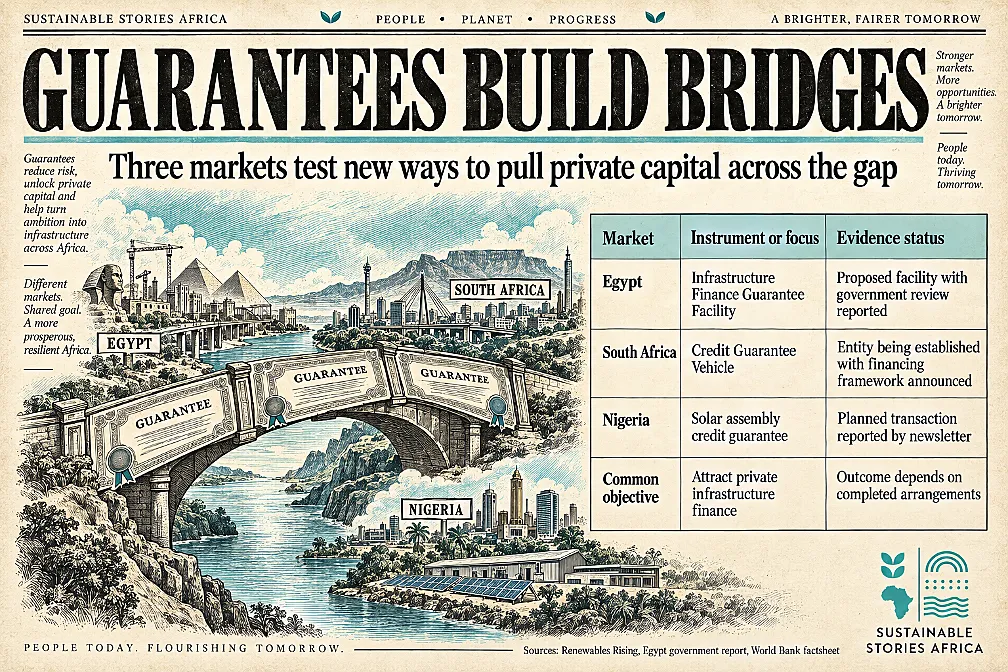
Egypt is working towards an Infrastructure Finance Guarantee Facility, according to the newsletter.
- A July 21 government report described the mechanism as a proposal under review.
- Renewable energy and water feature in the newsletter’s account of its intended priorities.
South Africa is establishing the World Bank-backed Credit Guarantee Vehicle as a privately run entity.
- The World Bank’s March factsheet envisages a U$500 million initial capital base, including up to $100 million financed through a Treasury loan.
- The remaining subscriptions are expected, rather than reported as complete.
The newsletter also reports that Nigerian InfraCredit plans a guarantee to support solar-panel assembly.
- That item should be treated as a reported plan, without assuming an issuance or completed transaction.
Clear risk allocation can support investment
Guarantees can help when a viable project faces a risk that investors cannot comfortably absorb.
- A payment guarantee, for example, may address a defined concern about an infrastructure customer meeting contractual obligations.
- It does not automatically solve poor engineering, weak maintenance or an unrealistic demand forecast.
That distinction matters to electricity users.
- Lower financing costs create room for better terms; however, consumer benefits depend on how the project and its contract are structured.
- Authorities should explain whether reduced costs affect tariffs, expand connections or finance better service.
Local-currency structures can also align financing with domestic revenues.
- Nevertheless, a guarantee cannot erase every currency exposure, particularly where equipment is imported.
- Project sponsors need to show how remaining risks are allocated and managed, rather than presenting a single instrument as a complete solution.
Disclose coverage costs and public exposure
Every facility should publish eligibility rules, guarantee fees, coverage limits and claims procedures.
- Investors need confidence that the instrument works; citizens need to understand the liabilities public institutions may assume.
- Both interests are served by clear governance and regular reporting.
Project selection should examine service value as well as financial mobilisation.
- A transaction that attracts capital but produces expensive or unreliable infrastructure has not fulfilled its development purpose.
- Reporting should connect guarantees issued with project completion, operating performance and the people actually served.
The facilities also need a way to assess additionality:
- Whether support enabled a transaction that would otherwise have been delayed or unavailable on reasonable terms.
- That assessment can help avoid subsidising investments that did not need public risk support.
For African energy systems, guarantees offer a potentially useful financing tool.
- Their credibility will rest on transparent liabilities, disciplined project selection and evidence that financed assets improve access or reliability.
- Announcing a facility is the beginning of that test, rather than its completion.
The reporting framework should include guarantee claims as well as successful financing.
- A claim is not automatically evidence of poor design; it may show that an instrument is covering the risk it was created to address.
- What matters is whether exposures were understood, fees and reserves were appropriate, and claims were handled according to disclosed rules.
That record would allow future facilities to learn from experience rather than rely on promotional accounts.
Make risk sharing deliver public value
Guarantee providers should publish their mandates, liabilities and transaction progress, while separating proposed facilities from operational instruments.
Energy authorities should track financing costs, service delivery and user outcomes.
The goal is to mobilise capital on terms that improve infrastructure without obscuring who carries the remaining risks.
Culled from: Africa turns to guarantees to unlock energy finance