
Quickmart’s shareholder plans to sell part of its stake through a proposed listing on the Nairobi Securities Exchange.
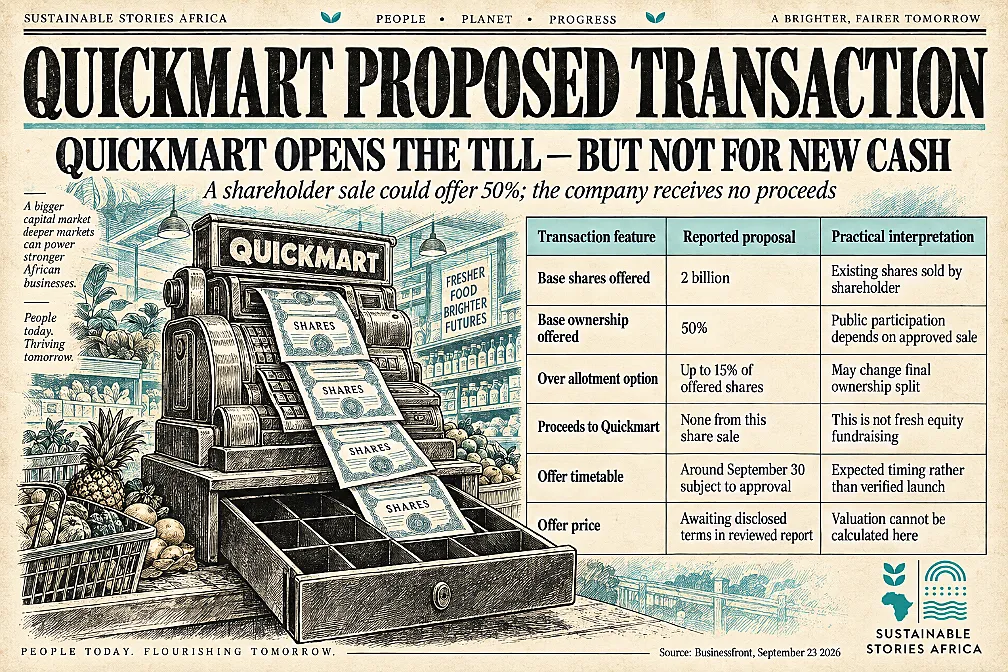
The reported transaction is an offer for sale. As such, proceeds would go to the selling shareholder rather than the retailer.
For investors, the important next documents are the approved offer terms, pricing and disclosures needed to assess ownership and business performance.
Quickmart proposal would broaden public ownership
Kenyan supermarket chain Quickmart plans to list on the Nairobi Securities Exchange by selling existing shares by Sokoni Retail Kenya Limited, according to Businessfront’s September 23, 2026, report.
- The proposed transaction would open ownership to public investors, subject to regulatory approvals.
The report anticipated an offer launch around September 30. That expectation is not confirmation that an offer opened on that date.
As this article’s editorial date is September 30, the proposal should remain described as proposed unless a subsequent approval or launch notice is verified.
Shareholder sale differs from company fundraising
Businessfront reports a proposed sale of 2 billion shares, representing 50% of Quickmart, with an over-allotment option of up to 15% of the offered shares.
- It says the retailer would receive no proceeds because the transaction involves existing shares.
- Offer pricing and final terms are expected in an Information Memorandum.
The distinction changes how readers interpret the listing.
- Broader ownership and a shareholder’s partial exit are different from a company issuing new shares to fund expansion.
- Neither structure alone establishes whether an offer is attractive; that assessment depends on valuation, terms and the business’s prospects.
Public ownership can strengthen market scrutiny
A listed retailer can give investors exposure to an everyday consumer business while increasing expectations for financial disclosure.
- Public scrutiny can make governance arrangements, related-party dealings and capital allocation more visible.
- The benefit depends on the quality and consistency of information provided after listing.
For customers, employees and suppliers, listing is not proof of improved treatment.
- Readers interested in sustainability should examine how the retailer reports workforce conditions, supplier payment practices, food waste and resource use.
- Ownership changes and operational responsibility are connected; however, one cannot substitute for evidence about the other.
Investors should also separate brand familiarity from financial understanding.
- Shopping at a business provides a view of its customer experience, not its debt, lease obligations or margins.
- An accessible prospectus or memorandum should help bridge that gap with comparable, verifiable information.
Review offer documents before drawing conclusions
The approved information documents should explain the selling shareholder’s position, the final number of shares, pricing, allocations and the intended free float.
- Readers should check whether any additional sale option changes control or public ownership beyond the base transaction.
Business performance needs equally careful treatment.
- Reported earnings should be assessed alongside cash generation, commitments and accounting adjustments.
- A growing store network may bring opportunities and additional costs; the investment case requires both to be visible.
For the exchange and regulator, clear communication about approval and launch dates would prevent an expected timetable from becoming an assumed fact.
- For the company, regular disclosure after listing would determine whether wider ownership translates into sustained accountability.
The broader capital-market opportunity is to bring familiar domestic businesses into public investment channels.
- Doing so responsibly requires understandable documents and reliable governance.
- The proposed Quickmart transaction should therefore be reported through its actual structure: an existing-share sale awaiting verified final terms, rather than an announcement of fresh capital raised for the retailer.
Readers should look for clear and demonstrable consistency between expansion plans and the resources available to support them.
- If growth is to rely on internally generated funds, the relevant questions concern cash conversion, reinvestment needs and the resilience of operations.
- The proposed listing changes who may own the business, but a credible account of its strategy must still explain how day-to-day performance supports future commitments and how progress will be reported.
Path Forward – Verify offer terms before public participation
Quickmart and its advisers should publish approved pricing, allocation rules, final ownership implications and the confirmed timetable.
Investors need to assess the offer documents and business disclosures.
The listing’s credibility will depend on transparent execution and continuing accountability after any completed transaction.
Culled from: Kenya's second-largest supermarket chain, Quickmart, plans listing on Nairobi stock exchange - Businessfront