
Ethiopia has approved rules for collective investment schemes, creating a regulated route into pooled investment products.
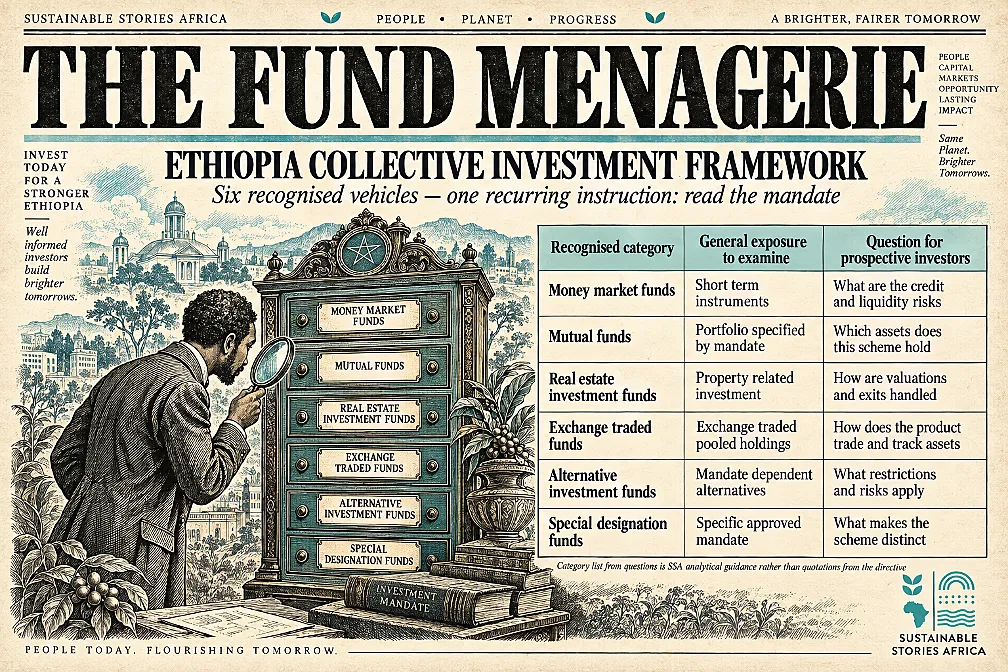
The framework recognises six fund categories and assigns responsibilities to operators and custodians.
Its public value will depend on effective supervision, understandable disclosures and access that helps smaller savers assess risk before committing their money.
Ethiopia creates rules for pooled investments
Ethiopia’s capital-markets regulator introduced a framework governing collective investment schemes, and the Ministry of Justice is registering and approving it.
Businessfront reported the development the following day, while the Ethiopian Capital Market Authority’s regulations page lists the directive among its September 23 publications.
The framework creates a route for professionally managed pooled investments.
- It does not establish that every recognised product category is already available to the public.
The next practical step is to register schemes and supervise providers.
Six categories bring different investment exposures
Businessfront identifies six categories:
- Money-market funds
- Mutual funds
- Real-estate investment funds
- Exchange-traded funds
- Alternative investment funds
- Special designation funds.
It reports that public offers require ECMA registration, the scheme's assets must be managed by an independent custodian, and providers must make ongoing disclosures.
Those safeguards address how money is managed and accounted for.
- They should not be interpreted as protection against every investment loss
- Investors still need to understand the underlying assets, charges, liquidity and risks of the particular scheme they choose.
Smaller savers need understandable market access
Pooled investment can make professional management accessible to people whose savings are too small to build a diversified portfolio directly.
- Its success, however, depends on whether the product is suitable for the saver’s needs and whether costs leave a reasonable share of returns with the investor.
A person saving for a near-term expense may need ready access to cash.
- Someone investing over a longer period may accept a different pattern of risk.
- Marketing should explain those differences rather than presenting every regulated scheme as equally appropriate.
Independent custody is an important structural safeguard because it separates asset holding from the operator’s business.
- Effective protection also requires accurate reconciliation, credible valuations and enforceable responsibilities.
- Rules on paper need institutions capable of checking how schemes operate in practice.
Build confidence through disclosure and supervision
Providers should publish clear explanations of investment objectives, fees, redemption arrangements and the circumstances in which withdrawals can be limited.
- Performance reporting should state the period covered and whether figures account for charges. Risk disclosures should use language ordinary savers can understand.
The regulator can strengthen confidence by making registration status easy to check and explaining how investors can raise complaints.
- Early enforcement decisions will help show that approval is followed by continuing oversight. Public education should distinguish supervised investment from a promise of guaranteed profit.
Access should be assessed beyond the number of funds launched.
- Minimum subscriptions, distribution channels and information formats will determine who can participate.
- A market may become broader in product range while remaining difficult for lower-income savers to use.
For Ethiopia, the framework marks an institutional development whose benefits will emerge through implementation.
- Responsible operators and informed investors will need reliable information about actual products, rather than assumptions drawn from the legal permission to create them.
- The public test is whether the new system supports credible participation and channels savings into productive investment with risks clearly understood.
Providers should also explain how conflicts of interest are managed.
- Decisions about distribution, valuations and related-party transactions can affect investor outcomes even where custody is separate.
- Clear governance disclosures, backed by consistent public reporting, would help savers understand who makes decisions and whose interests they represent.
As new products emerge, access to explanations and enforceable responsibilities can build confidence more effectively than promotional claims about the returns investors might receive.
Path Forward – Build investor confidence through enforceable safeguards
ECMA and providers should make scheme registration, custody arrangements, charges and withdrawal rules easy to verify.
The next priority is supervised implementation and accessible investor education.
A wider range of products should be judged on suitability, transparency and trust, alongside their ability to mobilise savings.
Culled from: Ethiopia opens capital markets to retail investors new collective framework - Businessfront