Ghana’s updated Renewable Energy Master Plan outlines an estimated $10.8 billion investment requirement for 2026 – 2030.
Its targets cover generation, mini-grids and wider access to energy technologies.
The delivery challenge is to turn a national roadmap into financed, functioning services, while distinguishing projected jobs and planned capacity from outcomes already achieved.
Ghana roadmap sets investment delivery challenge
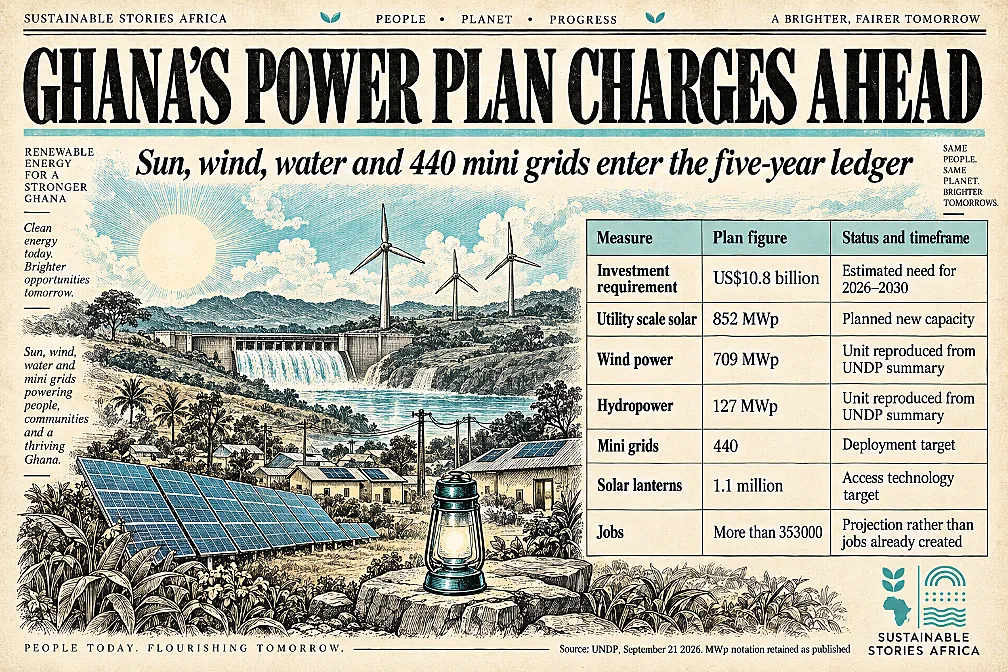
Ghana’s updated Renewable Energy Master Plan requires an estimated $10.8 billion to deliver its 2026 – 2030 ambitions, according to a UNDP summary published on September 21, 2026.
Developed by the Ministry of Energy and Green Transition with UNDP support, the roadmap links renewable energy expansion with access and economic inclusion.
The figure reflects an investment requirement, rather than confirmation that $10.8 billion has been committed.
For businesses and communities, the more consequential question is how projects will move from the plan into procurement, financing, construction and reliable operation.
Targets extend beyond utility-scale generation
UNDP lists targets including 852 MWp of new utility-scale solar, 709 MWp of wind power, 127 MWp of new hydropower and 440 mini-grids.
- Its summary uses MWp for all three generation figures; this article preserves that notation rather than silently changing the units.
The plan also targets 1.1 million solar lanterns and projects more than 353,000 jobs.
- Access to electricity rose from 85% in 2019 to 89.5% by December 2024, according to the summary.
- The job estimate is a projection, while the access figures describe earlier progress.
Reliable services give targets practical meaning
National capacity targets are important, but users experience energy through functioning equipment and dependable service.
- A household needs a connection it can afford to use. A business needs sufficient power when production requires it.
- A rural facility needs maintenance support when equipment fails.
These practical needs should shape financing decisions.
- A mini-grid budget that covers installation but leaves weak arrangements for repairs can produce an impressive completion announcement and an unreliable service.
- Evaluating the full operating model makes the difference between an asset delivered and a benefit sustained.
The investment programme also creates an opportunity to link local participation with verifiable work.
- Training should link to actual contracts and occupational standards.
- Employment reporting should distinguish temporary construction work, continuing operations roles and indirect estimates, rather than combining them into a single unqualified success figure.
Publish project funding and service milestones
A useful delivery dashboard would identify projects, implementing agencies, financing status and expected service dates.
- It should separate funding sought, funding committed, financial close and money disbursed.
That would allow citizens and investors to assess progress without confusing different stages.
Procurement and operating arrangements deserve equal visibility.
- Communities should understand how tariffs are determined, who handles complaints and which institution is responsible for service failures.
- Developers need clear rules for approvals and connections, while public authorities need reliable evidence of performance.
The broader financing context reinforces the importance of preparation.
- The IEA’s 2023 analysis found that capital costs for utility-scale clean energy in Africa were at least two to three times those in advanced economies and China.
- That is historical continental context, rather than a current Ghana-specific financing quote.
Ghana’s plan can guide investment; however, implementation will need project-level evidence.
- Reporting should therefore connect national ambition with actual financing and user outcomes, including the affordability and reliability of the services delivered.
Transparency should also cover revisions to the plan.
- If financing, costs or delivery dates change, authorities should explain the reasons and publish updated milestones.
- That would allow the roadmap to remain useful as circumstances evolve.
- Regular updates should identify responsible agencies and provide enough detail for independent scrutiny of progress and spending.
- Communities and investors should be able to distinguish a justified adjustment from an unexplained delay, with reporting that follows each project through operation rather than ending at contract award or construction completion.
Path Forward – Turn national targets into dependable services
Ghana should publish a transparent project pipeline, financing milestones and operating responsibilities as the roadmap advances.
The priority is delivery that communities can verify; functioning energy services, affordable access and documented employment, with planned capacity and projected benefits kept distinct from completed results.
Culled from: Ghana unveils $10.8bn renewable energy investment plan