
Tullow Oil faces a renewed financial challenge after an arbitration tribunal upheld Ghana’s corporate income tax assessment on insurance proceeds.
The decision triggered a reported share-price fall of about 50%.
For Ghana and investors, the next question is how it will handle the liability while protecting revenue collection, operational continuity and transparent disclosure.
Ghana ruling sends shock through investors
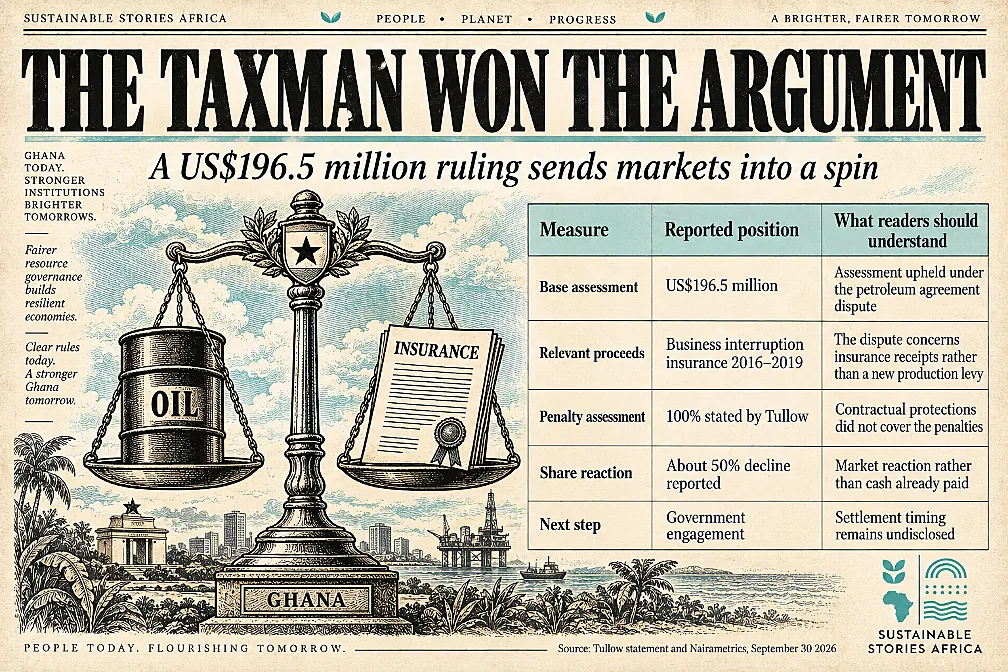
Tullow Oil said on September 30, 2026, that an International Chamber of Commerce tribunal had ruled Ghana’s $196.5 million corporate income tax assessment did not breach its petroleum agreements.
Nairametrics reported that the company’s shares fell about 50% following the disclosure.
The ruling highlights a contested tax exposure; however, it does not establish that Ghana has already received payment.
The immediate significance is financial and institutional. Investors must reassess a disputed liability; Ghana must consider how to enforce its revenue claim; and people whose livelihoods depend on the petroleum sector need clarity about what happens next.
A market reaction is an early signal of concern, rather than a complete measure of the eventual operational consequences.
Insurance proceeds sit behind disputed assessment
The assessment concerns proceeds received under Tullow’s corporate Business Interruption insurance policy in the 2016 – 2019 financial years.
The company’s statement also said penalties assessed at 100% fell outside the contractual protections of its petroleum agreements.
Tullow said it would consider next steps after further engagement with Ghana’s government.
The distinction matters.
- A ruling on contractual protection is not the same as a published settlement schedule.
- Readers should avoid treating the base assessment, penalties, and any eventual negotiated payment arrangement as interchangeable.
The reviewed announcement did not set out a final payment timetable.
Revenue certainty requires credible corporate disclosure
The public interest extends beyond who won.
- A predictable tax system should collect legitimate revenues while giving businesses clear rules for recognising and reporting exposures
- Companies, meanwhile, need to explain how material disputes affect liquidity and future commitments, rather than leaving shareholders to infer those consequences from a falling share price.
For communities, the practical issue is whether a financial shock changes procurement, employment or investment.
- These outcomes cannot be assumed from this announcement.
- They are questions that subsequent company disclosures and government communications should answer with evidence.
The ruling also offers a governance lesson for other resource companies: insurance arrangements and tax treatment deserve the same scrutiny as production contracts.
- Boards should understand where contractual assurances end and where ordinary fiscal obligations begin.
- A disputed assessment can remain unresolved for years while still shaping financial planning.
Clarify obligations before projecting wider consequences
Tullow’s next update should distinguish recognised liabilities from contingent exposures and explain any agreed settlement terms.
Ghana’s authorities should communicate the implementation process and disclose actual collections when they occur.
- Clear reporting would reduce the space for conflicting interpretations of the award.
Investors should examine the company’s filings alongside the arbitration update, including liquidity, debt commitments and operational guidance.
- An isolated percentage decline cannot establish whether the business will reduce investment, renegotiate obligations or continue unchanged.
- Equally, an award should not be booked in public discussion as revenue collected before the payment position is known.
The sustainability question is therefore one of accountable resource governance: how fiscal rights, corporate obligations and local economic interests are managed together.
- Transparency over the next steps will be more useful than predictions that the reviewed evidence cannot support.
Accountability also depends on disclosure timing.
- A company update should explain which matters have been decided and which remain under discussion, while avoiding language that implies certainty where none exists.
- The government’s account should apply the same discipline.
Consistent descriptions of the liability and process would help the public compare subsequent announcements and understand whether the dispute is moving towards resolution rather than merely generating another round of commentary.
Path Forward – Publish settlement terms and protect accountability
Ghana and Tullow should clarify payment arrangements, how penalties will be treated and any operational implications.
Public reporting should distinguish the award from money collected.
The priority is an enforceable, transparent process that protects fiscal accountability and allows investors and affected communities to assess the consequences using disclosed facts.
Culled from: Tullow Oil shares crash 50% after Ghana wins $196.5 million tax dispute - Nairametrics