AfricaRice and AATF have launched a five-year partnership to move improved rice technologies from research systems into farmers' fields across Africa.
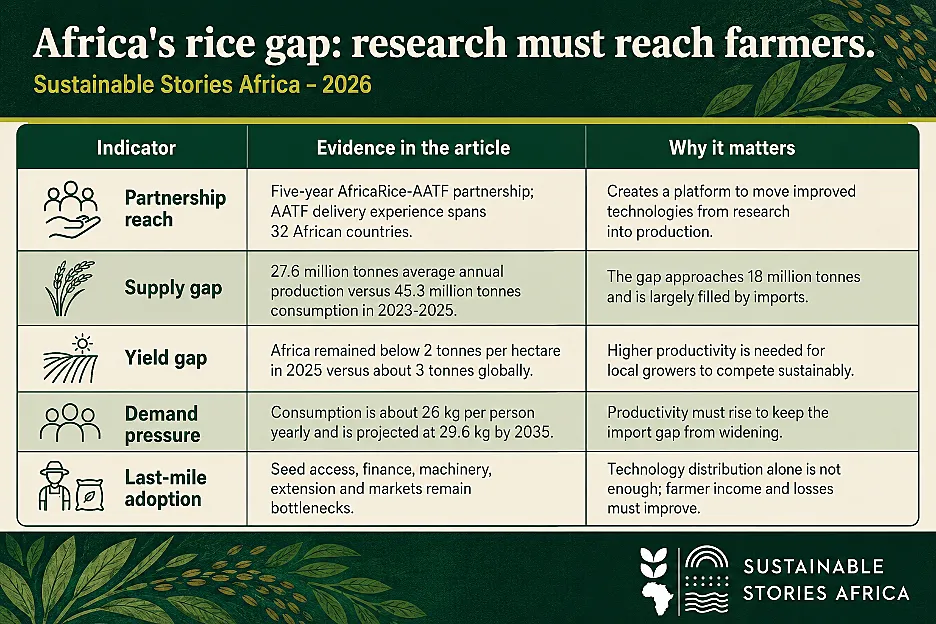
The intervention targets a large structural gap: average annual production was 27.6 million tonnes in 2023 - 2025 compared with a consumption of 45.3 million tonnes.
Closing it will require more than better seed. Mechanisation, finance, extension, infrastructure and markets must work together if productivity gains are to strengthen food security and farmer incomes.
Research meets the production gap
The Africa Rice Centre and African Agricultural Technology Foundation have entered into a five-year partnership aimed at raising rice productivity and accelerating the adoption of improved agricultural technologies as Africa's appetite for the staple continues to outpace domestic supply.
Signed on 21 July, the agreement combines AfricaRice's research in breeding and agronomy with AATF's technology-delivery experience across 32 African countries.
The partners plan to expand farmer access to improved varieties, mechanisation, modern production practices and technical support.
The scale of the challenge is visible in the balance sheet of African food demand. OECD-FAO data cited by the source show average annual rice production of 27.6 million tonnes between 2023 and 2025, compared with consumption of 45.3 million tonnes, a gap approaching 18 million tonnes, largely filled by imports.
Yield growth needs delivery systems
Africa's average rice yield remained below two tonnes per hectare in 2025, compared with a global average of about three tonnes.
That productivity gap raises production costs and makes it harder for local growers to compete with imports even where demand is strong.
Research has already produced higher-yielding and climate-resilient varieties suited to African conditions.
The bottleneck is often adoption: farmers may lack reliable seed distribution, affordable finance, machinery, extension advice or markets that reward improved output.
The new partnership is designed around that last-mile problem.
- AfricaRice Director General Baboucarr Manneh said the collaboration would support machinery for land preparation, harvesting and post-harvest processing, reducing drudgery while improving efficiency and product quality.
Mechanisation matters because rice production in many markets remains labour-intensive.
However, machines alone will not solve the productivity problem if smallholders cannot finance them, access maintenance or organise shared-use models that make equipment economical in smaller farms.
Food security can create industry
Higher domestic production can do more than reduce import bills.
- It can create opportunities in seed systems, equipment services, milling, packaging, storage and logistics.
- Those activities retain more value locally and can generate rural employment beyond the farm gate.
Demand will continue to grow.
- Average African rice consumption is about 26 kilograms per person each year and is projected to reach 29.6 kilograms by 2035.
- Population growth, urbanisation and changing diets mean productivity must improve to prevent the import gap from widening further.
Climate resilience is equally important.
- Higher yields that collapse under drought, flood or heat will not create lasting food security.
- Locally adapted seed, water management, extension and risk finance must therefore be treated as part of the productivity package.
Policy must also avoid confusing self-sufficiency with isolation.
- Imports can remain an important buffer when harvests fail or demand spikes.
- The more resilient goal is to raise competitive domestic production, diversify supply and reduce avoidable exposure to external shocks.
That requires open markets alongside stronger local capacity, not protection without productivity.
Build systems around better seed
Governments and partners should use the AfricaRice-AATF collaboration to strengthen the full adoption chain: seed multiplication, extension, mechanisation services, farmer finance, storage, processing and market access.
Progress should be measured by yield, farmer income and reduced losses, not by technology distribution alone.
The partnership also aligns with the African Union's agricultural agenda and Agenda 2063.
Its real test will be whether scientific advances reach farmers at scale and whether those farmers can convert higher productivity into reliable commercial returns.
Path Forward – Turn Research Into Harvests
AfricaRice, AATF, and governments should build delivery systems around improved varieties, combining extension, access to mechanisation, finance, water management, and post-harvest infrastructure.
Adoption must be affordable for smallholders.
Success should be tracked through yields, farmers' incomes, losses and import substitution rather than technologies distributed.
With consumption still rising, Africa needs research to quickly transcend from laboratories into productive, climate-resilient and commercially viable rice value chains.