The Bank of England says climate-related threats to firms and financial stability are becoming more immediate, with both market repricing and physical damage capable of creating severe disruption.
Its annual climate disclosure warns that extreme weather could also weaken the availability of insurance.
The message for financial institutions is direct: climate risk must be priced, tested and governed as a present financial exposure, not a distant sustainability scenario.
Climate risk moves closer to markets
Climate change is becoming a nearer-term financial stability risk for the United Kingdom, the Bank of England has warned, sharpening the case for banks and insurers to strengthen how they price, test and manage climate exposures.
In its annual climate-related disclosure, published in July, the central bank said evidence increasingly suggests climate risks to firms and the wider financial system are becoming more proximate.
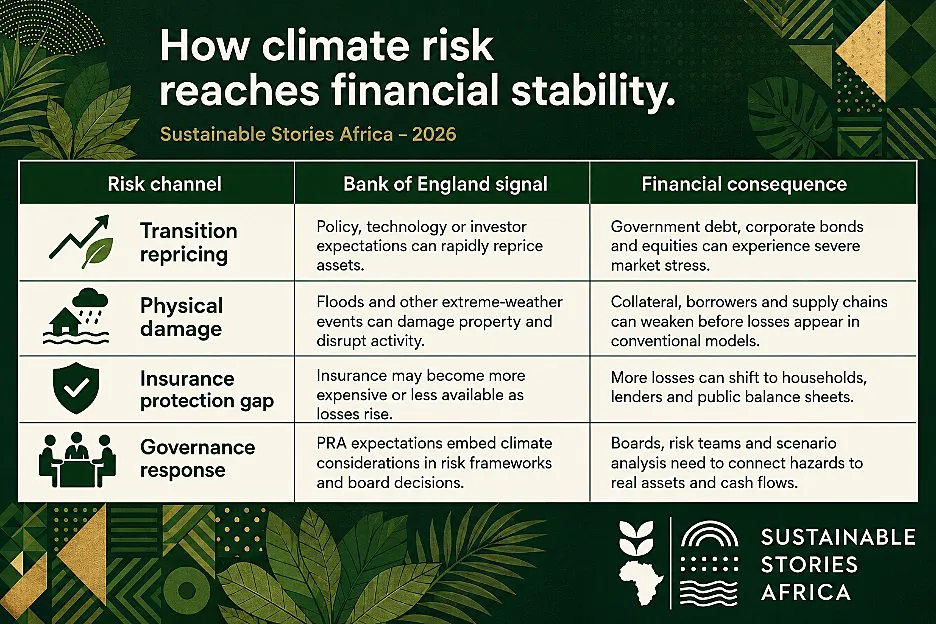
The warning covers both transition risk, where policy, technology or investor expectations can reprice assets, and physical risk from events such as flooding.
The significance is not confined to environmental policy.
- In a severe but plausible scenario, the Bank said rapid repricing of government debt, corporate bonds and equities to reflect climate risk could generate asset-price moves comparable with those seen in recent episodes of market stress.
Insurance gaps can amplify shocks
Physical risk creates a second channel.
- As floods and other extreme-weather events become more damaging, households and businesses may find insurance more expensive or less available.
- That can transfer losses to property owners, lenders and ultimately government balance sheets, turning a local disaster into a broader financial problem.
The Bank pointed to resilience measures such as the Flood Re initiatives, which help households reduce flood vulnerability.
The principle is wider than the UK:
- Insurance is most effective when risk reduction accompanies risk transfer.
- Without investment in resilient homes, infrastructure and businesses, premiums alone cannot solve a rising-loss problem.
The Prudential Regulation Authority has also tightened expectations for banks and insurers, requiring climate considerations to be embedded in risk frameworks and board-level decision-making.
The Bank acknowledged progress among supervised firms but said capabilities remain uneven.
For African markets, where insurance penetration is often lower, and public budgets have less room to absorb climate losses, the warning has particular relevance.
Floods, droughts and heat can damage collateral, derail supply chains and weaken borrowers before those effects appear in conventional credit models.
Pricing risk can improve resilience
Stronger climate-risk management does not mean predicting the exact path of warming.
- It means testing plausible futures and understanding where losses could accumulate.
- Scenario analysis can reveal whether a lender is excessively exposed to flood-prone property, carbon-intensive borrowers or regions vulnerable to repeated climate shocks.
That information can improve decisions about capital, pricing, insurance and resilience investment.
- It can also help financial institutions engage clients early, when adaptation measures remain cheaper than post-disaster recovery.
Bank of England chief operating officer Sarah John said climate considerations are being integrated more deeply across supervisory, macroeconomic, monetary policy and financial stability work.
The direction suggests climate is becoming part of ordinary institutional risk management rather than a parallel ESG exercise.
Finance must be prepared before losses
Financial institutions should treat the Bank's disclosure as a governance signal.
- Boards need clear ownership of climate risk; risk teams need usable data
- Lenders and insurers need scenario analysis that connects physical hazards and transition policy to real counterparties, assets and cash flows.
Public policy also matters.
- Adaptation investment, reliable hazard information and better building standards can reduce losses before they reach financial balance sheets.
The more physical risk is reduced in the real economy, the less pressure falls on insurers, banks and taxpayers later.
Path Forward – Price Climate Risk Earlier
Banks and insurers should strengthen scenario analysis, board oversight and the connection between climate data and everyday risk decisions.
Regulators can reinforce that shift by setting clear, proportionate expectations and tracking whether firms close capability gaps.
Governments should pair financial supervision with adaptation: resilient infrastructure, flood protection, and better risk information can reduce losses likely to affect lenders, insurers, households, and public finances.
Culled from: UK financial stability under risk from climate change, says Bank of England - Green Central Banking