BNP Paribas Asset Management is backing Rainforest Builder to expand forest restoration.
The investment reflects growing interest in nature-based solutions for climate mitigation.
It could unlock new carbon markets, livelihoods, and ecological resilience across West Africa.
A New Bet on Nature as Infrastructure
In the race to meet global climate targets, forests are becoming as valuable as infrastructure.
BNP Paribas Asset Management has backed Rainforest Builder, a company focused on large-scale forest restoration, to expand operations across West Africa.
The move signals a growing shift in global finance, toward nature-based solutions that combine climate impact with economic returns.
As carbon markets evolve and pressure mounts to reverse deforestation, the partnership places West Africa at the centre of a new investment frontier: restoring ecosystems while building sustainable livelihoods.
From Carbon Sinks to Investment Assets
Forest restoration is no longer viewed solely as environmental conservation; it is increasingly recognised as a viable asset class.
Rainforest Builder’s model focuses on restoring degraded land while generating revenue through carbon credits, sustainable timber, and ecosystem services.
By attracting institutional capital from players like BNP Paribas AM, the company aims to scale projects that would otherwise struggle to secure long-term financing.
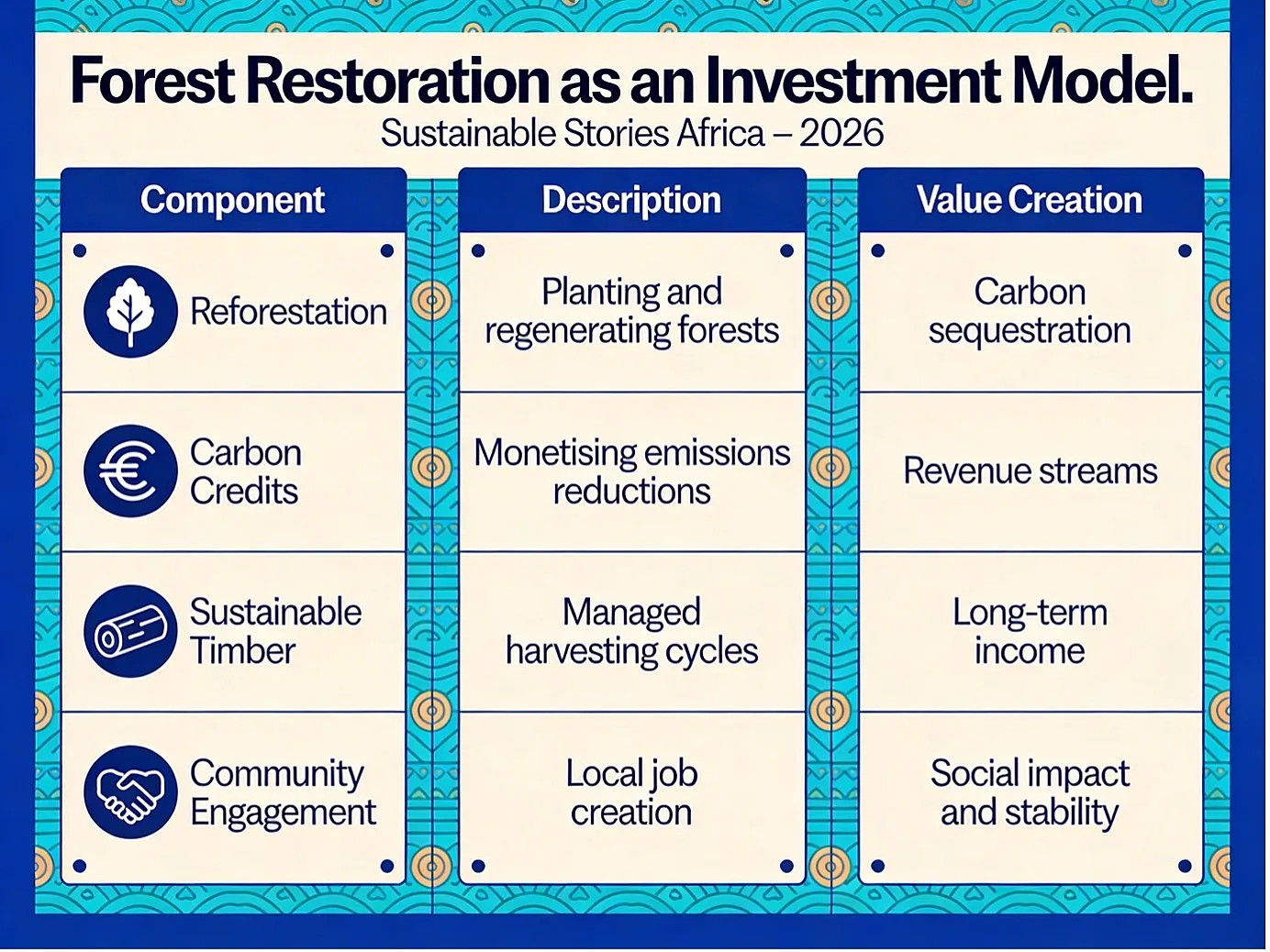
Forest Restoration as an Investment Model
Component | Description | Value Creation |
|---|---|---|
Reforestation | Planting and regenerating forests | Carbon sequestration |
Carbon Credits | Monetising emissions reductions | Revenue streams |
Sustainable Timber | Managed harvesting cycles | Long-term income |
Community Engagement | Local job creation | Social impact and stability |
West Africa, with its vast degraded forest landscapes and high climate vulnerability, presents both a challenge and an opportunity. The region has experienced significant deforestation over the decades, driven by agriculture, logging, and urban expansion.
By linking restoration efforts to global carbon markets, projects like Rainforest Builder aim to turn ecological recovery into a scalable business model.
What Scaled Restoration Could Deliver
If successful, the partnership could unlock multiple layers of value, environmental, economic, and social.
Restored forests act as powerful carbon sinks, helping to offset emissions and stabilise ecosystems. For local communities, they create jobs, improve soil health, and enhance food security.
For investors, the appeal lies in diversification: nature-based assets provide exposure to emerging carbon markets and long-term sustainable returns.
Potential Impact Pathways
Impact Area | Expected Outcome |
|---|---|
Climate | Increased carbon sequestration capacity |
Economy | New revenue streams from carbon and timber |
Communities | Job creation and improved livelihoods |
Biodiversity | Restoration of ecosystems and habitats |
Importantly, such models could redefine how Africa participates in global climate finance, not just as a recipient of aid, but as a provider of high-value environmental assets.
Scaling Nature-Based Finance Requires Alignment
While momentum is building, scaling forest restoration across West Africa will require coordinated action across multiple stakeholders.
Key priorities include:
- Strengthening carbon markets – Ensuring transparency, pricing integrity, and global demand
- De-risking investments – Blended finance structures to attract institutional capital
- Policy support – Clear land-use regulations and protection frameworks
- Community inclusion – Ensuring local populations benefit directly from projects
- Measurement and verification – Robust systems to track environmental outcomes
For financial institutions, the message is clear: nature-based solutions are no longer optional; they are becoming integral to climate-aligned portfolios.
For African governments, the opportunity is equally significant: positioning ecosystems as strategic assets in national development planning.
PATH FORWARD – Nature-Based Finance Gains Strategic Momentum
Forest restoration is emerging as a critical bridge between climate action and economic development.
Investments such as this signal growing confidence in nature-based solutions as scalable assets.
To sustain momentum, stakeholders must align finance, policy, and community engagement to ensure restoration efforts deliver measurable impact while unlocking long-term value across West Africa’s ecosystems.
Culled From: BNP Paribas AM Backs Rainforest Builder to Expand Forest Restoration in West Africa