Central-bank officials are pushing prudential transition plans higher up the supervisory agenda as climate risks become harder to separate from financial stability.
The approach asks banks to show how they will identify and manage risks arising from the shift to lower-carbon economies.
For emerging markets, the debate also raises a harder question: how to finance transition without deepening debt, energy insecurity or unequal access to capital.
Climate risk enters prudential core
Climate transition planning is moving from the sustainability department to the core of banking supervision, as central bank officials argue that the shift away from high-carbon activity can create risks large enough to affect entire financial systems.
At a World Resources Institute webinar on 16 July, held after April's Santa Marta conference on transitioning away from fossil fuels, officials and former policymakers argued that conventional central bank tools may not be enough.
Sarah Amorim Torres of Banco Central do Brasil described climate transition risks as systemic risks requiring action now.
The discussion matters because prudential transition plans are not simply corporate decarbonisation promises.
They are intended to show supervisors how financial institutions identify, manage and disclose exposures created by economic transition; from stranded assets and changing energy prices to borrowers whose business models may weaken as regulation, technology and demand change.
Supervisors want credible economic pathways
Europe is already testing the supervisory model.
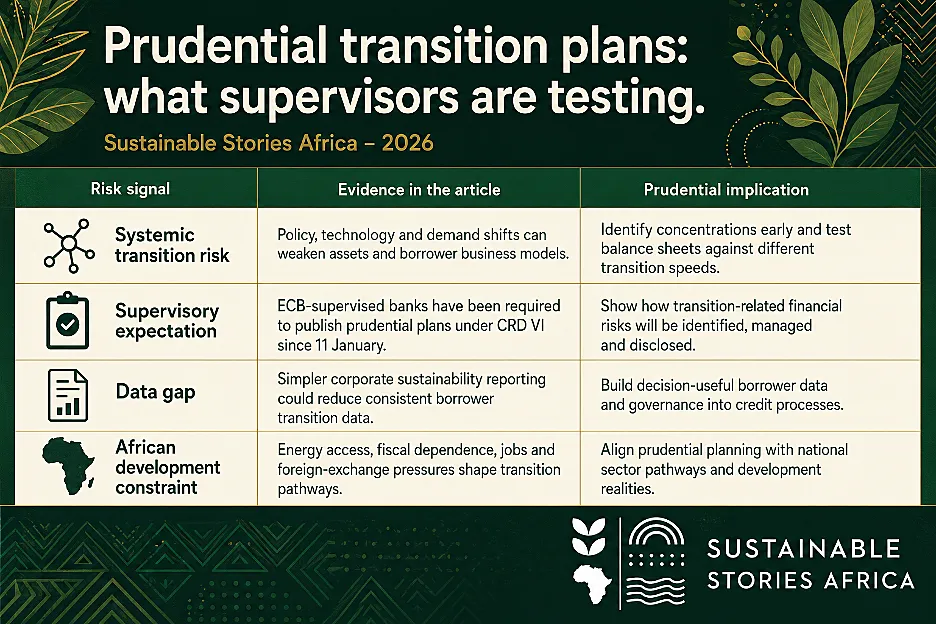
- Since 11 January, banks supervised by the European Central Bank have been required to publish prudential plans under the amended Capital Requirements Directive VI, explaining how they intend to manage financial risks associated with the low-carbon transition.
That requirement creates a practical tension.
- European policymakers have also been simplifying parts of corporate sustainability reporting.
- If fewer companies provide consistent transition data, banks could face a wider information gap precisely when supervisors expect them to assess climate exposures more rigorously.
For African financial systems, the lesson is especially important
- Many economies remain dependent on fossil-fuel revenues, energy imports or carbon-intensive infrastructure while also facing large climate-finance needs.
- A transition plan that ignores energy access, fiscal dependence, jobs or foreign-exchange constraints may look orderly on paper while shifting risk elsewhere in the economy.
This is why national transition pathways matter.
- Banks cannot credibly model where risk is heading if governments, regulators and major industries do not provide reasonably clear policy signals about power, transport, industry and land use.
Better planning can protect investment
Well-designed prudential plans could improve financial resilience without turning supervisors into climate policymakers.
- They can force institutions to identify concentrations early, test balance sheets against different transition speeds and engage borrowers before vulnerabilities become losses.
- They could also help capital move towards firms with credible investment plans. In African markets, that may include renewable power, grid expansion, cleaner industrial processes and adaptation infrastructure, alongside transition finance for businesses that cannot decarbonise overnight.
Former Trinidad and Tobago central bank governor Jwala Rambarran added another dimension:
- Countries trapped between expensive debt and fossil-fuel revenues need a global financial architecture that responds to vulnerability, not only income classifications.
That argument makes transition planning inseparable from the cost and availability of capital.
Central banks cannot act alone
The immediate task is therefore coordination. Central banks can strengthen scenario analysis, supervisory expectations and research; however, governments must establish credible sector pathways while financial institutions build the data and governance needed to translate them into lending decisions.
Santa Marta brought together more than 50 governments and a dozen stakeholder groups, but major emitters and fossil-fuel exporters were absent.
That gap underlines the limits of voluntary coalitions.
A follow-up conference planned for Tuvalu next year will have to connect transition ambition with finance, debt sustainability and the development realities of vulnerable states.
Path Forward – Make Transition Plans Operational
Supervisors should define proportionate transition-planning expectations, strengthen scenario analysis and ensure banks can obtain decision-useful data from borrowers.
Governments, meanwhile, need credible sector pathways that connect climate goals with energy security, jobs and fiscal realities.
For African markets, transition finance must reward credible change without withdrawing capital from economies that need investment most.
Prudential planning succeeds only when it reduces risk while preserving development space.
Culled from: Climate risks push prudential transition plans to the top of central bank agendas - Green Central Banking