
Sustainability responsibility must move beyond specialist teams and into the offices that allocate capital, value assets and manage enterprise risk, ISSB chair Emmanuel Faber has said.
The warning exposes a persistent corporate gap: executives understand sustainability strategy, but few quantify its financial consequences.
For African companies, the shift could determine whether climate exposure becomes decision-useful evidence or remains a reporting exercise.
Climate Risk Reaches the Finance Desk
Companies must shift responsibility for sustainability from specialist functions to the executives who control investment, valuation and risk, International Sustainability Standards Board chair Emmanuel Faber told the IFRS Foundation’s annual conference.
His intervention came as an exceptional European heatwave offered a visible example of the physical threats companies are expected to measure.
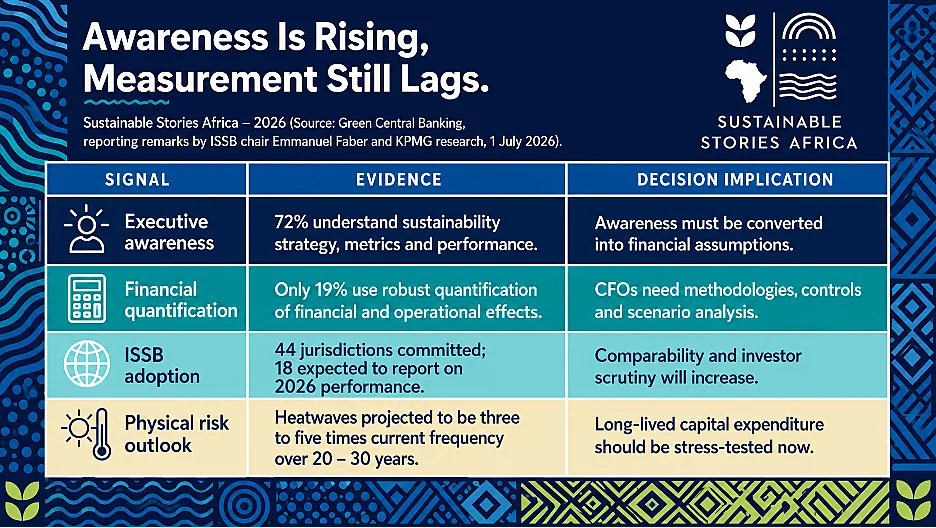
Faber said climate models point to three to five times more heatwaves over the next 20 to 30 years, with events becoming longer and more intense.
Capital expenditure approved today, such as factories, buildings, logistics systems and other long-lived assets, will earn returns inside that altered climate.
Treating the risk as a communications issue therefore leaves investment committees without information that could materially change a project’s value.
Awareness Is Rising, Measurement Still Lags
The organisational problem is not a lack of sustainability language. It is the weak connection between that language and the financial model.
Faber cited KPMG research showing that 72% of executives have a detailed understanding of sustainability strategies, metrics and performance.
However, only 19% use robust methods to quantify effects on financial outcomes, operational gains and innovation.
That divide matters because chief sustainability officers often collect environmental and social information but may not sit in the meetings where portfolio managers allocate capital.
Moving ownership towards the CFO, chief investment officer and chief risk officer does not make the CSO redundant.
It turns sustainability expertise into assumptions that can be challenged, audited and embedded in budgets, impairment tests, cash-flow forecasts and risk appetite.
African Firms Gain Better Capital Discipline
For African companies, the change is especially consequential.
Power instability, water stress, extreme heat, flood exposure, supply chain disruption and shifting disclosure rules can affect operating costs and access to finance.
A finance-led process can connect these risks to project hurdle rates, insurance coverage, liquidity buffers and the useful lives of assets.
The reporting architecture is also expanding. Faber said 44 jurisdictions have committed to adopting ISSB standards, with 18 expected to report on 2026 performance.
Comparable disclosures could help investors distinguish businesses that have priced transition and physical risks from those relying on broad ambitions.
It could also help African issuers explain resilience investments as necessary protection of enterprise value, rather than as discretionary spending.
Governance Must Connect Expertise and Authority
- Boards should define joint accountability: sustainability teams provide subject-matter depth; finance teams own measurement and integration; risk teams test scenarios; and audit committees oversee controls.
- Finance leaders will need credible emissions, nature and workforce data, but also clear links between those indicators and revenue, costs, assets, liabilities and capital allocation.
The ISSB is balancing ambition and implementation simultaneously. Vice-chair Sue Lloyd defended proposed non-mandatory guidance on biodiversity and ecosystems, saying IFRS S1 already requires material nature-risk information and that immediate binding requirements could disrupt adoption of IFRS S1 and S2.
Draft guidance is planned for public comment in October, while work continues on interoperability with European reporting rules.
Path Forward – Finance Must Own Sustainability
African boards should make the CFO accountable for translating material sustainability risks into forecasts, investment papers and financial controls, while preserving the CSO’s technical leadership.
Regulators and professional bodies can accelerate the shift through guidance, training and assurance expectations.
The test is practical: whether climate and nature evidence changes a capital decision. When it does, sustainability moves from narrative to governance, and from reputation management to durable value protection.
Culled From: Sustainability focus must shift to CFOs from CSOs, ISSB chair says - Green Central Banking