A new study says the EU’s carbon border tariff could influence climate policy beyond Europe.
Researchers found it may reduce carbon leakage and encourage trading partners to adopt carbon pricing.
For African exporters, the message is urgent: industrial competitiveness now depends on cleaner production, data systems and climate-smart trade policy.
Europe’s Climate Rule Goes Global
The European Union’s carbon border tariff may do more than protect European industry. It could push other economies to strengthen their own climate policies, according to a new study highlighted by Down To Earth.
The study, led by researchers at the Potsdam Institute for Climate Impact Research and published in the Journal of the Association of Environmental and Resource Economists, finds that the EU’s Carbon Border Adjustment Mechanism, or CBAM, could increase global emissions reductions by 73% compared with EU climate policy alone.
That finding comes at a critical moment. CBAM entered its definitive phase in 2026, moving from reporting into a more consequential compliance era for imports of carbon-intensive goods such as iron and steel, aluminium, cement, fertilisers, electricity and hydrogen.
For a steel exporter in North Africa, a fertiliser producer in West Africa or an aluminium supplier looking toward European markets, the message is no longer theoretical. Carbon is becoming a trade cost.
Climate policy is becoming industrial policy. And the rules written in Brussels are beginning to shape decisions far beyond Europe.
Carbon Leakage Drives The Debate
At the heart of CBAM is a concern known as carbon leakage. If Europe raises carbon prices on its domestic producers but imported goods face no similar cost, production can shift abroad to countries with weaker climate rules.
Europe may reduce emissions at home, but global emissions may fall far less, or even rise elsewhere.
The study’s modelling shows why these matters. A European carbon price of $100 per tonne could cut EU emissions by 505 million tonnes of carbon dioxide annually.
However, without border measures, emissions outside the EU could increase as production shifts and fossil fuel demand adjust.
Net global emissions reductions would fall to 305 million tonnes, meaning carbon leakage would offset about 40% of Europe’s climate gains.
With CBAM in place, leakage falls to 15%, while global emissions reductions rise to 399 million tonnes annually.
If major trade partners adopt their own carbon pricing systems, global emissions cuts could rise further to 691 million tonnes.
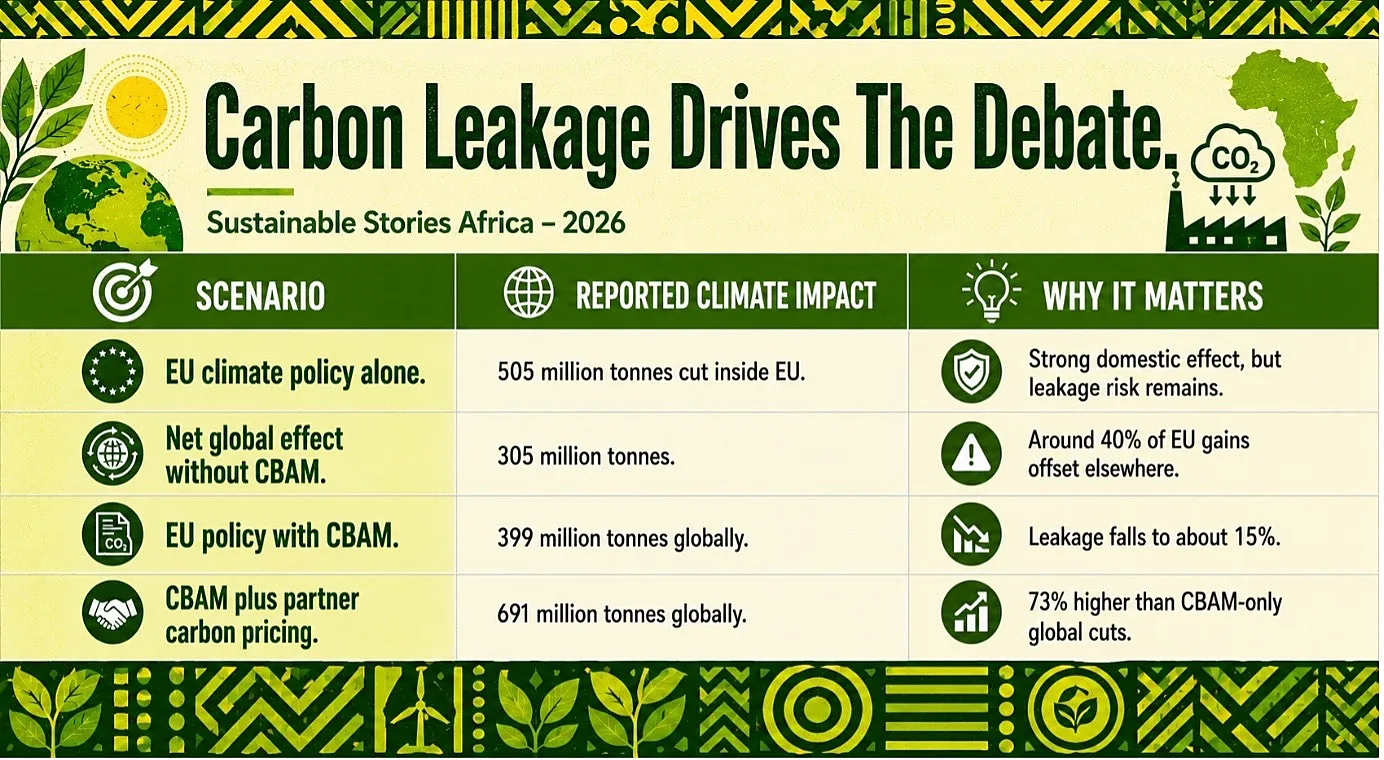
The researchers argue that CBAM can create a “Brussels effect” in climate policy: countries trading with the EU may prefer to keep carbon revenues at home by enabling domestic carbon prices, rather than paying the levy at the EU border.
Trade Pressure Can Create Opportunity
Europe's Carbon Border Adjustment Mechanism presents African exporters with varying risks and strategic signals.
The immediate risk is structural. Many African producers operate within power systems that are dependent on fossil fuels or diesel backup.
They lack the emissions data, verification infrastructure and low-carbon industrial finance that carbon-linked trade rules demand. For smaller exporters, compliance will be costly and administratively burdensome.
However, the opportunity is equally tangible. Countries that decarbonise early can attract green investment and position themselves as credible suppliers in a carbon-constrained global market.
Low-carbon cement, green fertiliser, renewable-powered aluminium and cleaner steel are no longer environmental aspirations; they are market-access strategies.
The political tension, however, is legitimate. Climate justice advocates argue that CBAM places adjustment burdens on developing economies without matching climate finance or technology transfer commitments from Europe.
A fair carbon trade system cannot penalise exporters that lack capital. It must help them decarbonise.
African Markets Need Carbon Readiness
The next step for African governments and companies is not to wait for exemptions. It is to build readiness.
That means mapping exposure to CBAM-covered sectors, improving emissions measurement, strengthening standards bodies and mobilising transition finance for hard-to-abate industries.
Banks, export agencies and industrial ministries need to treat carbon data as trade infrastructure, not sustainability paperwork.
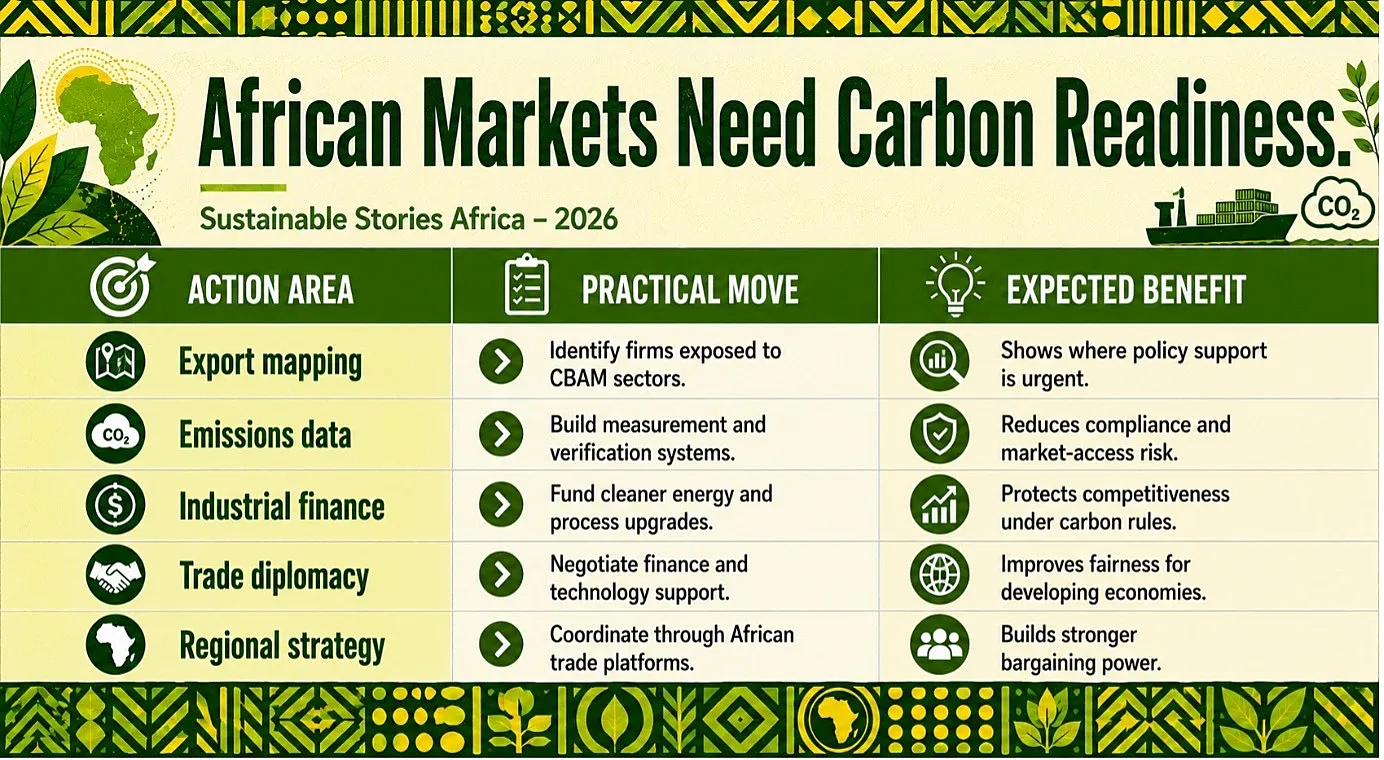
- For businesses, the immediate task is to understand the carbon intensity of products before buyers ask.
- For governments, the task is to link trade, climate and industrial policy.
- For financiers, the opportunity is to support firms that can decarbonise early and defend export value.
CBAM may have started as a European instrument. However, its real impact will be measured in factories, ports, customs offices and power systems across the world.
Path Forward – Build Fair Carbon Trade Systems
The path forward is carbon readiness with fairness. African markets need data systems, cleaner industrial power, transition finance and stronger trade diplomacy before carbon costs deepen competitiveness gaps.
The wider promise is a global climate economy that cuts emissions without excluding developing exporters.
For that to happen, CBAM must be matched by finance, access to technology, and policy support that help countries decarbonise, not merely pay.