The EU Council has backed plans to expand CBAM to more downstream products, tightening Europe’s carbon border rules.
The move matters because carbon costs are transitioning from raw materials to finished goods, including steel and aluminium-intensive products.
For African exporters, this could become both a market-access challenge and a signal to accelerate cleaner production.
Europe’s Carbon Border Is Moving Downstream
Europe’s carbon border tax is no longer just a story about steel slabs, cement bags or aluminium ingots.
It is moving closer to the finished products that sit inside factories, ports, construction sites and homes.
The Council of the European Union has agreed on its negotiating position to expand the Carbon Border Adjustment Mechanism (CBAM) to more downstream products and strengthen safeguards against circumvention.
The decision, announced on June 12, 2026, moves the bloc closer to applying carbon costs to a wider set of imported goods that contain emissions-intensive inputs.
The policy is designed to prevent “carbon leakage”, where companies shift production outside the EU to avoid stricter climate costs, while still selling into the European market.
However, for African exporters, the message is equally clear: access to Europe will increasingly depend not only on price and quality, but also on credible carbon data and cleaner production pathways.
Downstream Products Now Face Carbon Scrutiny
The EU's Carbon Border Adjustment Mechanism has been live since January 2026, covering carbon-intensive imports across steel, cement, fertilisers, aluminium, electricity and hydrogen.
The European Council is now moving to extend its reach to downstream products, particularly goods with significant iron, steel or aluminium content, closing a loophole that allowed producers to route finished goods through uncovered categories.
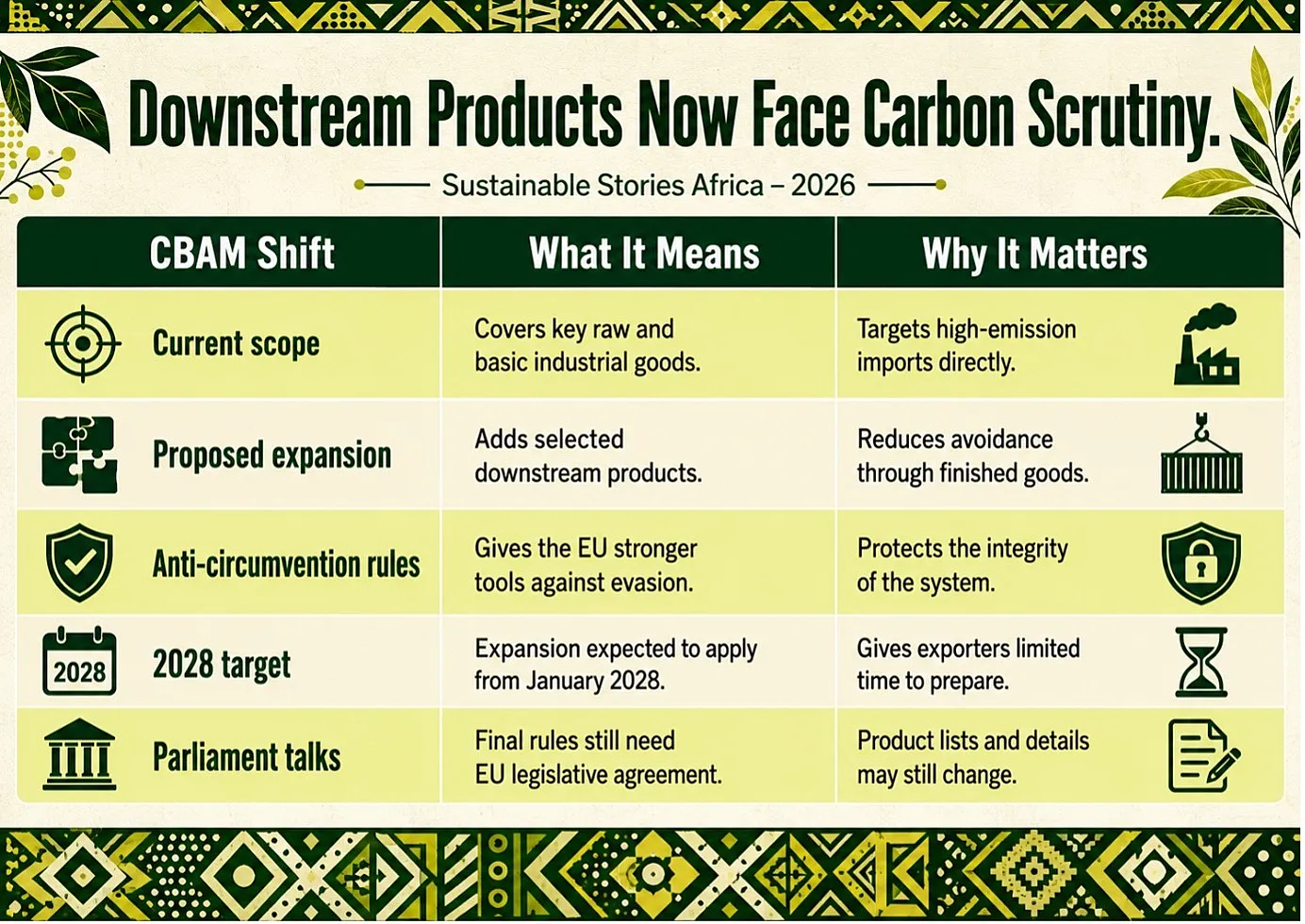
The expansion could encompass nearly 400 additional product types and affect roughly €160 billion in annual imports, shifting CBAM firmly from climate policy into trade strategy.
For African exporters, such as South African metal fabricators, North African component suppliers, and West African industrial producers, this is no longer a regulatory abstraction.
CBAM is reshaping contracts, supplier decisions, customs documentation and margins for any manufacturer with ambitions in the European market.
Cleaner Exports Can Become a Market Advantage
The risk is real, but so is the opportunity.
The African Climate Foundation and LSE analysis has warned that CBAM could reduce Africa’s exports to the EU by up to 13.9% for aluminium, 8.2% for iron and steel, 3.9% for fertiliser and 3.1% for cement if producers remain more carbon-intensive than competitors.
That is not just an environmental warning. It is an industrial competitiveness warning.
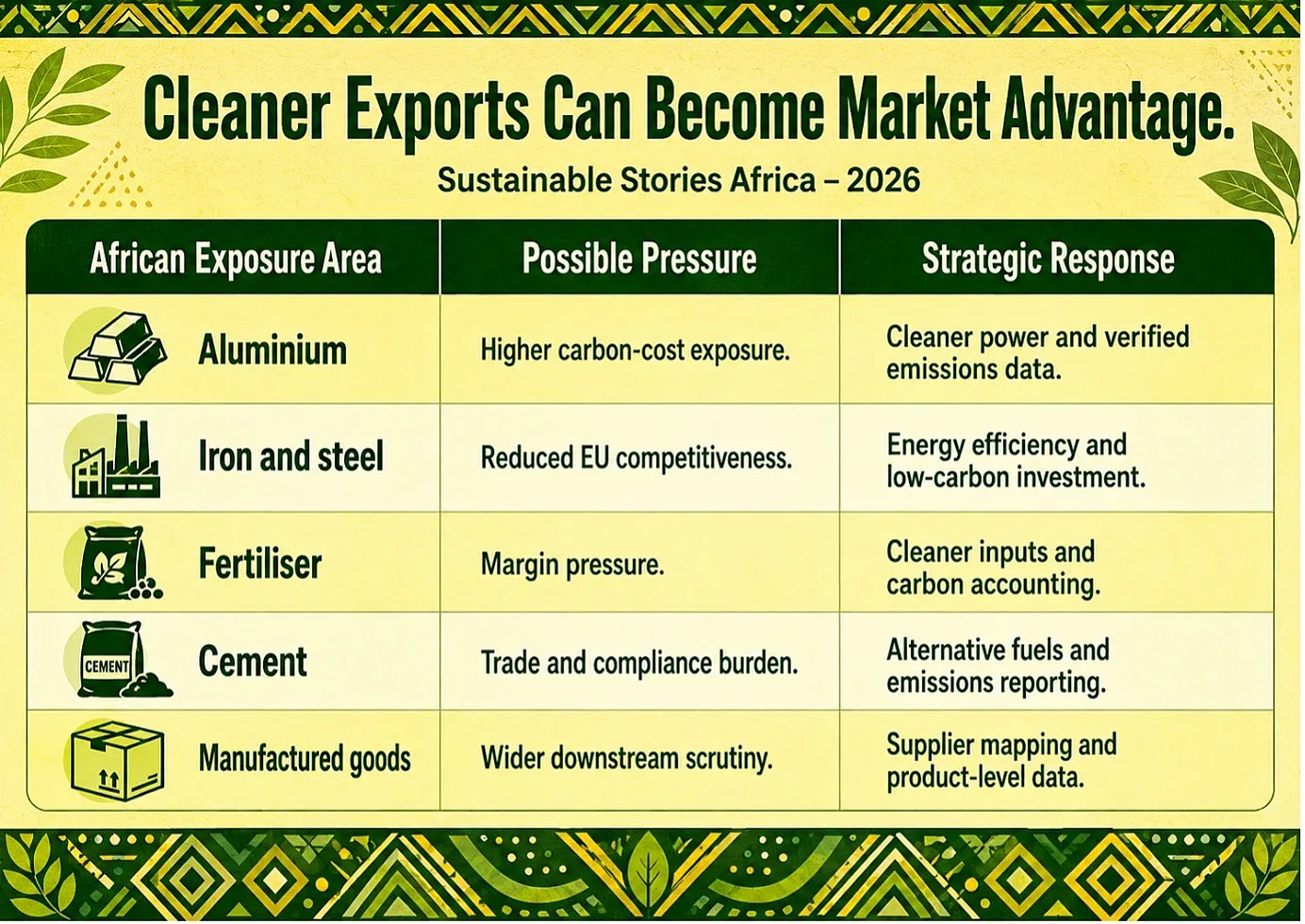
However, the same shift could reward early movers. Companies that can demonstrate lower embedded emissions may become preferred suppliers for European buyers under pressure to clean their supply chains.
Countries that invest in renewable power, green industrial parks, cleaner logistics and emissions verification could turn compliance into market access.
For Africa, the question is not whether CBAM is fair in every detail.
The immediate question is whether exporters, regulators and financiers will prepare fast enough to avoid being locked out of higher-value markets.
African Suppliers Must Prepare Before 2028
The next 18 months should be treated as a transition window, not a waiting period.
Exporters need to map which products may fall under CBAM, trace emissions across their inputs, engage European customers and build systems for verified carbon data.
- Governments should support firms with technical guidance, carbon accounting standards, access to renewable energy, and trade diplomacy.
- Financiers also have a role. Banks, development finance institutions and climate funds should treat CBAM readiness as part of export resilience. Cleaner boilers, solar power, energy audits, efficient furnaces, digital product passports and emissions verification may soon be as important to trade competitiveness as ports and roads.
Europe must also recognise the development dimension. If CBAM becomes only a penalty on poorer producers without enough technology transfer and concessional finance, it could deepen trade inequality.
If implemented with practical support, it can help accelerate cleaner industrialisation.
Path Forward – Make Trade Fairer Through Cleaner Industry
The path forward is to combine climate ambition with trade fairness.
African governments and exporters should prepare now for product-level carbon rules, while the EU should expand technical and financial support for developing economies.
CBAM’s wider scope can advance ESG goals if it drives cleaner production, credible data and fairer supply chains.
The real test is whether carbon rules open a bridge to greener industrial growth, not another barrier to African value addition.
Culled From: EU Council Expands CBAM Carbon Tax Scope to More Downstream Products