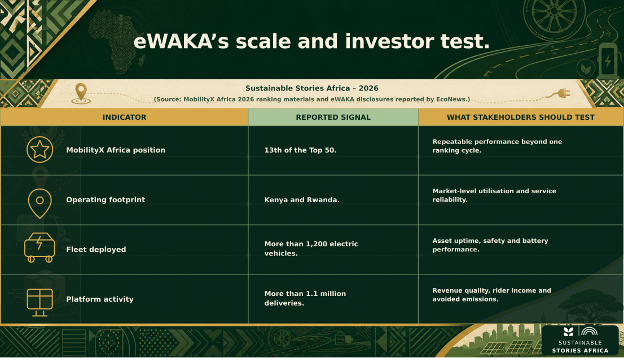
Kenyan-Rwandan eWAKA has placed 13th in MobilityX Africa’s 2026 ranking of 50 mobility companies assessed from more than 250 applicants.
Its 1,200-plus electric vehicles have supported more than 1.1 million deliveries across Kenya and Rwanda.
The ranking spotlights a larger test: whether integrated fleets, financing and charging can ensure durable economics at African scale.
A ranking validates more than vehicles
eWAKA has been ranked 13th among Africa’s top 50 mobility companies, giving the Kenyan-Rwandan operator new visibility as investors search for commercially credible ways to electrify transport.
The company was also listed among Kenya’s five highest-ranked mobility businesses and identified as the highest-ranked woman-led mobility company in East Africa.
MobilityX Africa compiled the ranking of more than 250 companies across 13 markets.
- Fifteen independent assessors used a 300-point framework covering business strength, innovation, impact and sustainability.
- That methodology makes the recognition more than a popularity list, although a ranking remains a signal rather than proof of future performance.
Integrated operations answer adoption barriers together
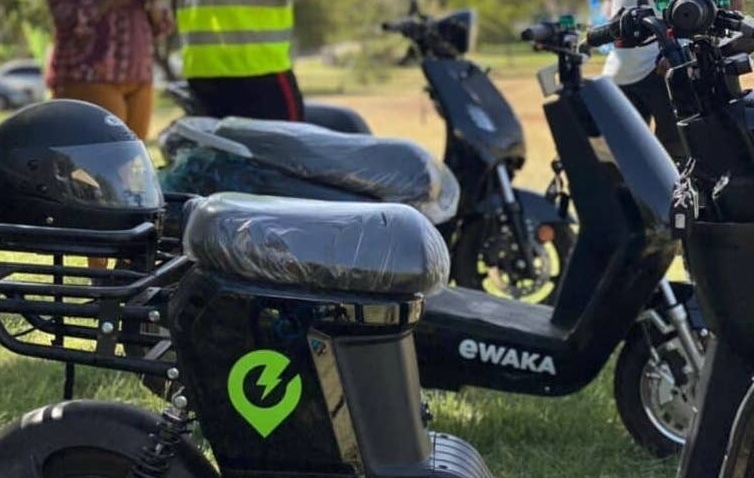
eWAKA operates more than 1,200 electric cargo bicycles and motorcycles in Kenya and Rwanda.
Its platform has processed more than 1.1 million deliveries, providing evidence that electric two-wheelers can serve everyday commercial routes rather than remain pilot projects.
The operating model combines managed fleets, battery access, rider and technician management, financing and proprietary software.
This integration matters in markets where the upfront cost of a vehicle, limited access to charging, maintenance gaps and uncertain residual values can stop adoption even when electricity is cheaper than fuel over time.
Founder and chief executive Céleste Tchetgen Vogel said disciplined execution and efficient capital allocation remain central to the company’s growth.
The emphasis is significant: clean technology firms must manage hardware, credit and operations simultaneously, and rapid fleet growth can strain cash if utilisation and collections lag.
Mobility capital now seeks operating evidence
The wider ranking shows why eWAKA’s operating data matters.
- MobilityX Africa says companies in its integrated-mobility category make up 40% of the top 50 and account for $903.75 million, or 87.2%, of the capital tracked across the ranking.
- Across African mobility, it tracked $3.98 billion of investment since 2021, including $1.68 billion between January 2025 and June 2026.
Capital is concentrating around models that separate asset ownership from riders through pay-as-you-drive, battery-as-a-service and lease-to-own structures.
These approaches can widen access, but they also shift risk to fleet operators and financiers.
Transparent reporting on utilisation, repayment, battery performance, safety and emissions is therefore essential.
Kenya leads the ranking by company count, followed by Nigeria and South Africa, reflecting distinct mobility markets rather than a single continental model.
East Africa’s commercial two-wheeler demand supports fleet electrification, while Nigeria combines scale with a stronger fintech and logistics layer.
South Africa faces different questions around grid reliability and consumer vehicle adoption.
eWAKA’s expansion strategy must therefore remain locally specific even as the technology platform becomes more standardised.
Growth must deepen jobs and resilience
eWAKA plans to expand its managed fleet and technology platform.
- Its next phase should show whether more vehicles translate into stable rider earnings, reliable deliveries, skilled technical jobs and measurable emissions reductions.
- Expansion should also include safe battery handling, responsible end-of-life systems and electricity sourcing disclosures.
Investors and policymakers can support that path with local-currency finance, interoperable charging standards, predictable import and assembly rules, and training systems for technicians.
Procurement by delivery companies and public agencies can create dependable demand, as long as contracts reward service quality and verified emissions outcomes.
Recognition can open doors, but durable impact depends on execution after the attention moves elsewhere.
Path Forward – Turn recognition into measurable shared value
eWAKA’s ranking strengthens the case for African-built mobility platforms that combine hardware, finance and operations.
The path forward is to publish consistent unit economics and impact data while expanding responsibly
That evidence will determine whether today’s top-50 recognition becomes tomorrow’s scalable, investable and inclusive transport system.
Culled From: eWAKA ranked among Africa's top 50 electric mobility firms