South Africa is preparing to verify SIM registrations against Home Affairs identity records in real time.
The plan seeks to curb fraud, kidnapping, money laundering and the circulation of inaccurately registered SIM cards.
Its success will depend on strong privacy safeguards, accessible enrolment and clear limits on how a mobile number may function as identity infrastructure.
SIM registration becomes identity infrastructure
South Africa is moving to overhaul SIM registration by connecting customer checks more directly to the Department of Home Affairs, treating the mobile number as part of a wider trusted digital identity system rather than merely a telecommunications account.
Under the proposed direction, identity information supplied during SIM registration would be verified in real time against authoritative Home Affairs records.
The reform follows government and industry concern that weaknesses in the Regulation of Interception of Communications and Provision of Communication-Related Information Act, known as RICA, have allowed bulk or inaccurate registrations and weakened the ability to trace criminal activity.
Criminal abuse exposes ageing controls
Justice Minister Mmamoloko Kubayi convened telecom operators, regulators, police and other government agencies in March 2026 after evidence linked improperly registered SIM cards to banking fraud, extortion, cash-in-transit robberies, contract killings, kidnappings, cybercrime and money laundering.
Officials identified gaps in registration and distribution, including incorrect or unverifiable subscriber information.
They also said the framework must keep pace with eSIM technology and organised fraud that has evolved far beyond the environment in which mandatory registration was introduced.
Home Affairs already provides real-time verification capabilities used in banking. Applying similar checks to telecoms could make pre-registered SIM cards harder to circulate and strengthen confidence in mobile numbers used for one-time passwords, payments and account recovery.
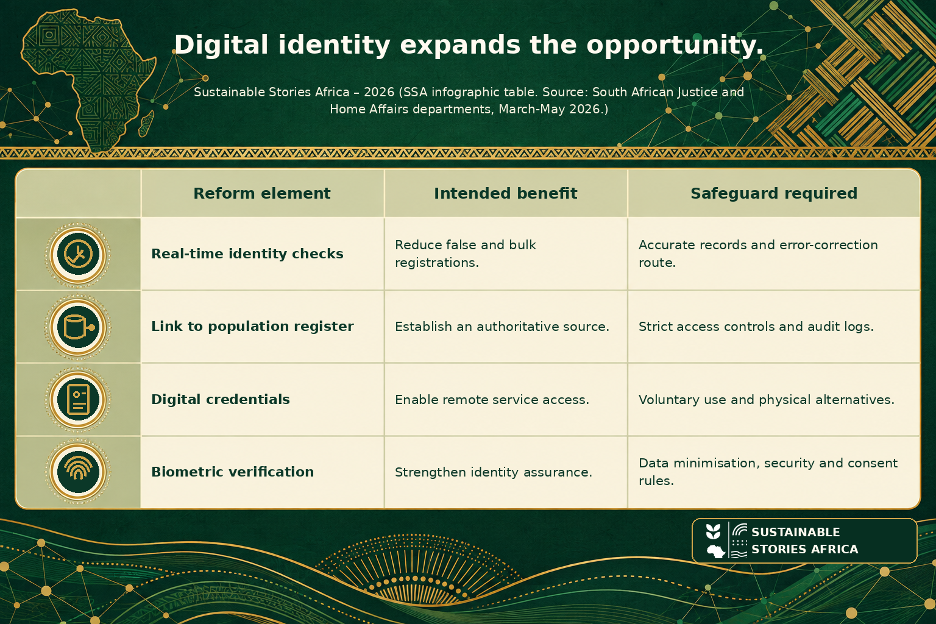
Digital identity expands the opportunity
The SIM reform aligns with draft Digital Identity regulations published in May.
Those regulations propose optional digital credentials that coexist with physical documents, allow people to maintain official records on smartphones and enable remote biometric identity confirmation.
Home Affairs says the population register would remain the authoritative identity record.
This integration could reduce duplicated checks across government and business, simplify access to services and strengthen the digital economy.
However, a verified SIM is not the same as a universal identity credential.
Phones are shared, numbers are recycled, devices are stolen, and some people lack reliable documentation or connectivity.
Security cannot erase inclusion or privacy
A stronger system must comply with the Protection of Personal Information Act and limit data sharing to defined, lawful purposes.
- Verification should return only the information required to confirm identity, not create an unrestricted channel into the population register.
- Independent security testing, breach notification and audit trails are essential because a centralised identity service becomes a high-value target.
Inclusion deserves equal weight.
- Foreign nationals, people in rural areas and citizens whose records contain errors need accessible ways to register and challenge failed matches.
- Public communication should explain what data are checked, who may access them and whether existing users must re-verify.
Telecom operators will also need common technical standards so that customers receive equivalent protection regardless of network.
- A phased pilot can expose false matches, capacity constraints and enrolment bottlenecks before millions of active SIMs are subjected to a compulsory transition at full national scale.
Path Forward – Design trust before nationwide implementation begins
The government should publish the legal basis, technical standards, privacy impact assessment and phased implementation timetable before compulsory changes take effect.
The path forward is a secure but proportionate identity layer: real-time verification, minimal data exchange, meaningful redress and offline alternatives.
If those safeguards hold, SIM reform can reduce fraud without turning connectivity into a new barrier to participation.
Culled From: South Africa wants every SIM to become a digital ID