D.light and Sun King are converting household solar repayments into securities that mainstream investors can finance.
A $50 million green bond and $286 million in securitised debt suggest Africa’s pay-as-you-go market is maturing.
The breakthrough could recycle capital into millions of new connections, but guarantees, reliable data and affordability remain decisive.
Household payments reach capital markets
For years, Africa’s off-grid solar companies have solved the customer side of the energy-access puzzle by allowing families to pay for systems in small instalments.
Now two landmark transactions are testing the financing side: whether those thousands of modest household payments can become an asset large investors will buy.
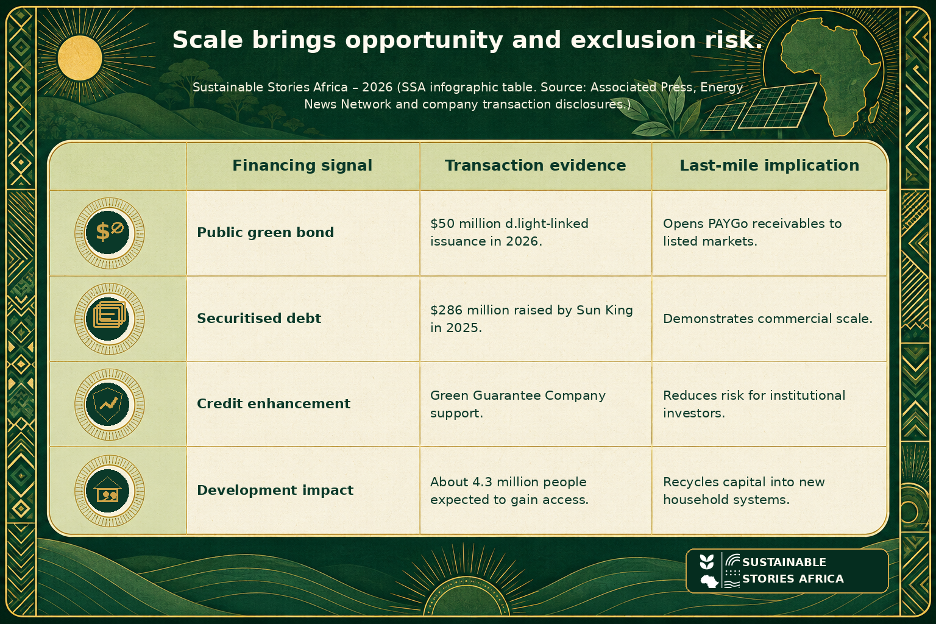
In June, African Frontier Capital issued a $50 million green bond backed by receivables from d.light customers and listed it on the London Stock Exchange’s International Securities Market.
The transaction took d.light’s receivables platform beyond $1 billion in cumulative purchasing capacity.
Rival Sun King raised $286 million through securitised debt transactions in 2025, bringing commercial scale to a model once funded mainly by donors, development institutions and private impact investors.
Receivables unlock the next connection
The structure begins at the last mile.
- A household receives a solar home system and pays over time, often through mobile money.
Those future payments are bundled inside a special-purpose vehicle.
- Investors provide cash against the pool, allowing the solar company to recover capital now and finance the next group of customers rather than waiting years for instalments.
- A green bond adds a use-of-proceeds commitment and investors reporting around environmental benefits.
- Securitisation focuses on the cash flow and credit quality of the underlying receivables.
In both cases, customers’ payment histories become the bridge between decentralised energy and institutional capital.
The d.light bond required credit enhancement from the Green Guarantee Company.
That support helps a security backed by African household receivables reach the risk profile and rating that institutional mandates can accept.
The financing is expected to extend electricity access to about 4.3 million people across sub-Saharan Africa.
Scale brings opportunity and exclusion risk
Sun King’s chief financial officer, Krishna Swaroop, described the transactions as pathbreaking because they bring a scale of commercial capital and financial instruments not previously seen in the sector.
He also highlighted the barrier: investors may require five to seven years of repayment data, while legal, regulatory and guarantee costs make securitisation uneconomic for many smaller companies.
That creates a two-speed market.
- Large firms with seasoned portfolios can lower their cost of capital and expand.
- Smaller local providers serving difficult markets may remain dependent on grants or expensive debt even when their customers perform well.
Aggregation platforms, standardised reporting and shared guarantees will be needed if the revolution is to extend beyond the strongest balance sheets.
Affordability must remain the real test
Mainstream capital is useful only if it improves the customer proposition.
- Foreign-currency debt, inflation and weak household income can still raise repayment risk.
- Structures should therefore use local currency where possible, disclose effective customer costs, monitor repossessions and protect service continuity for vulnerable households.
The opportunity is large.
- Mission 300 aims to connect 300 million Africans by 2030, including through distributed renewable energy.
- The World Bank and African Development Bank reported in June that more than 50 million people had already been connected across 40 countries.
- Off-grid solar can reach remote households faster than conventional grid extension in many locations.
- However, it needs patient equity, working capital and consumer protection alongside bonds.
Path Forward – Make institutional capital serve universal access
Governments and development financiers should expand local-currency guarantees, standardise PAYGo performance data and help smaller providers aggregate credible receivable pools.
Investors, meanwhile, should track affordability, connection quality and customer outcomes alongside repayment.
If the market prices risk without abandoning poorer households, green bonds can turn scattered last-mile payments into a repeatable engine for energy access, jobs and climate resilience.
Culled From: Africa's off-grid solar sector courts mainstream investors with landmark financing deals - ABC News