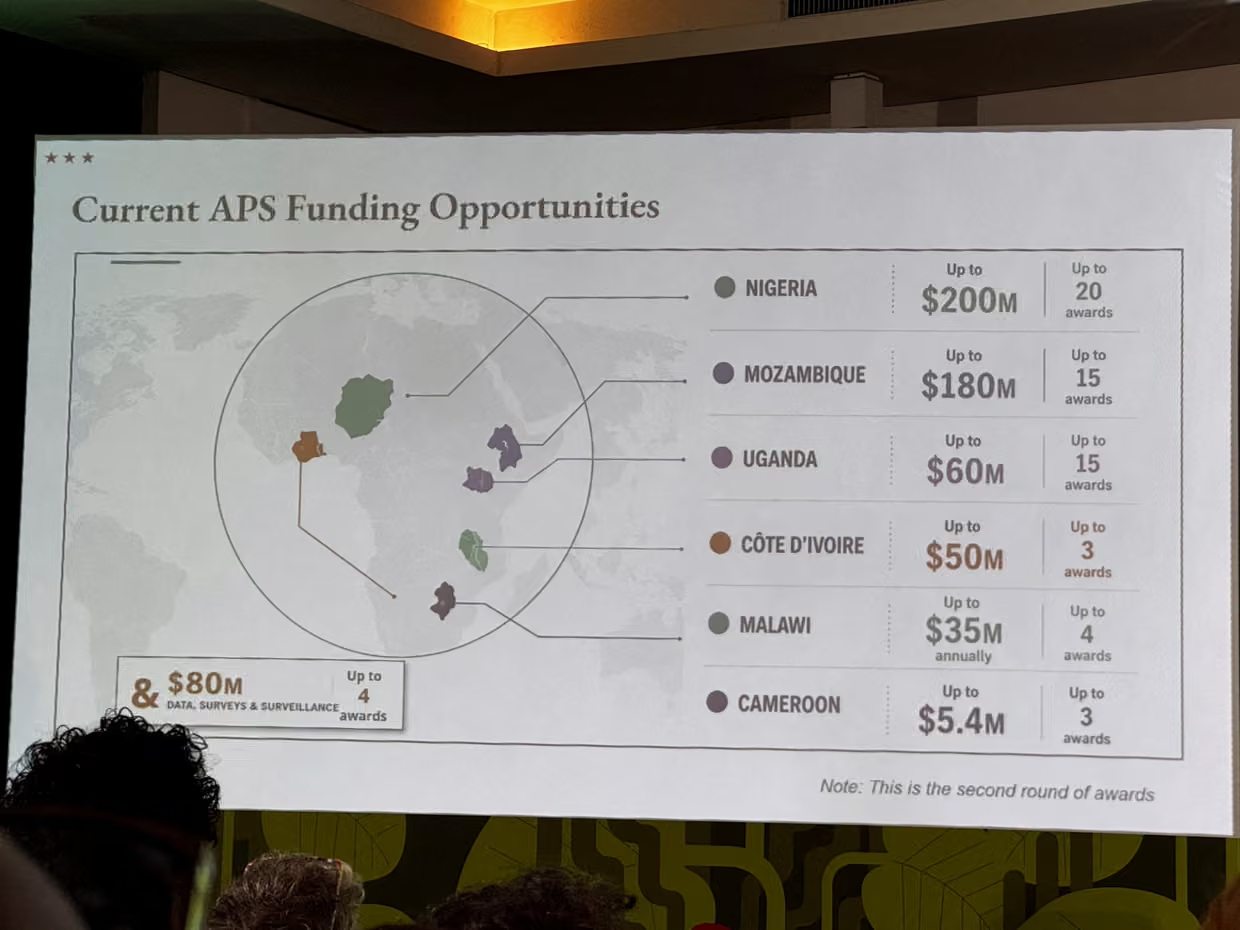
A US State Department presentation at AIDS 2026 displayed a map that mislabelled every African country.
The image, which Reuters reported carried an artificial-intelligence watermark, was corrected only after screenshots spread online.
Beyond embarrassment, the episode raises questions about institutional respect, human verification and the governance of generative AI in public diplomacy.
One slide became a diplomatic signal
A map intended to support a United States presentation on new health agreements instead became the most memorable image from AIDS 2026 in Rio de Janeiro.
During the State Department session, every African country was labelled incorrectly: Nigeria appeared landlocked in the Sahara, Mozambique was moved to the Horn of Africa and Côte d’Ivoire was placed on the continent’s eastern side.
The State Department later accepted responsibility, saying a team member had hastily changed the slide deck before the event.
Reuters reported that the image contained a watermark associated with an OpenAI image-generation tool. OpenAI said it was investigating the report.
The error spread after conference attendees captured the screen and posted it online, converting what might have been a fleeting production mistake into a global governance lesson.
Accuracy matters most where trust is thin
Maps are not neutral decorations in diplomacy. They communicate who is seen, how places are understood and whether an institution has invested in the care required to engage its partners.
That is particularly important when the subject is public health, and the audience includes countries whose relationships with major donors have already been strained by funding uncertainty.
The presentation concerned US health agreements and was delivered by Jeff Graham, the senior US health envoy overseeing the President’s Emergency Plan for AIDS Relief.
The mistake therefore sat beside a serious policy conversation. PEPFAR’s core life-saving drug programmes have largely resumed after a funding review; however, the United States has reduced spending in other areas, including prevention and surveillance, and plans to phase out the programme in South Africa.
In that setting, a wholly inaccurate map can reinforce a perception that African partners are being treated as an undifferentiated bloc.
The substantive discussion may have been constructive, as the State Department said; however, credibility is shaped by small signals, including large commitments.
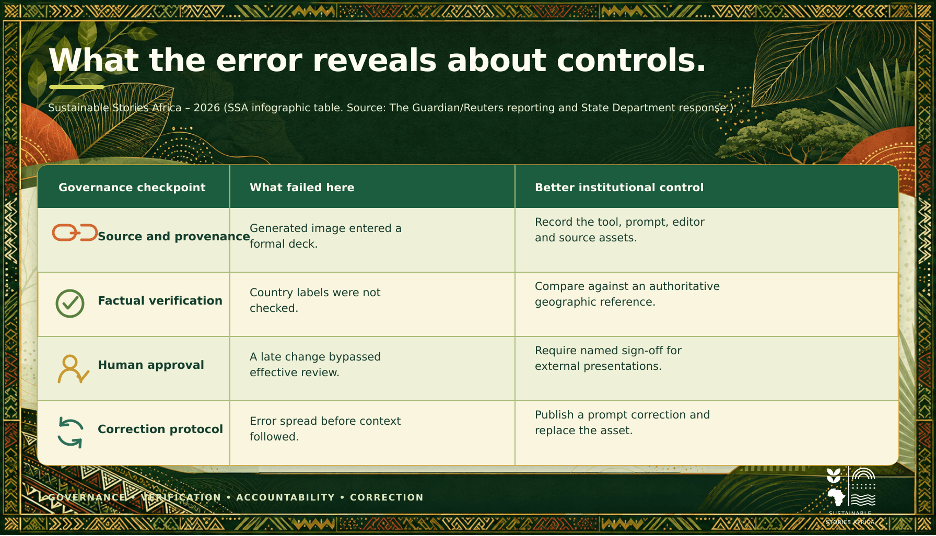
What the error reveals about controls
Generative AI can accelerate routine production, but speed does not remove accountability.
- Geography is verifiable
- A basic review against an authoritative map would have identified the errors in seconds.
- The failure was therefore not only technical; it reflected a broken approval chain involving creation, checking and final sign-off.
The most useful institutional response is not a blanket prohibition on AI-generated visuals.
- It is a risk-based process: require source disclosure, preserve provenance, verify factual content against trusted references and assign a named human approver.
- Public-facing material involving countries, borders, health or security should face a higher threshold than an internal concept image.
Respect must be designed into workflows
The State Department’s acceptance of responsibility was necessary; however, an apology should be supported by a documented control change.
Government agencies, companies and development organisations using generative AI should treat factual verification as part of responsible technology governance, rather than an optional editorial courtesy.
African institutions also have a role: insist that international partners use correct names, boundaries and local context, and correct public errors when they occur.
Representation is part of accountability. If public diplomacy is meant to build durable partnerships, its production systems must demonstrate the same attention to detail that policy statements promise.
Path Forward – Better verification can rebuild diplomatic trust
The immediate priority is a transparent review of how the slide was created, altered and approved, followed by stronger human verification for high-risk public material.
The broader path is to make responsible AI use visible: disclose provenance, verify facts and give African partners meaningful review where their countries and communities are represented.
Accuracy is a small operational discipline with large diplomatic consequences.
Culled From: US government map of Africa mislabels every country at global conference | US foreign policy | The Guardian