
MTN Ghana has rejected allegations that its mobile money business used Clydestone Ghana’s intellectual property without authorisation or compensation.
The dispute dates back to work Clydestone says it performed in 2007.
As the case moves through Ghana’s Commercial High Court, it could sharpen expectations around contracts, disclosure and ownership in Africa’s technology partnerships.
A formative partnership reaches the courtroom
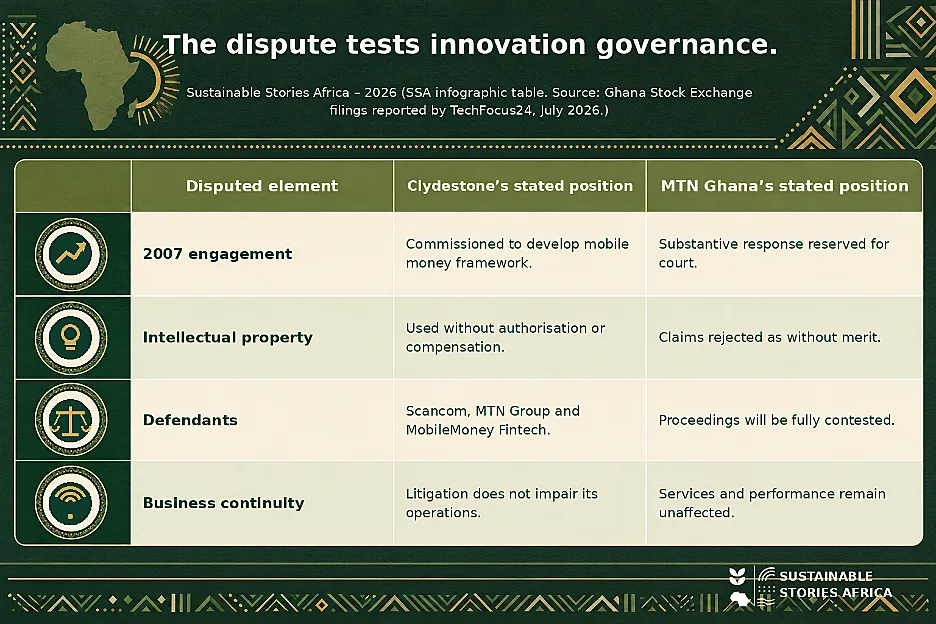
MTN Ghana has said it will fully contest a lawsuit brought by Clydestone Ghana Plc over the origins of its mobile money business, moving a disagreement about work allegedly commissioned almost two decades ago into the Commercial Division of the High Court in Accra.
Scancom Plc, which trades as MTN Ghana, told the Ghana Stock Exchange that it received the writ of summons and statement of claim filed on 27 July 2026.
The action also names MTN Group Limited and MobileMoney Fintech Limited.
MTN said the claims were without merit and assured stakeholders that the proceedings had not affected its services, operations, performance or results.
Clydestone alleges uncompensated proprietary work
Clydestone, a Ghana Stock Exchange-listed technology company, says MTN engaged it in 2007 to develop a commercial and operational framework for a mobile money business.
According to its filing, the work included an ecosystem model, an operational architecture, an implementation approach and a business case.
The company alleges that this material was used without authorisation or compensation after a proposed non-disclosure agreement and memorandum of understanding were not executed.
It says elements later implemented in Ghana and other African markets materially derived from its work. Clydestone is seeking declarations, damages, equitable remedies and any further orders the court considers appropriate.
Those remain allegations. MTN has denied them and said it would not comment on the substance as the case is before the court.
No court has determined ownership, use, liability or damages.
The dispute tests innovation governance
Mobile money has become critical infrastructure in Ghana’s economy, linking households, merchants and formal financial services.
That scale makes the case commercially significant, but its wider value lies in the governance questions it raises for technology development.
Early-stage partnerships often begin before a product’s eventual value is visible.
- A concept note, prototype or operational framework that appears modest at commissioning can later sit beneath a large platform.
- Clear contracts must therefore define background intellectual property, newly created work, permitted uses, geographic scope, confidentiality, payment triggers and the treatment of later modifications.
Better records protect both collaborators
- For large companies, disciplined procurement and document retention can demonstrate what was commissioned, delivered, accepted and paid for.
- For smaller technology firms, signed agreements, version histories and contemporaneous correspondence may be the only practical defence of their contribution.
Both sides benefit when governance begins before code, models or strategy documents change hands.
- Investors also need proportionate disclosure.
- Litigation alone does not prove wrongdoing, but markets should understand material claims, the stage of proceedings and possible operational exposure.
MTN has committed to update shareholders if material developments arise under listing rules; that discipline should remain central as the case progresses.
- Boards should treat disputed intellectual property as both legal and operational risk.
Periodic audits of licences, contractor agreements and inherited technology can identify unclear rights before a product becomes systemically important or expands across borders.
Path Forward – Let evidence clarify ownership and accountability
The court must now test the documents, chronology and legal rights behind the competing positions.
Public commentary should avoid deciding facts that have not yet been tried.
Beyond this case, African technology partnerships should adopt stronger intellectual property schedules, signed confidentiality terms and auditable delivery records.
Clear ownership is not bureaucracy around innovation; it is infrastructure that allows innovators and platforms to collaborate with confidence.
Culled From: MTN Ghana rejects Clydestone’s allegations, vows to contest Mobile Money IP lawsuit | TechFocus24