Mosquito-borne diseases are reaching new places as heat, rainfall shifts, urbanisation and travel reshape transmission.
The warning is global, but Africa already carries the overwhelming share of malaria illness and death.
The response must connect climate adaptation with surveillance, housing, sanitation and equitable access to proven disease-control tools.
The disease map is moving
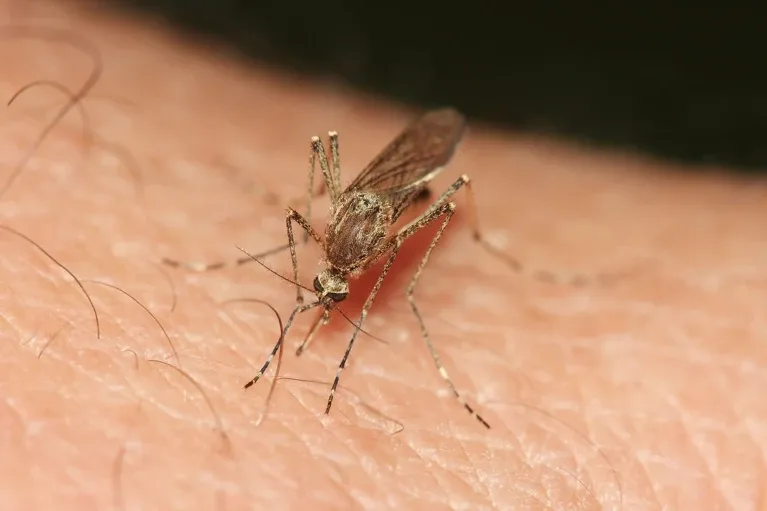
Mosquitoes are exploiting a world humans have made more connected, warmer and densely urban.
Nature’s four-chart warning on their expanding range points to a public-health shift: outbreaks once associated mainly with tropical settings are appearing in new locations, while countries already carrying heavy burdens face longer or less predictable transmission seasons.
The drivers overlap.
- Higher temperatures can speed mosquito development and viral replication within some temperature ranges.
- Changes in rainfall create breeding sites or concentrate people and vectors around shrinking water.
- Unplanned urban growth leaves containers, drains and waste where Aedes mosquitoes thrive.
- Air travel and trade then move infected people, eggs and insects between regions.
Africa bears the sharpest burden
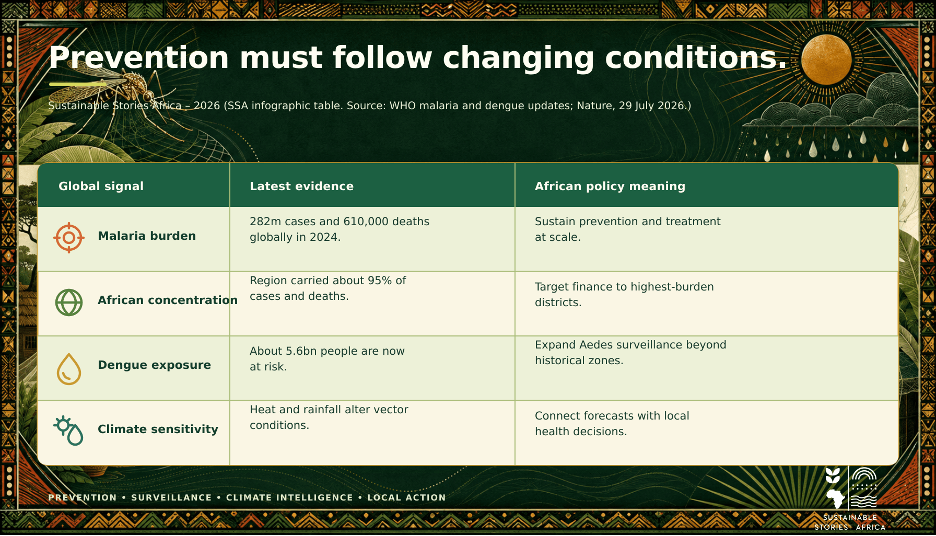
The World Health Organisation estimated 282 million malaria cases and 610,000 deaths globally in 2024.
Its African Region accounted for 265 million cases and 579,000 deaths, about 95% of each total.
Children under five represented roughly three-quarters of malaria deaths in the region.
Dengue tells a parallel story of expansion. WHO now estimates that about 5.6 billion people are at risk, with 100 million to 400 million infections each year. The disease is moving beyond tropical and subtropical zones into temperate areas, while chikungunya and other Aedes-borne viruses continue to expose weaknesses in surveillance.
- Climate change is not the only cause, and it does not affect every mosquito species identically.
- Public health systems, poverty, housing, immunity, vector control and access to care determine whether ecological suitability becomes a large outbreak.
- That distinction matters because it turns a daunting climate signal into a set of practical interventions.
It also changes budgeting.
- A ministry cannot control global temperature through its health programme.
- However, it can identify vulnerable districts, protect essential commodities and pre-position staff before predictable seasonal pressure becomes a hospital emergency.
Prevention must follow changing conditions
African governments cannot build resilience through emergency spraying alone.
- They need climate-informed surveillance that combines health-facility reports, laboratory confirmation, weather information and local vector data.
- Early-warning systems should tell districts when to intensify testing, distribute nets, remove breeding sites or prepare clinical capacity.
Urban planning is part of the health response.
- Reliable, piped water reduces household storage in open containers.
- Covered drains, waste collection and better housing reduce mosquito habitats and human exposure.
For malaria, insecticide-treated nets, seasonal chemoprevention, vaccines where recommended, rapid tests and effective medicines must be protected even as resistance patterns evolve.
Innovation should reach vulnerable communities
New tools offer genuine hope. Wolbachia-carrying mosquitoes can reduce dengue transmission, while improved vaccines, spatial repellents and next-generation nets widen the control portfolio.
However, an innovation succeeds only when financing, regulation, community acceptance and delivery systems carry it to the people at greatest risk.
This creates a sustainability test.
- Wealthier cities may fund sophisticated monitoring while informal settlements and rural districts remain data-poor.
- Climate and health finance should therefore reward coverage, local capacity and measurable reductions in illness, not only the purchase of technology.
Path Forward – Build climate-ready vector control systems now
Countries should map surging vector-related risks, protect routine malaria programmes and integrate climate data into district health planning.
Cross-border surveillance must match the mobility of people and mosquitoes.
The longer-term path is resilient infrastructure: safe water, effective drainage, stronger laboratories and trusted primary care.
Mosquitoes are expanding through gaps created by climate and development; closing those gaps will protect health, productivity and household income.
Culled From: How mosquitoes are conquering the world — in four charts | Nature