Nigeria’s Public Complaints Commission has asked the Federal Capital Territory’s transport authorities to address complaints involving ride-hailing platforms.
Drivers cite low fares, high commissions and arbitrary account deactivations.
The intervention creates an opportunity to build transparent rules that protect livelihoods without pricing passengers out of app-based transport.
Driver complaints move toward government action
The Public Complaints Commission has directed the Federal Capital Territory Administration’s Transport Secretariat to address concerns raised by drivers working through Uber, Bolt and inDrive, pushing a long-running argument over fares, commissions and platform control into Abuja’s regulatory system.
The complaints include low trip prices, excessive commissions and allegedly arbitrary account deactivations.
After deliberations involving stakeholders, the PCC asked the Transport Secretariat to ensure the platforms and driver representatives engage on the issues.
The intervention does not itself establish new fare or commission rules, but it creates a formal route for resolving unsettled disputes towards avoiding periodic strikes.
Costs rise while earnings remain uncertain
Ride-hailing drivers supply the vehicle, fuel, maintenance, insurance and much of the day-to-day operating risk.
- Platforms supply the technology, matching, payments, customer acquisition and safety systems.
- A sustainable market requires both sides to recover their costs, yet drivers say the current balance has become unworkable.
Earlier protests in Nigeria cited commissions of about 25% on some trips alongside higher petrol, spare parts and maintenance costs.
Low promotional fares may attract passengers; however, the driver absorbs much of the strain when pricing fails to reflect operating conditions.
Long hours can then produce inadequate net income after expenses.
Platform deactivation adds another layer of vulnerability.
- Fraud prevention and passenger safety require platforms to suspend risky accounts.
- However, a driver who loses access without clear reasons or a timely appeal can lose an income source immediately.
Procedural fairness therefore matters alongside the final decision.
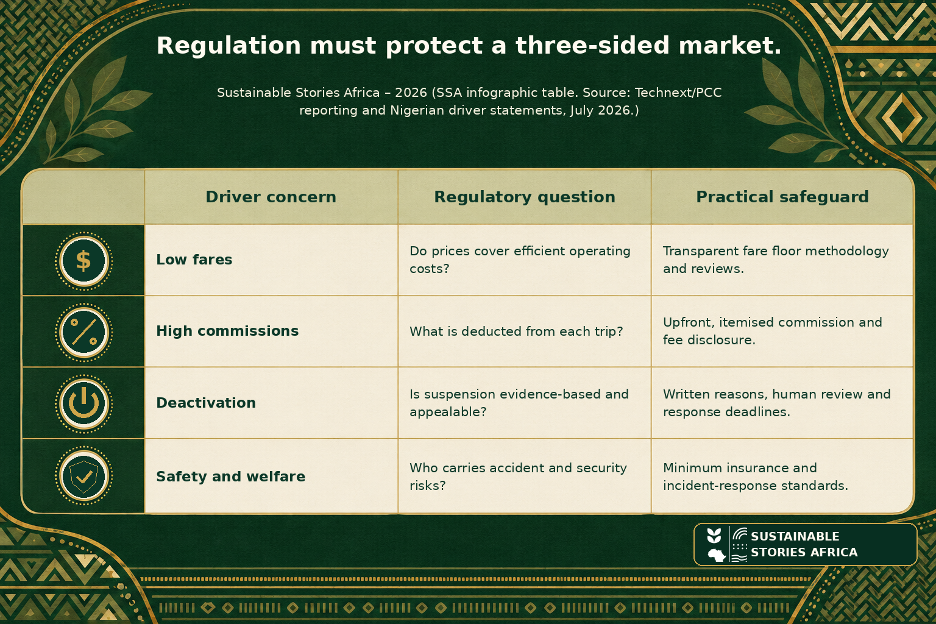
Regulation must protect a three-sided market
Simply hiking fares could reduce passenger demand, while an aggressive commission cap could weaken investment in safety, support and technology.
The FCTA needs evidence before choosing an instrument.
- That means modelling driver net earnings, trip volumes, platform costs and passenger affordability across peak and off-peak periods.
The better objective is a fair, transparent market rather than a single politically attractive number.
- Minimum per-kilometre and per-minute components could be reviewed periodically; commissions and additional charges should be disclosed before a driver accepts a trip; and promotions should state clearly who funds the discount.
Fair work can strengthen urban mobility
Better rules would benefit passengers as well as drivers.
- Stable earnings can reduce churn, improve vehicle maintenance and support safer service.
- Predictable obligations give platforms a clearer basis for investment and reduce the risk of repeated shutdowns that disrupt commuters.
The process should include drivers, platforms, passenger groups, labour experts and competition authorities.
- It should also produce publishable indicators: median net earnings per active hour, deactivation appeal outcomes, safety incidents and complaint-resolution times.
- Without data, the same dispute will return whenever fuel prices or promotions change.
Any rules must distinguish active working time from time merely logged in an app, account for drivers who use several platforms and prevent retaliation against those who participate in complaints or collective representation.
These details determine whether a policy improves real income or only its headline measure.
Path Forward – Build enforceable rules through transparent dialogue
The FCTA should turn the PCC referral into a time-bound consultation, request platform data under appropriate confidentiality and publish a reasoned policy response.
The durable path is periodic fare review, transparent deductions, fair deactivation appeals and minimum welfare protections.
Abuja can show that digital mobility need not choose between affordable trips and dignified work when evidence guides the balance.
Culled From: Uber, Bolt, inDrive: PCC directs FCTA to tackle excessive commission, low fares