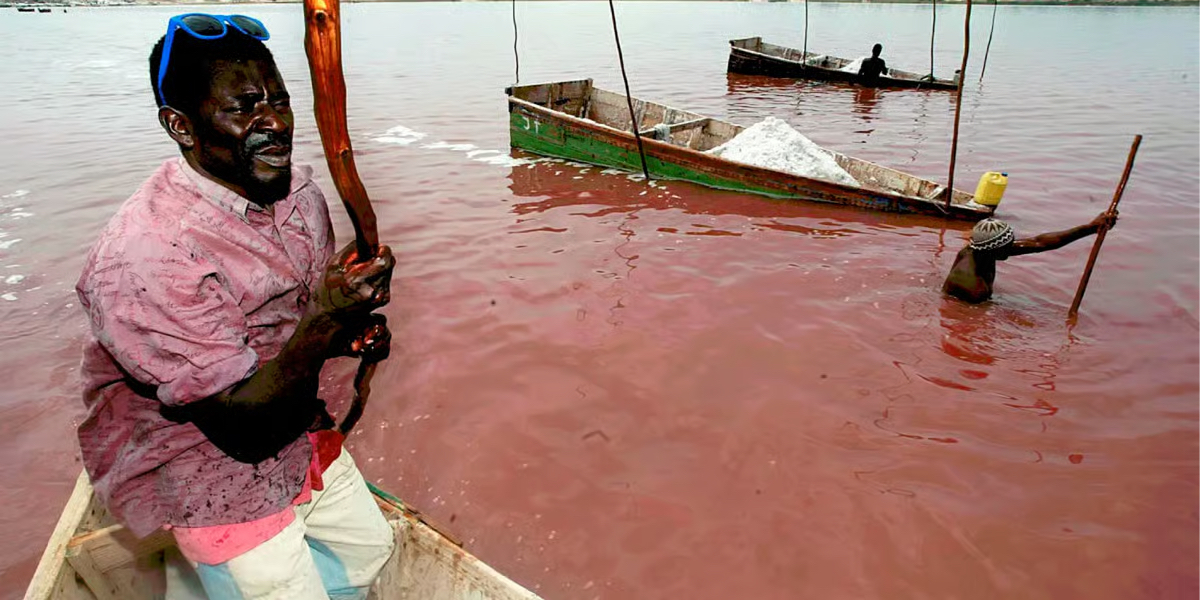
Lake Retba has regained its pink colour and resumed salt extraction after communities removed excess freshwater that had diluted the lake following severe flooding in 2022.
The recovery, supported by 23 million CFA francs and volunteer labour, highlights how ecosystem restoration can protect livelihoods while exposing the need for better long-term water management.
Pink colour signals an economic return
Senegal’s Lake Retba has recovered its distinctive pink colour after almost four years of ecological disruption, allowing salt harvesting to resume and restoring income for communities around the national landmark.
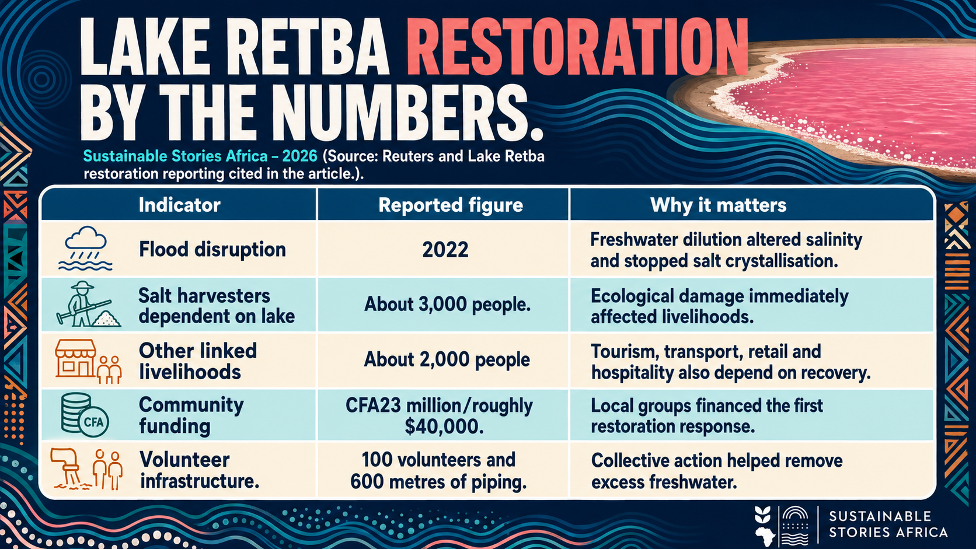
The hypersaline lake, about 30 kilometres northeast of Dakar, lost its colour after authorities diverted floodwater into the basin during severe flooding in 2022.
The emergency measure protected nearby communities but diluted salinity and disrupted the Dunaliella salina microalgae associated with the pink appearance.
Salt crystallisation stopped, and tourism fell sharply.
- About 3,000 salt harvesters depend directly on the lake
- An estimated 2,000 other people earn income from transport, hospitality, retail and related services.
Communities financed the first response
Associations representing salt workers, tour operators, artisans and businesses raised about 23 million CFA francs, roughly $40,000, to rent pumps, purchase fuel and build drainage infrastructure.
Around 100 volunteers helped install and operate roughly 600 metres of piping to move excess freshwater towards the Atlantic Ocean.
Local authorities later added larger pumps and electricity, accelerating the effort.
As salinity recovered, the algae returned and salt harvesting became possible again.
Community leaders marked the reopening with a traditional ceremony, connecting ecological recovery with the restoration of an industry that has supported generations.
Restoration protected natural capital
Lake Retba shows how ecosystems function as productive assets.
- Its chemistry supports salt extraction, its colour attracts visitors and the surrounding economy depends on both.
When the ecological balance changed, the economic loss was immediate.
- Restoring the lake was therefore not only a conservation activity; it was an investment in employment, household income and regional tourism.
This natural-capital lens is increasingly important across Africa.
- Wetlands, forests, mangroves and healthy soil provide flood protection, water regulation, food and livelihoods.
However, their economic contribution is often absent from budgets until degradation creates a visible cost.
Emergency decisions can transfer risk
The 2022 diversion also illustrates a difficult climate-adaptation problem.
- An urgent action may reduce one hazard while creating another.
- Moving floodwater away from homes protected lives and property.
- However, concentrating it in the lake altered a sensitive ecosystem and disrupted livelihoods.
Future planning should assess these trade-offs before disasters occur.
- Hydrological studies, drainage alternatives, buffer zones and early-warning systems can help authorities manage flood risk without repeatedly destabilising the lake.
Climate change is likely to increase the pressure.
- More intense rainfall, coastal change and rapid urban development can overwhelm drainage systems, making emergency diversions more likely unless infrastructure and land-use planning improve.
Recovery remains vulnerable
The return of the pink colour does not mean the ecosystem is permanently secure.
- Water levels, salinity, pollution and extraction practices need to be monitored.
- Tourism recovery also requires safe access, sanitation and management that does not overwhelm the restored environment.
Salt extraction should be supported with workers' safety measures and value chain improvements.
Harvesting is physically demanding, and better equipment, processing, packaging and market access could increase income without requiring unsustainable extraction.
Authorities should also clarify maintenance responsibility for drainage and pumping infrastructure.
Community mobilisation achieved the recovery, but long-term resilience cannot depend only on volunteers raising emergency funds.
Lake Retba offers a replicable lesson
The lake’s revival demonstrates the power of local organisation.
- Communities identified the economic threat, pooled resources and created the momentum that government support later expanded.
It also shows why adaptation finance should reach local institutions.
- Small, timely investments can protect assets that support thousands of livelihoods, even when they do not resemble major infrastructure projects.
Senegal now has an opportunity to move from restoration to stewardship.
- Protecting Lake Retba will require sustained science, public investment and community participation so its colour, salt economy and tourism value can endure the next climate shock.
A permanent local management forum could provide harvesters, tourism operators, scientists and authorities a shared place to review monitoring data and agree corrective action.
That forum should report publicly.
Path Forward – Senegal Must Monitor, Protect Lake Retba
Senegal should establish continuous monitoring of salinity, water levels, pollution and flood pathways, with clear public responsibility for maintenance.
Future tourism and salt-industry support should improve worker safety and income while keeping extraction and visitor growth within the lake’s ecological limits.