Nigeria’s sustainability professionals have warned that IFRS-aligned disclosure should be treated as the output of credible sustainability management, not the whole agenda.
The distinction matters as companies prepare for mandatory reporting: better reports cannot compensate for weak governance, unmanaged impacts or poor environmental and social performance.
Reporting is evidence, not the activity
Nigeria’s transition towards IFRS-aligned sustainability disclosure is strengthening investor transparency, but practitioners warn companies not to confuse the report with the sustainability work it is meant to describe.
The Sustainability Professionals Institute of Nigeria said organisations cannot report credibly without governance, impact measurement, risk management, stakeholder engagement and strategy.
In its view, disclosure should be the outcome of effective management rather than its starting point.
That distinction is timely as the country prepares for broader implementation of the International Sustainability Standards Board’s IFRS S1 and IFRS S2 requirements.
Investor information has a defined purpose
IFRS S1 and IFRS S2 are designed to provide investors with consistent information about sustainability-related risks and opportunities that could affect an organisation’s prospects and enterprise value.
This focus is valuable because lenders and investors need comparable information to price risk and allocate capital.
It does not, however, cover every environmental and social impact that communities, workers, regulators and civil society may consider important.
Companies may therefore need complementary frameworks and processes.
The Global Reporting Initiative addresses organisational impacts on the economy, environment and people, while the UN Guiding Principles and OECD Guidelines provide direction on human rights and responsible business conduct.
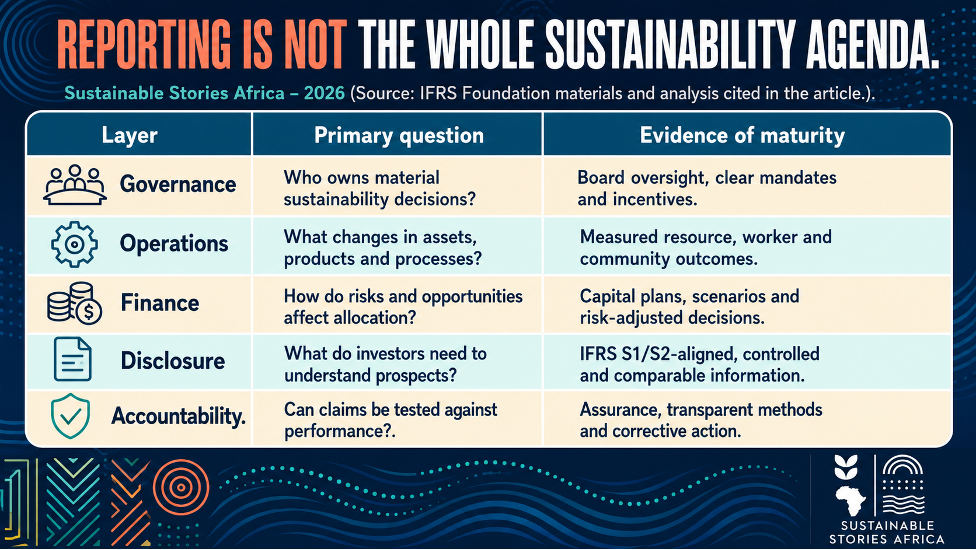
Sustainability decisions occur before disclosure
- A credible climate statement begins with decisions about energy, assets, suppliers and resilience.
- A workforce disclosure depends on fair employment practices, safety controls and grievance systems.
- A community-impact claim requires engagement, evidence and remedy where harm occurs.
If these systems are absent, reporting can become a documentation exercise that describes policies without demonstrating performance.
It may satisfy a checklist temporarily while leaving the business exposed to operational, legal and reputational risk.
Boards and management teams should therefore connect sustainability with budgeting, risk appetite, procurement, product development and executive accountability.
Finance teams can support data control, but operational owners must deliver the underlying outcomes.
Nigeria needs clear institutional roles
SPIN also raised questions about the roles of institutions within Nigeria’s sustainability ecosystem.
The Financial Reporting Council of Nigeria has statutory responsibility for corporate reporting, while other bodies are responsible for professional development, certification, academic work and wider sustainability practice.
Clear responsibilities can reduce duplication and strengthen confidence.
Reporting regulators should set and enforce disclosure expectations; professional institutions should build competence and ethical standards; companies should own implementation; assurance providers should test the reliability of reported information.
The system will work best when these functions complement one another without presenting financial disclosure as the complete definition of sustainability.
Capacity is the implementation constraint
Large companies may have sustainability teams, consultants and international reporting experience.
Many smaller organisations do not. They face limited data, unclear responsibilities and competing investment priorities.
Proportionate implementation is therefore essential.
- Companies can begin with material issues, establish baselines and improve controls over time.
- Regulators and professional bodies can publish sector guidance, support training and prevent the market from becoming dependent on expensive templates.
Assurance readiness should also be built early.
- Evidence trails, documented methodologies and accountable data owners reduce the risk of errors and make reported claims more defensible.
Credibility comes from performance
Nigeria needs stronger sustainability reporting because capital providers require trustworthy information.
It also needs broader sustainability management because climate risk, pollution, labour conditions, biodiversity loss and community relations affect the economy beyond investor decisions.
The two agendas should reinforce each other.
- Better operational practice creates credible data
- Credible disclosure creates accountability and helps markets reward resilient businesses.
The warning from practitioners is therefore not an argument against IFRS S1 and S2.
It is a call to ensure implementation changes how companies are governed and operated, rather than producing better-formatted reports around unchanged practices.
Boards should ask a simple question before approving any disclosure: what decision, control or operating result supports each material claim?
That discipline can expose gaps early and direct investment towards the systems needed to close them.
It also gives assurance providers a clearer evidence trail.
Path Forward – Companies, Regulators Must Build ESG Foundations
Companies should build governance, controls and operational performance before treating disclosure as the final layer of evidence.
Regulators and professional bodies should clarify roles, coordinate capacity building and promote complementary standards that address both enterprise value and wider impacts.