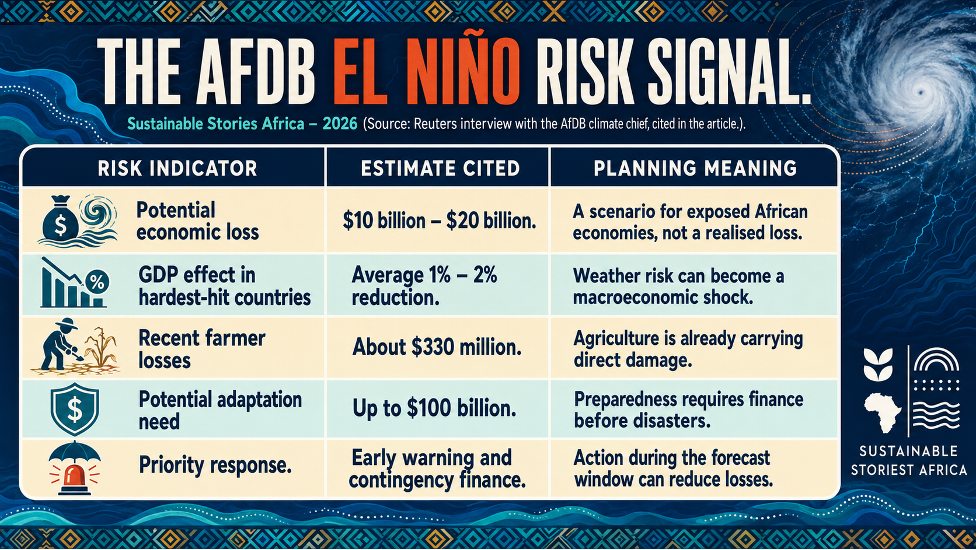
An unusually strong El Niño could impose between $10 billion and $20 billion in losses across affected African economies, according to the African Development Bank’s climate chief.
The estimate is conditional, but the warning is immediate: droughts, floods and food-price shocks can weaken budgets, banks and fragile communities before humanitarian systems respond.
Forecast turns climate risk into economics
An approaching “super” El Niño could inflict between $10 billion and $20 billion in losses across affected African economies and reduce gross domestic product in the hardest-hit countries by an average of 1% to 2%, the African Development Bank’s climate chief has warned.
Anthony Nyong, the bank’s director for climate change and green growth, told Reuters that severe droughts, floods and storms could damage infrastructure, undermine food and water security and drive migration from highly exposed areas.
The estimate is a scenario, not a realised loss. Its significance lies in showing how a climate pattern can quickly move from weather forecasts into public finances, loan performance, food prices and social stability.
Agriculture carries the first shock
El Niño affects African regions differently, with some facing drought and others heavy rainfall or storms.
Agriculture is often the first economic transmission channel because much production remains rain-fed and smallholders have limited savings or insurance.
Nyong said farmers had already lost an estimated $330 million during recent disruptions.
- A stronger event could reduce harvests, disrupt fisheries and push up prices for staples such as maize.
Food price increases affect more than household nutrition.
- They raise wage pressure, import bills and government spending on subsidies or emergency assistance.
- Poorer households, which devote a larger share of income to food, have the least capacity to absorb the shock.
Infrastructure losses can reach banks
Floods and storms can damage roads, bridges, power systems, schools and water infrastructure.
- Governments must then finance reconstruction while collecting less revenue from weakened economic activity.
The losses can also reach financial institutions.
- Farmers and businesses whose assets or income are destroyed may struggle to repay loans, while damaged collateral loses value.
- Banks concentrated in exposed sectors or regions face rising credit risk.
Countries already managing high debt-service burdens have little fiscal space for repeated emergencies.
Climate disasters can therefore increase borrowing needs while weakening the same economic indicators lenders use to assess repayment capacity.
Fragility can amplify displacement
The AfDB warning identified countries including Sudan, Somalia and Nigeria among places where climate pressure could interact with existing fragility.
Crop failure, water scarcity and livelihood loss can intensify competition, displacement and insecurity.
Migration is not caused by weather alone.
- It emerges when climate shocks combine poverty, conflict, weak public services and limited alternatives.
- Early response must therefore connect meteorological information with social protection, food systems and peacebuilding.
Governments should identify exposed districts, pre-position supplies and protect essential services before conditions deteriorate.
Waiting for disaster declarations increases both human and financial cost.
Adaptation finance remains insufficient
Nyong said the scale of required adaptation support could reach $100 billion.
The AfDB is considering internal planning and possible support through global climate funds.
The immediate priority is not to attach a precise price tag to an uncertain event, but to use the forecast window.
- Seasonal information can guide crop choices, reservoir management, infrastructure protection, insurance triggers and emergency budgets.
- Regional coordination is essential because of food markets, rivers, pastoral routes and migration across borders.
- Export restrictions adopted during shortages may protect domestic supply briefly but worsen regional price pressure and undermine trust.
Preparedness costs less than recovery
African governments cannot prevent El Niño, but they can reduce exposure.
- Early-warning systems need last-mile communication, so farmers, schools, health facilities and local authorities know what action to take.
Contingency finance should be arranged before disasters.
- Parametric insurance, reserve funds and pre-agreed credit can release money faster than post-event appeals, while resilient infrastructure standards reduce repeated reconstruction.
The AfDB’s $20 billion upper estimate should be read as a planning signal.
- Even if losses are lower, investments in water, food security, resilient infrastructure and social protection will retain value as climate volatility increases.
Public communication should update forecasts without sensationalism, explaining where confidence is high, what remains uncertain and which protective actions households can take.
Path Forward – Governments, AfDB Must Fund Climate Readiness
Governments should activate early-warning, food-security and contingency-finance plans now, targeting the most exposed regions and vulnerable households.
The AfDB and climate funds should accelerate pre-arranged finance and resilient support for infrastructure before losses materialise, with transparent triggers and regional coordination.