
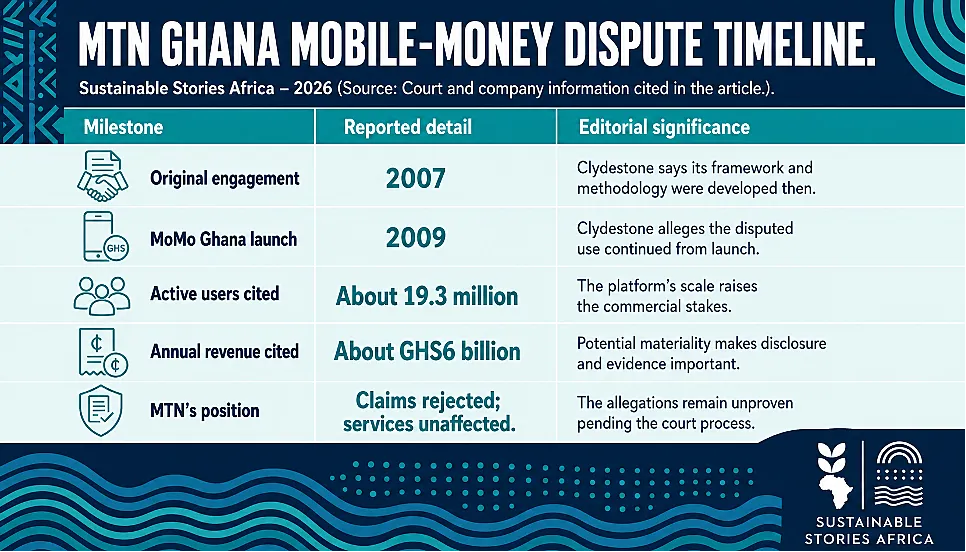
Clydestone Ghana has sued MTN Ghana, MTN Group and MobileMoney Fintech, alleging unauthorised use of intellectual property developed during a 2007 engagement.
MTN Ghana says the claims lack merit and will be fully contested.
The dispute does not currently affect MoMo services, but it places contract discipline, local innovation and ownership at the centre of Africa’s fintech growth.
A 2007 project reaches court
A dispute over the origins of MTN Ghana’s mobile money business has reached the Commercial Division of Ghana’s High Court, placing one of the country’s most widely used financial platforms under legal scrutiny.
Clydestone Ghana Plc filed proceedings against Scancom Plc, which operates as MTN Ghana, MTN Group Limited and MobileMoney Fintech Limited.
The Ghana-listed technology company alleges that proprietary intellectual property, confidential information and an operational methodology developed during a 2007 engagement were later used without authorisation or compensation.
MTN Ghana acknowledged service of the claim in a July 30 market notice, rejected the allegations as without merit and said it would contest the proceedings.
It added that the case does not affect its operations, financial performance or mobile money services.
The allegations concern MoMo’s foundations
Clydestone says MTN commissioned it to develop a commercial and operational framework for a Ghanaian mobile money business.
It describes the work as covering the commercial model, operational architecture, implementation methodology and business case.
The company alleges that a non-disclosure agreement and memorandum of understanding were expected but never finalised despite repeated requests, and that its work was subsequently used in Ghana and other markets.
It is seeking declarations, damages, equitable remedies and other orders.
These remain allegations. No court has found MTN or the other defendants liable.
That distinction is essential because the legal process must determine what information was protectable, what was disclosed, how it was used and whether any contractual or equitable duty arose.
Scale raises the commercial stakes
Clydestone says the alleged use has continued since MTN Mobile Money Ghana launched in 2009.
It cited public industry and company information showing roughly 19.3 million active users and annual revenue of about GHS6 billion, figures that underline the platform’s commercial importance.
The dispute arrives months after MTN completed the structural separation of its Ghana mobile money business.
MobileMoney Fintech Limited now operates the service under a structure designed to comply with Ghana’s Payment Systems and Services Act.
- For users and agents, the immediate message is continuity: MTN says services are unaffected.
- For investors, the material questions concern possible damages, disclosure and whether the claim changes the ownership or economics of key technology.
African innovation needs stronger contracting
The case carries lessons beyond the parties.
- Local technology firms often contribute early-stage designs, pilots and market knowledge to larger companies.
- If ownership, licensing, confidentiality and payment are not documented clearly, successful products can later generate disputes that are expensive to resolve.
Corporations should record the provenance of important systems, maintain decision trails and ensure vendor agreements identify background and newly created intellectual property.
Smaller firms should avoid beginning strategic work without signed protections, staged payments and clear dispute mechanisms.
Regulators and market operators must communicate carefully as the case progresses.
- Mobile money is everyday infrastructure for households, merchants and agents, so unverified claims about service interruption could create unnecessary concern.
- Material court developments should be disclosed promptly, while legal reporting should preserve the difference between allegations, evidence and findings.
- The dispute could ultimately end through judgment, settlement or other resolution.
Whatever the outcome, continuity planning and consumer protection should remain separate from the commercial contest over past intellectual-property rights.
Path Forward – Let evidence settle ownership claims fairly
The path forward is a transparent court process that protects legitimate intellectual property without disrupting millions of users who rely on mobile money.
Ghana’s technology ecosystem should also treat the dispute as a governance prompt.
Clear contracts, auditable product histories and fair commercial recognition can reduce conflict while ensuring that local innovators share in the value their work creates.
Culled From: https://www.jbklutse.com/mtn-ghana-mobile-money-lawsuit-momo/