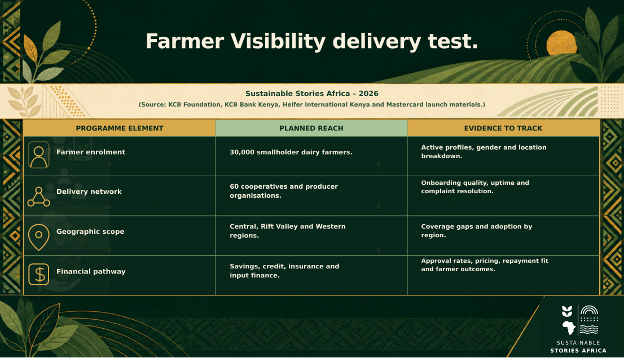
KCB Foundation and its partners have launched a nine-month programme to give 30,000 Kenyan dairy farmers usable digital transaction histories.
The project will work through 60 cooperatives and producer organisations across three regions.
Its promise is broader than cashless payments: turning everyday milk sales into evidence that can unlock financing, insurance and stronger market participation.
Digital records could unlock formal finance
For thousands of Kenyan dairy farmers, the barrier to credit is not necessarily a lack of economic activity.
It is the absence of records that a bank can see and assess. KCB Foundation, KCB Bank Kenya, Heifer International Kenya and Mastercard have launched the Farmer Visibility Project to close that gap for 30,000 smallholder farmers over nine months.
The initiative will digitise milk deliveries, payments, savings and input purchases, creating transaction histories linked to farmers’ digital identities.
It will be delivered through 60 dairy cooperatives and farmer producer organisations in the Central, Rift Valley and Western regions, where informal records and delayed payments can weaken cash flow and push farmers outside structured markets.
Visibility connects production with better services
The programme combines financial literacy, digital payments and practical agricultural support.
Its partners expect clearer records to help farmers access savings, credit, insurance and input finance while giving cooperatives and lenders a more reliable picture of production and payment cycles.
“Through the Farmer Visibility initiative, we are combining digital innovation, financial inclusion and practical agricultural support to help smallholder dairy farmers build resilient businesses, increase productivity and improve household incomes,” KCB Foundation Managing Director Mendi Njonjo said at the launch.
This matters because a farmer paid largely in cash may be commercially active yet remain invisible to formal risk systems.
Regular digital records can convert a pattern of milk deliveries into evidence of income, allowing products to be aligned with seasonal output instead of conventional monthly salaries.
Digitisation can also improve accountability inside cooperative systems.
- A time-stamped record of milk volume, quality, deductions and payment can reduce disputes and help farmers plan feed, veterinary care and household spending.
For lenders, the same information may reveal seasonal cash-flow patterns more accurately than a one-off application form.
- The value comes from linking records to useful decisions, not from issuing an identity alone.
The design must earn farmer trust
Digital visibility is not automatically inclusion.
- Farmers need affordable access, understandable consent processes and practical control over how their information is used.
- Poor data quality could reproduce exclusion if incomplete records are treated as evidence of weak creditworthiness.
- Platform downtime, low digital literacy and opaque fees could also reduce adoption.
The partners therefore need safeguards that are responsive to the technology:
- Clear data ownership, accessible dispute resolution, cybersecurity, assisted onboarding and non-digital alternatives during outages.
- Women, tenant farmers and producers using shared phones should be monitored separately so that household and device arrangements do not erase their economic contribution.
Product design should also reflect the economics of dairy farming.
- Credit tied to daily or weekly milk receipts may be safer than rigid monthly repayments, while insurance and input finance should be explained in terms farmers can compare.
If digital deductions are automatic, every charge must be visible before consent and reconcilable on the farmer’s statement.
Success requires outcomes beyond enrolment numbers
The headline target of 30,000 farmers is useful, but enrolment alone will not prove impact.
- The stronger tests are whether payments arrive faster, transaction records remain accurate, farmers obtain appropriately priced credit, insurance claims work, productivity improves, and household incomes become more resilient.
KCB and its partners should publish baseline and completion data through the 60 participating organisations.
- Reporting should distinguish farmers who receive a digital identity from those who actively use it and those who gain a financial or market benefit.
That would turn a technology rollout into an accountable inclusion programme.
Path Forward – Build finance around farmers’ real lives
If the project links trustworthy records with fair products and strong data rights, it can help formal finance recognise value that already exists in Kenya’s dairy economy.
The next step is to prove that digital visibility leads to better terms, faster payments and more resilient farm businesses, rather than a larger database.
Culled From: KCB Foundation targets 30,000 farmers in digital drive