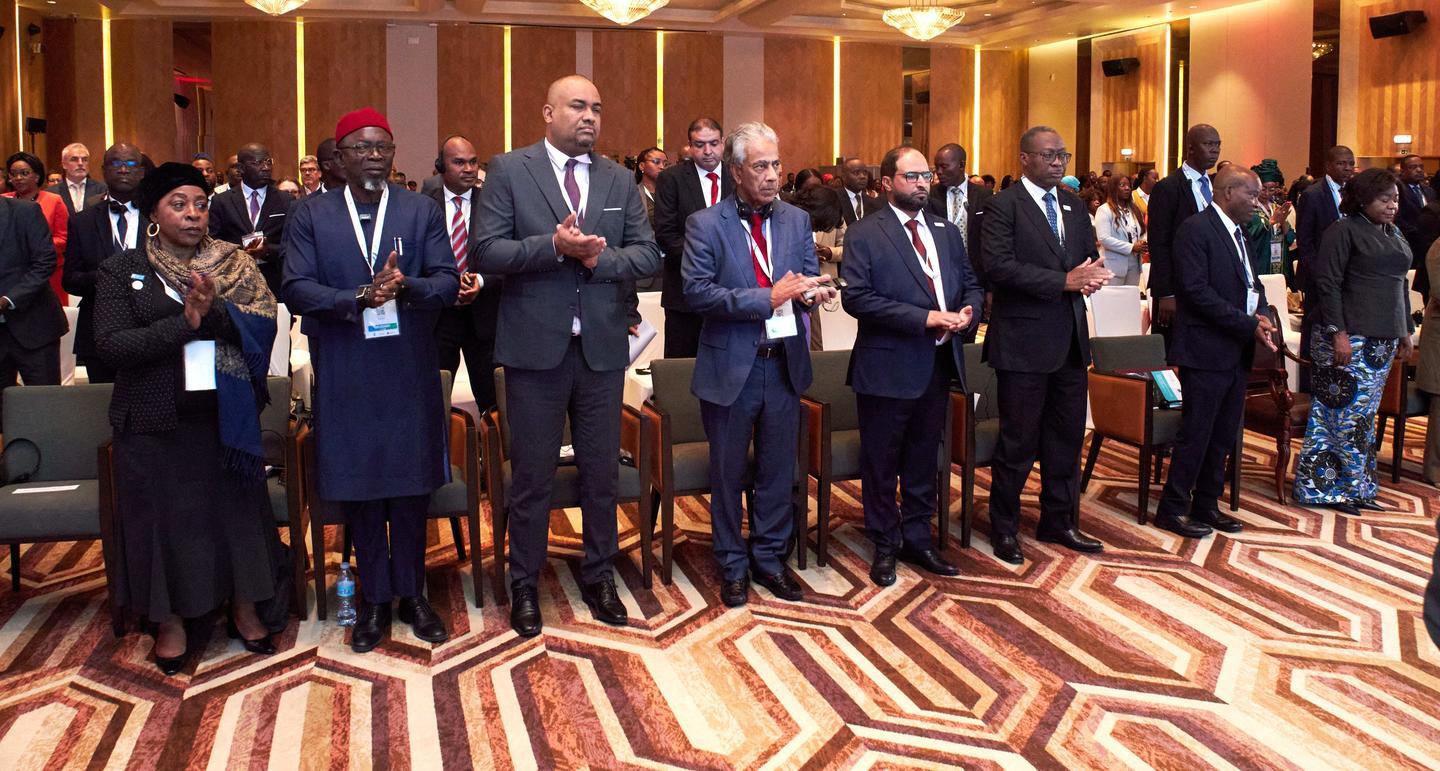
African ministers have adopted the Luanda Declaration, setting 2027 and 2028 deadlines for financing mechanisms and national blue-economy plans.
The agreement links fisheries, ports, trade, conservation and jobs to a costed continental roadmap through 2030.
Its credibility now depends on budgets, annual indicators and enforcement strong enough to move beyond repeated political commitments.
Ministers attach dates to blue ambition
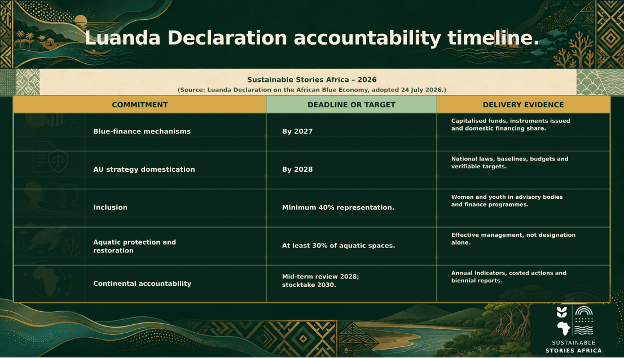
African Union ministers and heads of delegation adopted the Luanda Declaration on the African Blue Economy on 24 July 2026, committing governments to develop sustainable blue-financing mechanisms by 2027 and domesticate the African Union Blue Economy Strategy into national and regional plans by 2028.
The declaration followed the Third Africa Blue Economy Week, held in Luanda, Angola, from 22 to 25 July.
It mandates the African Union Commission, working with partners, to prepare a Continental Implementation Roadmap for 2026 – 2030 containing annual indicators, costed actions and biennial reports to the Assembly of African Union Heads of State and Government.
Shared waters carry continental economic stakes
The agreement covers oceans, seas, rivers and inland waters, treating them as connected economic and ecological systems.
It notes that 38 of the AU’s 55 member states are coastal, with inland water systems spanning about 305,000 square kilometres and transboundary river basins covering almost 64% of Africa’s land area.
The human stakes are immediate. More than 200 million Africans depend on fish for food and nutrition security, while close to 10 million people derive livelihoods directly from the sector.
However, the declaration acknowledges that policy adoption has outpaced delivery, leaving the blue economy undercapitalised, fragmented and unevenly implemented.
Financing and institutions define implementation routes
Governments committed to developing national and regional financing mechanisms including blue funds, bonds, insurance, debt-for-nature instruments, blended-finance vehicles and biodiversity credits.
The declaration also calls for a rising domestic share of blue-economy finance to reduce dependence on external resources.
Implementation is intended to run through a permanent ministerial platform, an African Blue Economy Scientific Panel and AU technical coordination.
A mid-term review is due in 2028, followed by a comprehensive stocktake in 2030. Africa Blue Economy Week is to be convened every two years on a rotating basis.
The declaration does not allocate country-level funding or state how the proposed mechanisms will be capitalised.
Those details are expected to emerge through national budgets and the cost-continental roadmap, making the roadmap the first major test of whether the commitments can be implemented.
Conservation commitments meet jobs and trade
Ministers pledged to combat illegal, unreported and unregulated fishing through surveillance, vessel monitoring, data-sharing and stronger enforcement.
They also committed to reducing pollution at source, restoring depleted stocks and protecting or restoring at least 30% of aquatic spaces under and beyond national jurisdiction, in line with global biodiversity agreements.
The economic agenda includes sustainable fisheries, aquaculture, green ports and shipping, coastal tourism, offshore renewable energy, blue biotechnology and circular-economy activity.
Governments also set a minimum 40% representation target for women and youth in advisory bodies and financing programmes, while calling for greater intra-African trade in blue goods and services through the AfCFTA.
Accountability must follow every political promise
The most important shift in Luanda is the move from broad aspirations toward dates, indicators and review points.
- Member states should now publish national baselines, budget lines, responsible institutions and annual progress data.
- Development partners and private investors should align finance with African-owned priorities while disclosing environmental and community safeguards.
Delivery will be visible in healthier fish stocks, cleaner coasts, functioning ports, safer livelihoods and finance reaching women, youth and small-scale operators.
Procurement rules, beneficial ownership disclosure and community participation will be essential where licences, concessions and conservation finance create valuable rights.
Without those outcomes and safeguards, the declaration risks becoming another statement of intent.
Path Forward – Turn Luanda deadlines into public results
The immediate priorities are a costed 2026 – 2030 roadmap, funded national mechanisms by 2027 and verifiable domestic plans by 2028.
Public dashboards, biennial reporting and independent scientific assessment can connect each promise to evidence.
That is how Africa’s shared waters can support food security, climate resilience, decent work and durable regional prosperity.