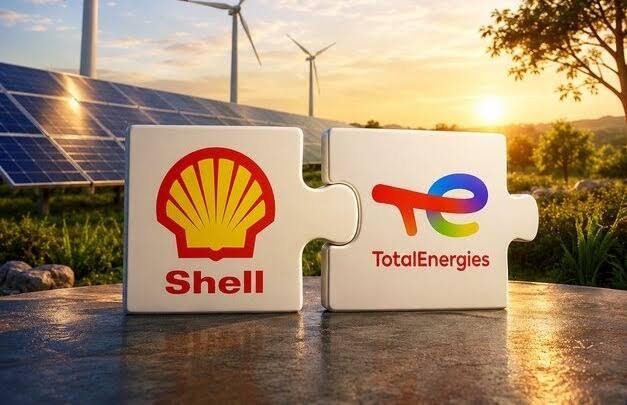
TotalEnergies is buying Shell’s 4 GW European onshore renewables business while selling KKR half of a separate 1.2 GW portfolio, valued at €1.8 billion.
The paired transactions add development options and release capital from more mature assets.
Their success will depend on converting pipelines into operating capacity without weakening the credibility or returns.
Two transactions reveal one capital strategy
TotalEnergies has paired a major European renewables acquisition with a partial asset sale, illustrating how large energy groups are trying to grow low-carbon power without carrying every project entirely on their own balance sheets.
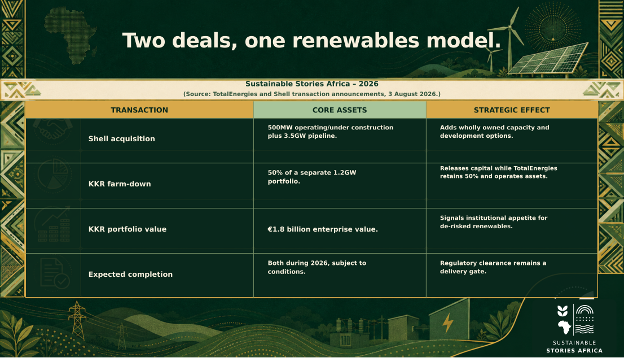
It agreed to acquire Shell’s European onshore renewables business, a 4 GW portfolio, while selling a 50% interest in a separate 1.2GW portfolio to an insurance account managed by KKR.
The Shell transaction includes 500 MW of solar and wind capacity operating or under construction, mainly in Italy and the Netherlands, plus a 3.5 GW pipeline of solar, wind and battery storage projects in Italy, the United Kingdom and Spain.
Completion is expected by the end of 2026, subject to regulatory approvals.
Shell pipeline adds options and execution risk
Most of the acquired capacity is still in development.
- TotalEnergies is therefore buying future project options as much as current generation.
- The portfolio complements markets where the company is building an integrated power position combining renewable output, customers, trading and flexible gas-fired generation through its TTEP joint venture with EPH.
Shell described the sale as;
- Part of a plan to high-grade its power portfolio and focus on areas where it believes it has differentiated capabilities, including asset-backed trading and customer-facing energy solutions.
The transaction highlights diverging portfolio choices: one company is narrowing its development exposure while another is compounding it.
- That divergence matters to investors tracking transition strategy across integrated energy companies.
- Asset sales can concentrate management attention and strengthen returns; however, they do not by themselves increase renewable generation.
Acquisitions can accelerate market entry, yet the buyer inherits permitting, grid and construction risks.
The climate outcome depends on whether the projects advance after ownership changes, not on the transaction announcement alone.
KKR deal recycles mature project capital
In the second transaction, TotalEnergies will sell KKR a 50% stake in a largely developed 1.2 GW onshore solar and wind portfolio across Germany, Spain, France and Poland.
- The portfolio carries an enterprise value of €1.8 billion.
- TotalEnergies will retain the other half and continue operating the assets after completion, expected during 2026.
This “farm-down” model allows a developer to monetise part of a de-risked portfolio while keeping operating control and future earnings exposure.
Released capital can then support new projects.
- TotalEnergies says the approach is central to its goal of achieving a 12% return on average capital employed in Integrated Power by 2030.
For KKR’s insurance client, the transaction offers long-duration infrastructure exposure supported by electricity already sold, or expected to be marketed, to third parties.
For TotalEnergies, retaining half the portfolio aligns both parties around operating performance.
The arrangement also shows how institutional capital can enter after development risk has fallen, freeing corporate balance sheets for earlier-stage work.
Capacity claims require disciplined project delivery
The two deals would reinforce a European renewables base that TotalEnergies says is close to 10 GW of gross installed or under-construction capacity, with another 27 GW under development.
However, development pipelines are not equivalent to production assets.
- Permitting, grid connections, equipment costs, power prices and community acceptance can all delay or reshape projects.
For sustainability-focused investors, the assessment should go beyond headline gigawatts.
- Useful indicators include the share of acquired pipeline reaching final investment decision, construction and commissioning; lifecycle and biodiversity management; additional renewable generation; and the emissions trajectory of the wider integrated portfolio. Financial discipline and transition delivery must be evaluated together.
Path Forward – Capital recycling must accelerate real generation
The transactions give TotalEnergies more development options while bringing institutional capital into operating renewables.
The path forward is to show that recycled capital creates additional capacity, resilient returns and credible emissions progress.
Transparent reporting from acquisition through commissioning will reveal whether the model accelerates Europe’s power transition or mainly reshuffles ownership.
Culled From: TotalEnergies Buys Shell's 4GW European Renewables Business, Sells 50% of 1.2GW Portfolio to KKR