South Africa’s new rollover regime will protect unused data, voice, and SMS bundles from January 2027, but only if they remain more than 7 days.
That leaves daily and weekly buyers, including many low-income users, outside the automatic safeguard.
The exemption preserves discounted products; however, it shifts the fairness test toward pricing transparency and evidence of who benefits.
Short bundles remain outside new safeguards
A daily data bundle bought by a student, informal trader or jobseeker can still expire with unused value after South Africa’s new consumer rules take effect.
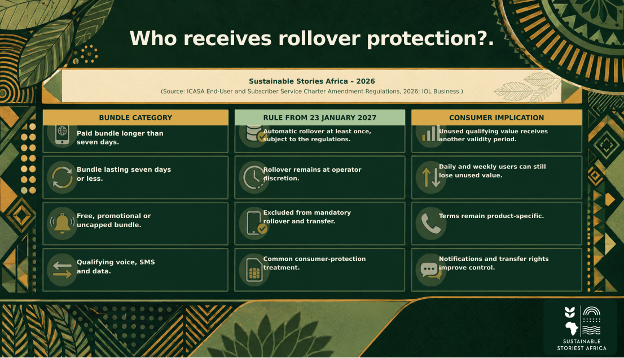
Communications and Digital Technologies Minister Solly Malatsi has confirmed that bundles valid for seven days or less remain exempt from the Independent Communications Authority of South Africa’s compulsory rollover requirements.
ICASA gazetted amendments to the End-User and Subscriber Service Charter Regulations on 23 January 2026.
From 23 January 2027, unused portions of qualifying paid voice, SMS and data bundles that last longer than seven days must roll over automatically at least once, on the same terms and for an equivalent validity period.
Customers should not need to take any action or buy another bundle to trigger that rollover.
Affordability logic creates a consumer trade-off
The regulator’s distinction is deliberate.
In a written parliamentary reply to Economic Freedom Fighters MP Sixolisa Gcilishe, Malatsi said ICASA considered extending the rule to short bundles but concluded that doing so could reduce competition and limit operators’ ability to offer discounted, innovative products. Free, promotional and uncapped bundles are also excluded.
That logic exposes a difficult trade-off. Short-validity bundles can reduce the cash needed for immediate connectivity, which matters to households managing income day by day.
However, the same expiry structure can penalise consumers whose usage is interrupted by power cuts, poor coverage, illness or simply a change in plans.
The bundle remains technically available only until the clock runs out; the unused entitlement then disappears.
Digital access now depends on transparency
The broader reform still strengthens consumer control.
Operators must send usage notifications at 50%, 80% and 100%, allow eligible bundle transfers between users on the same network, and protect customers from unapproved out-of-bundle charging.
Qualifying balances must be used in a way that gives consumers the benefit of the rollover.
However, rules that protect monthly users more fully than daily users risk creating a two-tier market.
The decisive question is not whether short bundles are popular, but whether their effective price per megabyte, expiry losses and service conditions remain fair.
Without comparable disclosure, consumers cannot easily tell whether a cheap-looking daily product is genuinely affordable over time.
Implementation also faces legal uncertainty.
MTN and Vodacom have filed challenges seeking review of parts of the amended regulations, raising questions about the regulator’s powers and the operational clarity of some provisions.
Unless a court suspends or sets aside the rules, operators must still prepare for the January 2027 start.
Consumers therefore need plain-language updates that separate the settled protections from issues still being contested.
Regulators must test who truly benefits
ICASA and the Department of Communications should track expiry losses by bundle duration and income profile after implementation.
Operators should publish simple, comparable information showing price, validity, effective unit cost and the share of purchased value that expires unused.
Such evidence would reveal whether the exemption sustains useful discounts or entrenches a poverty premium.
Consumer education will also matter.
- People need clear prompts before expiry and easy routes to transfer or use qualifying balances.
- Those messages should be available in local languages and accessible formats, with complaints handled quickly when balances are not carried forward correctly.
- If market data shows that short-bundle customers repeatedly lose disproportionate value, ICASA should revisit the exemption rather than assume that product variety alone delivers affordability.
Path Forward – Fair rules must reach daily users
The 2027 regime is a meaningful consumer-protection reset, but its success should be measured by value preserved across the whole market.
Transparent pricing, expiry-loss reporting and active monitoring can ensure that the convenience of short-term bundles does not become a recurring penalty for people with the least room to absorb itss.
Culled From: Why your daily data bundle still expires despite new ICASA rollover rules