The ongoing Middle East conflict is disrupting global oil flows and reshaping trade dynamics.
For Africa, the crisis is exposing deep structural dependencies and supply chain vulnerabilities.
The implications extend beyond energy markets, impacting fiscal stability, trade resilience, and long-term transition strategies.
A Distant Conflict, A Direct Impact
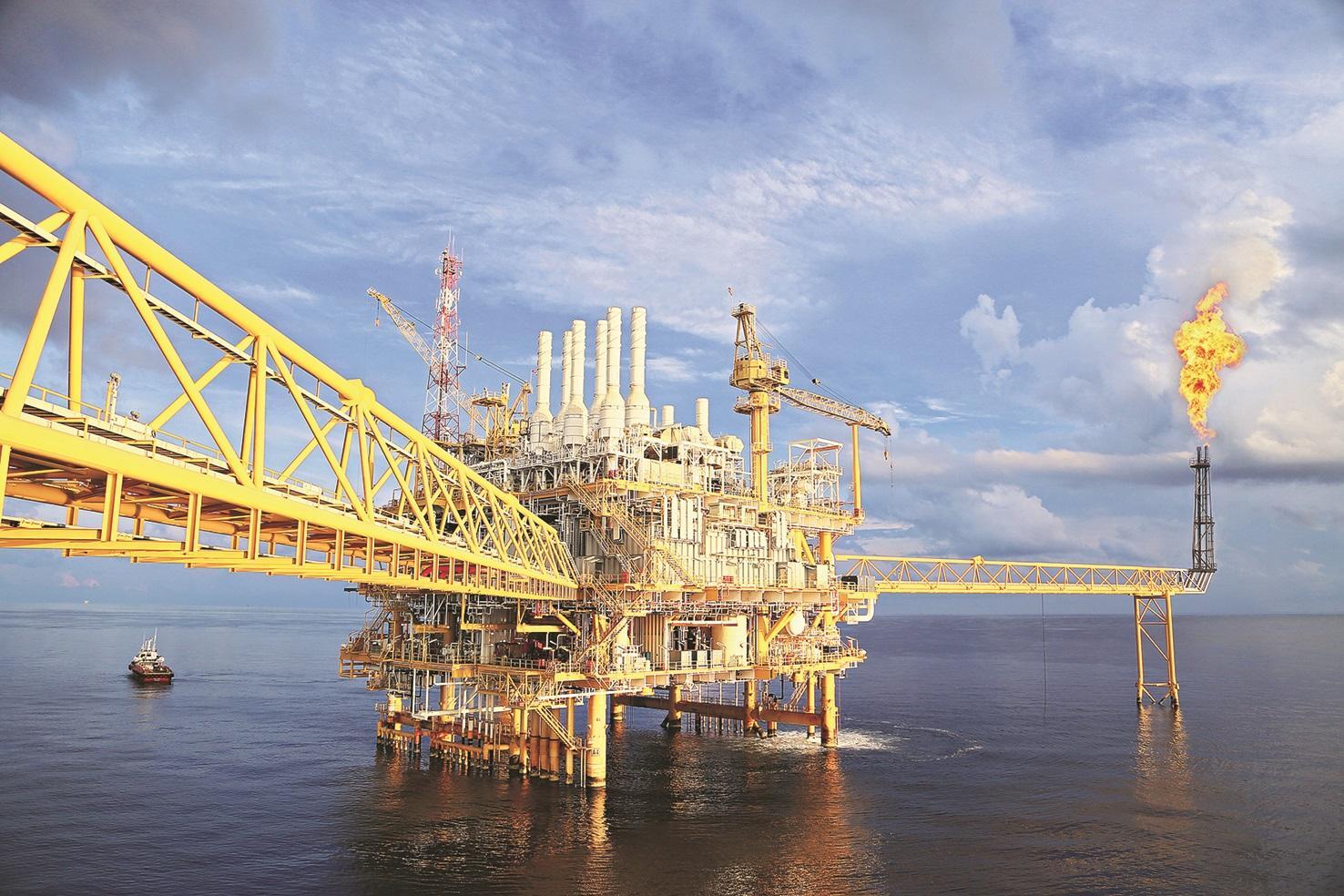
As tensions escalate in the Middle East, home to nearly a third of global oil supply, the ripple effects are being felt across Africa’s energy markets, exposing structural weaknesses in the continent's production, imports, and oil and gas trade.
From rising freight costs to supply disruptions and price volatility, the crisis is revealing a stark reality: Africa remains deeply exposed to external shocks despite its resource enrichment.
Six key lessons are emerging, each pointing to systemic gaps in trade architecture, refining capacity, and energy security strategies across the continent.
Six Lessons Reshaping Africa’s Energy Trade Reality
The ongoing conflict has laid bare critical vulnerabilities and strategic misalignments in Africa’s oil and gas ecosystem.
- Import Dependence Remains a Core Weakness – Despite being a major crude producer, Africa imports a significant portion of its refined petroleum products. Countries such as Nigeria and Angola export crude but rely heavily on external markets for refined fuels, leaving them exposed to global supply disruptions.
- Shipping Routes Are Strategic Risk Points – Disruptions in key maritime corridors, particularly those linked to the Middle East, have increased shipping costs and delays. For importers in Africa, longer routes and higher insurance premiums translate to higher domestic fuel prices.
- Price Volatility Directly Impacts Fiscal Stability – Oil-importing countries are facing mounting subsidy pressures as global prices fluctuate. At the same time, exporters benefit from price spikes—but with limited downstream capacity, much of the value is lost.
- Refining Capacity Gap Persists – Africa’s limited refining infrastructure continues to constrain value addition. Even as new projects emerge, the continent remains structurally dependent on imported refined products.
- Energy Security Is Still Externally Anchored – The crisis underscores that Africa’s energy security remains exposed to external factors. External geopolitical events continue to dictate availability and pricing across domestic markets.
- Transition Risks Are Becoming More Complex – While global attention shifts to renewables, fossil fuel volatility is complicating Africa’s transition pathway—forcing governments to balance short-term energy security with long-term decarbonisation goals.
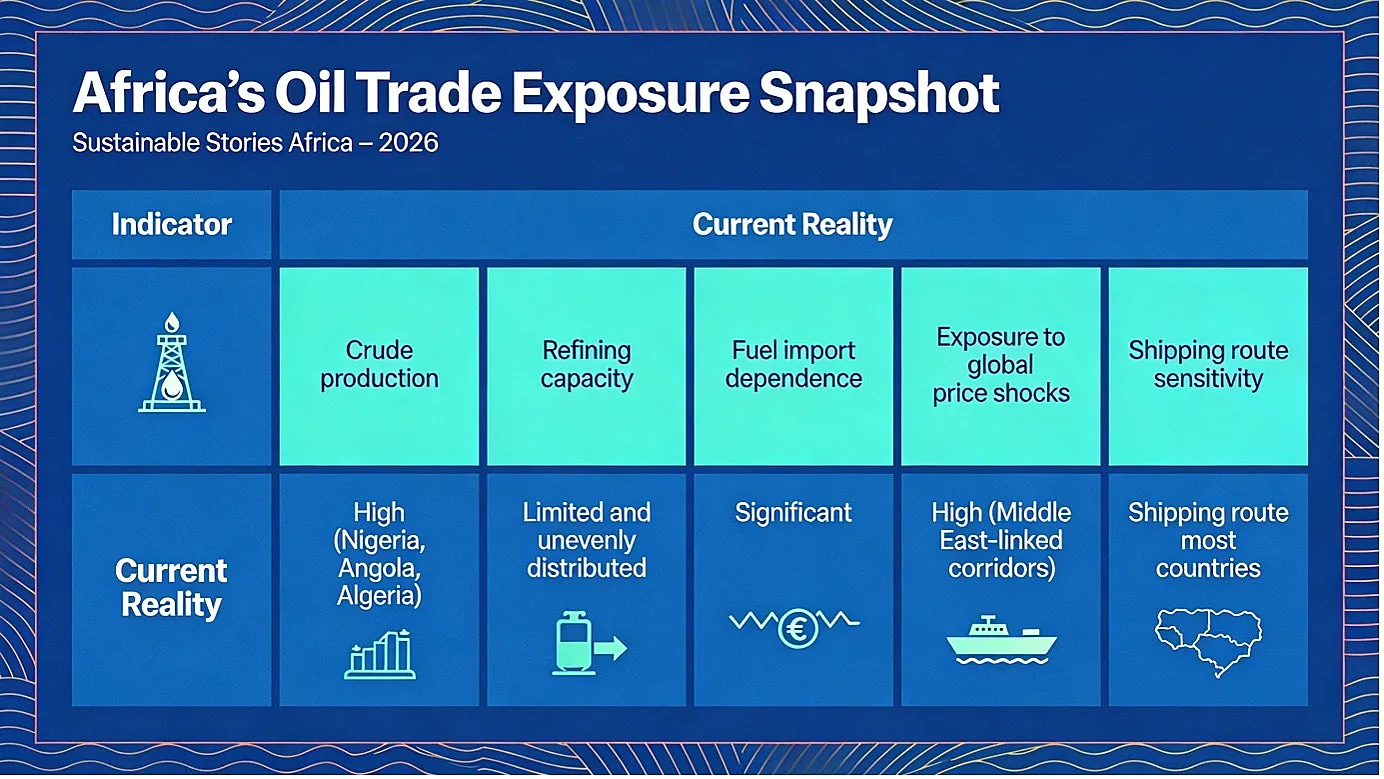
Africa’s Oil Trade Exposure Snapshot
Indicator | Current Reality |
|---|---|
Crude production | High (Nigeria, Angola, Algeria) |
Refining capacity | Limited and unevenly distributed |
Fuel import dependence | High across most countries |
Exposure to global price shocks | Significant |
Shipping route sensitivity | High (Middle East-linked corridors) |
Reimagining a More Resilient Energy System
The disruptions also present an opportunity, one that could redefine Africa’s energy future.
Strengthening regional refining capacity could reduce dependence on imports and retain more value within the continent. Investments in strategic storage infrastructure would help buffer against supply shocks, while intra-African trade, under frameworks like the African Continental Free Trade Area, could enhance energy resilience.
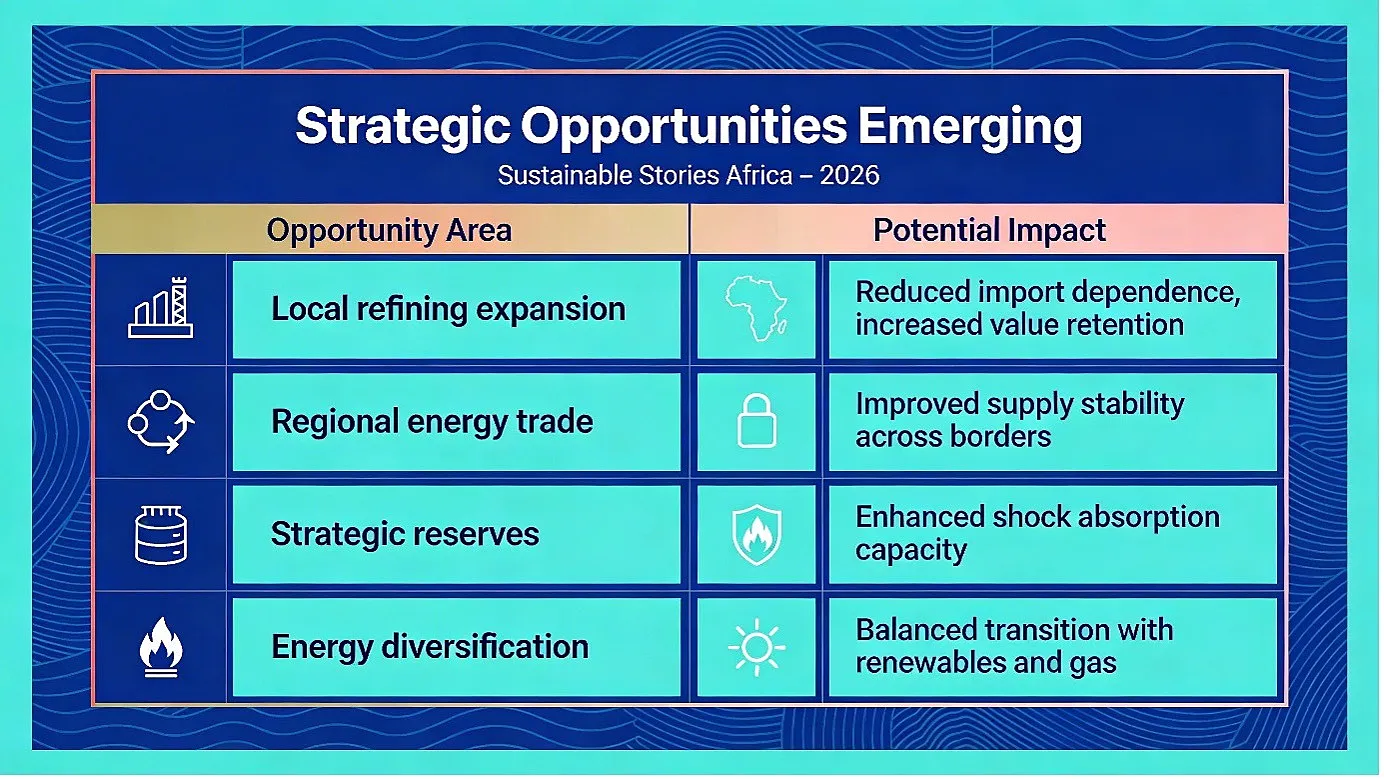
Strategic Opportunities Emerging
Opportunity Area | Potential Impact |
|---|---|
Local refining expansion | Reduced import dependence, increased value retention |
Regional energy trade | Improved supply stability across borders |
Strategic reserves | Enhanced shock absorption capacity |
Energy diversification | Balanced transition with renewables and gas |
If these opportunities are seized, Africa could transition from being a price-taker in global energy markets to a more self-reliant and strategically positioned player.
From Exposure to Energy Sovereignty
The path forward requires deliberate, coordinated action.
Governments must accelerate investments in refining infrastructure and streamline regulatory frameworks to attract private capital. Regional collaboration will be critical, aligning policies, harmonising standards, and enabling cross-border energy trade.
Development finance institutions and private investors should prioritise projects that enhance resilience, particularly in refining, storage, and logistics.
At the same time, energy transition strategies must be grounded in Africa’s realities, ensuring that decarbonisation efforts do not undermine energy access or economic stability.
The call is urgent: Africa must move from reactive adaptation to proactive energy sovereignty.
PATH FORWARD – Build Resilient Systems, Reduce External Energy Dependence
Africa’s energy future depends on strengthening internal capacity and regional integration.
By investing in refining, storage, and diversified energy systems, the continent can reduce vulnerability to external shocks while advancing a balanced, sustainable transition.
Culled From: Six things ongoing Middle East conflict reveal about oil and gas trade in Africa - Energy in Africa