Researchers digitised more than one million weather observations from fragile archives in the Democratic Republic of the Congo.
The records show hot days nearly doubled between the 1960s and 1980s, while temperature extremes continued rising into the 2000s.
The findings strengthen the evidence available for Central African climate adaptation and show why historical data rescue is urgent.
Rescued Records Reveal Rapid Regional Warming
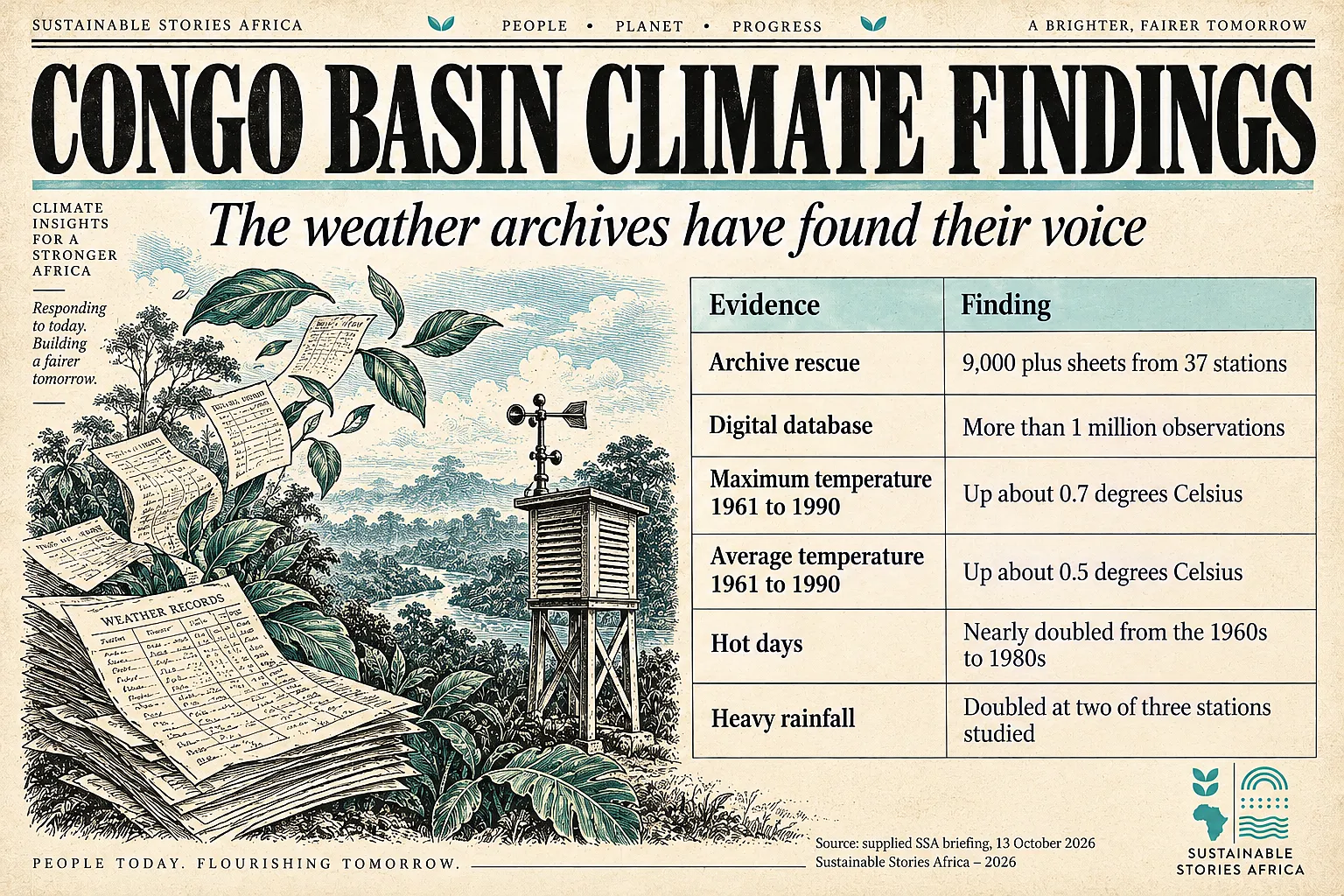
More than one million rescued weather observations have revealed a clear warming trend across the Congo Basin, including a near doubling of hot days between the 1960s and 1980s.
Researchers led by Vrije Universiteit Brussel reconstructed the record from fragile archives in the Democratic Republic of the Congo and Belgium.
During fieldwork in 2023, the team photographed more than 9,000 handwritten monthly sheets from 37 weather stations.
Open-source software then converted the images into digital records.
The work fills a major evidence gap in a region central to Africa's climate, forests, agriculture and water systems.
Historical Observations Quantify Rising Heat Extremes
The reconstructed data show that maximum temperatures rose by about 0.7 degrees Celsius from 1961 to 1990, while minimum temperatures increased by 0.3 degrees and average temperatures by 0.5 degrees.
- Stations with longer records indicate that warming continued into the 2000s.
- Each successive decade brought more hot days, and those days became hotter, while cold days declined.
- At two of three stations examined for rainfall, heavy rainfall events in the 1980s were twice as frequent as in the 1960s.
The study, published in Earth System Dynamics, provides observations where earlier global assessments lacked enough evidence to confirm changes in hot extremes.
Missing Climate Evidence Weakens Adaptation Decisions
The study is also a lesson about how evidence enters global climate assessments.
- Regions with long, accessible digital records can appear more certain than places where observations remain on paper, even when communities are experiencing severe change.
- Absence of evidence can therefore become a policy disadvantage.
- It may weaken the case for adaptation funds or produce models that do not reflect local extremes.
Data rescue corrects part of that imbalance, but African institutions should retain leadership over interpretation and use.
Research partnerships need fair credit, training, infrastructure and decision-making roles for the agencies and scientists who safeguard the original records.
Local Data Can Improve Climate Planning
Reliable historical data can improve regional climate models and help governments plan for heat, flooding, agriculture and public health with greater confidence.
- Farmers need planting advice based on local conditions rather than continental averages.
- Cities need drainage and heat plans grounded in the extremes residents are already experiencing
- Health systems need to anticipate heat stress and disease risks.
The database is open access, making it possible for African researchers and public agencies to test new questions.
Its existence also shows that old paper files can become strategic infrastructure when they are preserved, digitised and shared.
Governments Must Preserve Records and Stations
Governments and research funders should support systematic rescue of climate records across Central Africa, including scanning, metadata repair, quality control and long-term digital storage.
National meteorological agencies need resources to maintain current stations so today's observations don’t become tomorrow's gap.
- Data sharing agreements should protect institutional ownership while enabling research and public planning.
- Adaptation finance should also recognise climate information as essential infrastructure.
Without local observations, investments in irrigation, roads, health and disaster response are more likely to use weak assumptions.
Path Forward – What Central African Climate Planning Needs
The priority is to preserve remaining archives before fire, humidity or neglect destroys them.
Pair digitisation with investment in weather stations, local researchers and open data systems.
The recovered evidence should now inform heat action, flood planning, agricultural advice and climate finance.
Central Africa cannot design a just adaptation strategy if its past climate remains invisible and its present observations remain too sparse.
Culled from: Rescued weather records reveal hot days became nearly twice as common in the Congo Basin over two decades