The African Development Bank has approved $1 million in emergency assistance for communities facing mounting humanitarian pressure in northern Togo's Savanes Region.
The intervention comes as insecurity across the wider Sahel drives refugee arrivals and internal displacement.
Beyond immediate relief, the programme is designed to strengthen household resilience, particularly among women.
This highlights how humanitarian financing can connect emergency support with longer-term economic recovery.
Sahel insecurity reaches communities in Togo
A humanitarian emergency in northern Togo has moved beyond displacement statistics and into the everyday capacity of communities to provide food, shelter and basic services.
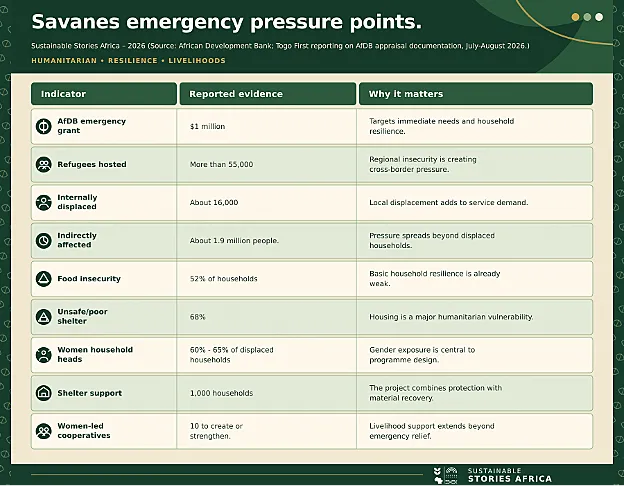
The African Development Bank has announced a $1 million grant for an emergency assistance project in the Savanes Region, where more than 55,000 refugees are now being hosted.
The intervention responds to the spillover from insecurity across the Sahel, which has pushed vulnerable populations towards northern Togo while adding pressure to already constrained host communities.
Earlier project appraisal information reported by Togo First indicated that the region was also supporting about 16,000 internally displaced people, with approximately 1.9 million people indirectly affected through growing pressure on infrastructure, services and local resources.
Shelter and food insecurity deepen pressure
The vulnerabilities extend well beyond displacement.
- Assessments cited in the project appraisal indicated that 52% of households faced food insecurity and 68% of shelters were unsafe or in poor condition.
- Women accounted for an estimated 60% to 65% of displaced household heads, exposing them disproportionately to economic insecurity and gender-based violence.
The proposed intervention was designed for implementation through UNHCR alongside Togolese institutions including the National Commission for Refugee Assistance and the Emergency Program for the Savanes Region.
Planned support includes shelter-rehabilitation materials for 1,000 households and basic household items such as mosquito nets, blankets, mats, kitchen equipment and solar lamps.
Registration, documentation, protection services and livelihood assistance form another part of the programme.
That combination matters because prolonged displacement can transform what begins as an emergency into a deeper development crisis.
Women-led enterprises can rebuild resilience
The project design also reaches beyond conventional humanitarian relief.
- Ten women-led cooperatives are expected to be created or strengthened, alongside training in management, governance and entrepreneurship.
- Support for income-generating activities, value-chain participation and connections with financial institutions is intended to reduce longer-term dependence on humanitarian assistance.
This approach recognises that resilience is not simply the availability of food or emergency shelter.
It also depends on whether displaced households and host communities can earn income, participate in local markets and rebuild some control over their economic lives.
In northern Togo, such investments could also reduce tension over increasingly stretched local services and economic opportunities.
Emergency funding needs sustained development support
A $1 million grant cannot resolve the structural pressures created by instability across the Sahel.
- Togo's broader Emergency Program for the Savanes Region has a 2026 - 2027 response plan estimated at CFA18 billion and intended to coordinate assistance for more than 430,000 vulnerable people.
- Other development partners have also expanded programmes covering social cohesion, education, protection and livelihoods.
The priority is therefore coordination:
- Humanitarian financing, national security responses and longer-term investment in schools, healthcare, livelihoods, water and infrastructure need to reinforce one another.
Otherwise, communities hosting displaced populations could see already limited services deteriorate further.
Path Forward – Relief must become durable local resilience
Togo's immediate task is to ensure assistance reaches refugees, internally displaced people and host communities transparently and quickly, particularly women and highly vulnerable households.
The longer-term test will be whether emergency support strengthens social cohesion and economic independence.
In a region increasingly exposed to the consequences of instability in the Sahel, humanitarian response and sustainable development can no longer be treated as separate policy agendas.
Culled from: Togo: US$1 Million Grant to Address the Humanitarian Emergency in the Savanes Region