The global energy transition is regaining momentum, but the foundations remain fragile.
The World Economic Forum's Fostering Effective Energy Transition 2025 report highlights modest recovery across countries, even as emissions hit record highs and financing gaps widen.
This is not a story of failure, but of misalignment between ambition and delivery, capital and need, global rules and local realities.
Momentum Returns, Fragility Persists
The energy transition is back in motion—but on unstable ground. After years of disruption from pandemics, wars and price shocks, global energy systems showed signs of recovery in 2025. Clean energy investment surpassed US$2 trillion, more than 65% of countries improved their energy transition scores, and equity rebounded as prices eased. Yet beneath this progress lies a more sobering truth: the transition remains uneven, underfinanced and exposed to geopolitical risk.
According to the World Economic Forum's Fostering Effective Energy Transition 2025 report, global Energy Transition Index (ETI) scores rose by 1.1% year-on-year, more than double the pace of recent years. System performance improved faster than transition readiness for the first time since 2017, raising questions about durability. Emissions climbed to a record 37.8 billion tonnes, while investment growth slowed sharply.
The report reframes the transition not as a linear shift to clean energy, but as a broader transformation shaped by energy security, affordability, industrial competitiveness and resilience. In that framing lies its most important message: ambition without delivery capacity will not endure.
The Transition Is Real And Uneven
The 2025 Energy Transition Index captures a world moving at multiple speeds. While 77 of 118 countries improved their scores, only 28% advanced simultaneously across security, equity and sustainability.
Equity showed the strongest rebound, helped by subsidy reforms and moderating prices. Sustainability continued its steady climb as renewables expanded. Energy security, however, stagnated, constrained by import dependence, grid inflexibility and supply chain risks.
SSA Insight: Progress is returning, but resilience remains weak.
What The Data Reveals About System Stress
The ETI measures two pillars: system performance (security, equity, sustainability) and transition readiness (regulation, infrastructure, innovation, human capital, finance). In 2025, performance improved by 1.2%, while readiness rose just 0.8%, well below its 10-year average.
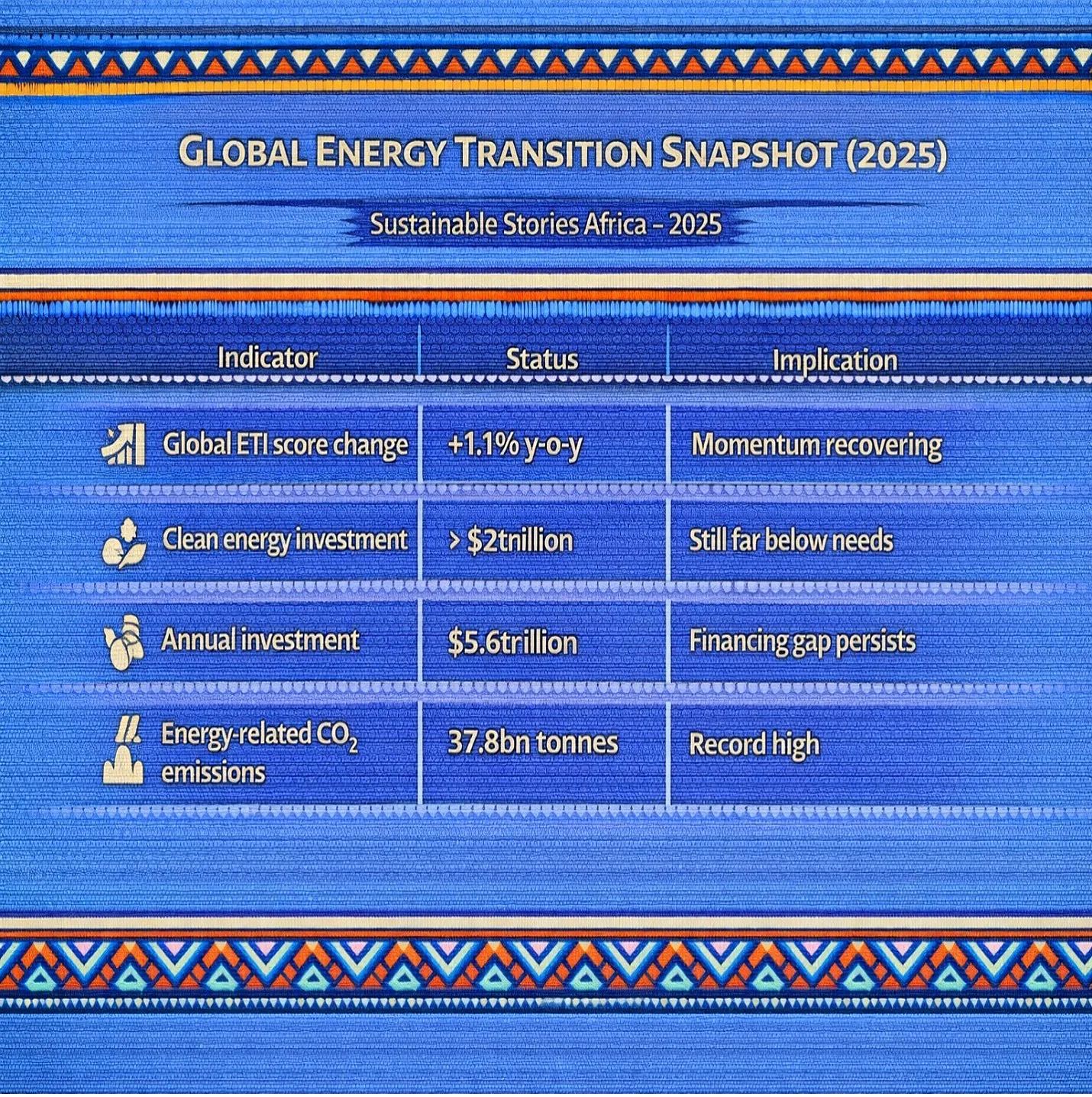
Global Energy Transition Snapshot (2025)
| Indicator | Status | Implication |
|---|---|---|
| Global ETI score change | +1.1% y-o-y | Momentum recovering |
| Clean energy investment | >US$2trillion | Still far below needs |
| Annual investment required | $5.6trillion | Financing gap persists |
| Energy-related CO₂ emissions | 37.8bn tonnes | Record high |
SSA Insight: Delivery capacity is lagging ambition.
Regions, Priorities And Diverging Paths
Regional dynamics underscore the transition's complexity. Emerging Europe led gains through infrastructure and education. Emerging Asia advanced via investment and regulation.
Sub-Saharan Africa recorded strong policy momentum but remains constrained by capital access and infrastructure gaps. Advanced economies continued to lead overall, but face permitting delays, grid congestion and political fragmentation.
Multi-Speed Energy Transition – Blocks - Advanced economies, Infrastructure-led, Emerging Asia: Investment-driven, Africa: Policy momentum, capital gap, Middle East: Equity gains, fossil dependence
Redefining Energy Security And Competitiveness
The report marks a shift in how energy security is defined. No longer limited to fuel supply and price stability, security now includes grid resilience, digital infrastructure, critical minerals access and system flexibility.
AI-driven data centres alone could account for 10% of global power demand growth by 2030.
Energy transition is increasingly intertwined with industrial policy. Countries are using clean energy, storage, hydrogen and electrification as competitiveness strategies, reshaping supply chains and trade relationships.
SSA Insight: Energy transition has become an economic strategy.
Capital Is The Binding Constraint
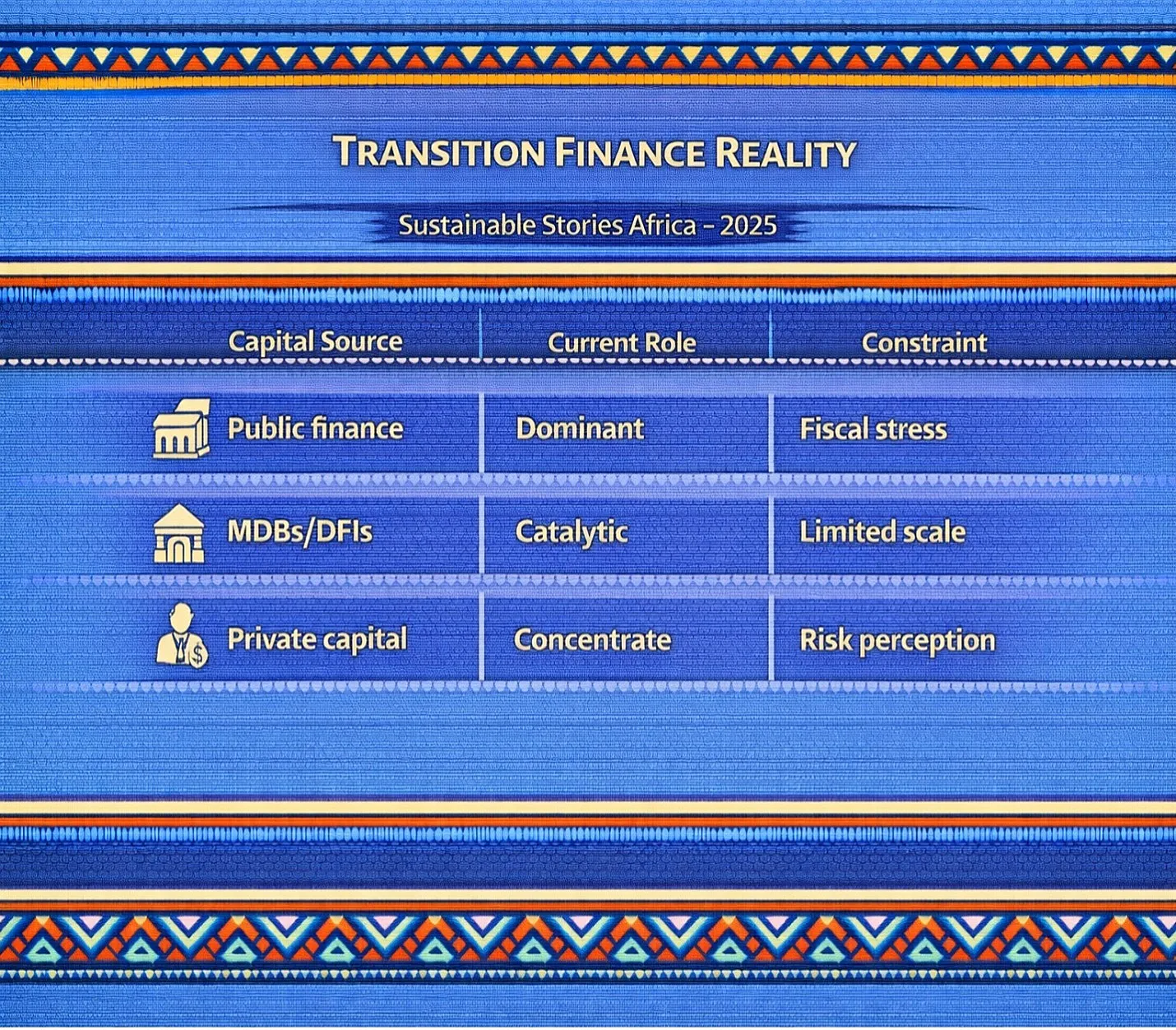
Despite rising ambition, finance remains the weakest link. Over 90% of clean energy investment since 2021 has flowed to advanced economies and China, even as emerging markets account for more than 80% of demand growth. Financing costs in developing economies remain up to seven times higher.
Transition Finance Reality
| Capital Source | Current Role | Constraint |
|---|---|---|
| Public finance | Dominant | Fiscal stress |
| MDBs/DFIs | Catalytic | Limited scale |
| Private capital | Concentrated | Risk perception |
SSA Insight: The transition will not scale without risk repricing.
From Targets To Execution Capacity
The WEF report identifies five priorities:
- stable policy frameworks
- modern infrastructure
- skilled talent
- accelerated clean technology commercialisation
- greater capital flows to developing economies.
These are execution challenges, not technology gaps.
Without credible pipelines, regulatory certainty and workforce readiness, momentum risks stalling, especially amid geopolitical fragmentation and fiscal tightening.
PATH FORWARD – Align Ambition With Delivery
The 2025 ETI makes one point clear: the energy transition is underway, but fragile. Countries that align ambition with finance, infrastructure and institutions will lead.
Those who do not risk reversal. Effective transition now depends less on pledges and more on the capacity to deliver under pressure.