IRENA's six power-system case studies show digital tools are increasing solar output, preventing grid failures and unlocking transmission capacity without waiting years for new lines.
For African utilities, the opportunity is substantial; however, AI only works when dependable data, cybersecurity, interoperability, market rules and institutional trust are built alongside the software.
Grid Bottlenecks Are Slowing Renewable Growth
The energy transition is colliding with the physical limits of electricity networks.
- Renewable capacity additions reached a record 692 gigawatts in 2025; however, grids cannot always move new power from windy and sunny locations to consumers.
In 2024, 1,650 gigawatts of advanced solar and wind projects were waiting for grid connection, while an estimated 65 million kilometres of lines must be added or refurbished by 2040 for a net-zero pathway.
- Building infrastructure remains essential, but it is slow.
- Permitting and commissioning a transmission line can take seven to ten years.
- Digital control can use the existing system more intelligently in the meantime, improving monitoring, forecasting, operational optimisation, end-user automation and transparency.
IRENA's Digitalisation and AI for transforming power systems examines six cases presented during Innovation Week 2025.
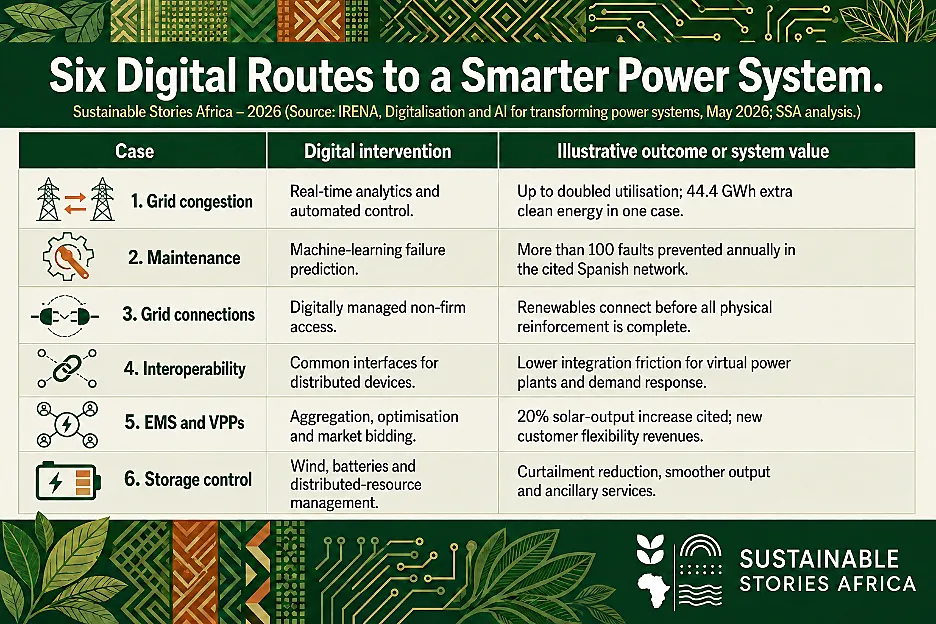
Together, they show that AI is not one application. It is a family of tools for congestion, maintenance, connection management, interoperability, energy distribution, and storage control.
Six Cases Show Measurable Digital Value
The first three cases focus on grid operations.
- Splight uses dynamic congestion management to identify constraints and automatically adjust generation, storage or large loads.
- Iberdrola applies machine learning to predict asset failures and target maintenance.
- Japan's NEDO uses non-firm connections, allowing renewable projects to connect earlier in exchange for controlled curtailment when the network is constrained.
The other cases focus on distributed energy.
- The Mercury Consortium is developing interoperability standards so electric vehicles, batteries, heat pumps and other devices can participate in virtual power plants.
- Fusebox aggregates behind-the-meter assets through energy management and virtual-power-plant software.
- Mitsubishi Electric combines storage and digital controls to manage wind output and distributed resources.
The measured outcomes are attention-grabbing:
- The report highlights a 20% increase in solar photovoltaic output in a Fusebox case, more than 100 avoided grid-asset incidents a year in Iberdrola's Spanish network and a doubling of grid utilisation in Splight's congestion-management work.
These are company-reported or case-study outcomes, rather than universal performance guarantees, but they show where value can be tested.
Software Can Release Capacity Within Months
Traditional reliability rules can leave transmission lines operating at 50-60% of physical capacity, enabling the system to survive the loss of a major component.
Splight's platform continuously monitors the network, predicts overloads and makes subsecond adjustments.
- The company says lines can operate closer to 100% of rated capacity, doubling or even tripling transmitted power in suitable cases without abandoning security standards.
- Deployment can take 10 - 12 months, compared with seven to ten years for a new line.
Across installations covering more than 2,000 kilometres and 6 gigawatts of assets, the platform has reduced curtailment and increased delivered energy.
One 2024 deployment delivered an additional 44.4 gigawatt-hours of clean electricity and was associated with a $66 million increase in project revenue.
That speed is relevant to emerging markets where demand grows faster than grid construction.
- It can buy time, improve the economics of existing renewable projects and connect new loads.
- It does not remove the need for network investment; it helps planners extract more value from each line while expansion proceeds.
Predictive Systems Make Maintenance More Targeted
Iberdrola's approach shows a different use of intelligence.
- Sensors, asset inventories, inspection histories, fault reports, topology, temperature and equipment specifications feed machine-learning models that estimate fault rates and failure probability.
- Maintenance can then move from a fixed schedule towards intervention based on condition and risk.
The Spanish network reported a system average interruption duration of 33.4 minutes per year and frequency of 0.53 interruptions a year, both all-time lows for the network cited in the case.
Those indicators were about 35% below their 2010 levels, while predictive maintenance was credited with preventing more than 100 faults annually.
Other cases extend flexibility to consumers and storage.
- Battery project costs fell 93% between 2010 and 2024, from USD 2,571 to USD 192 per kilowatt-hour.
Fusebox used price signals to manage a 1.2 MW and a 2.064 MWh battery at a Mexican solar site.
In Hokkaido, a 540 MW wind farm is paired with a 240 MG, 720 MWh battery behind a 300 MW grid connection.
Africa Needs Standards, Markets and Trust
African power systems can benefit from congestion management, predictive maintenance, smart mini-grids, storage control and demand response.
- Utilities often face limited capital, ageing assets, fast demand growth and long connection queues.
- Digital systems can direct scarce maintenance funds, reduce avoidable outages and integrate more renewable power before every physical constraint is removed.
However, software inherits the quality of the system surrounding it.
- Incomplete asset records, inconsistent sensor data and weak communications can produce unreliable predictions.
- Proprietary interfaces can trap utilities in one vendor's platform.
- Cybersecurity risks increase as control systems become more connected
- Regulators may also lack a tariff or market product that rewards digitally released capacity or aggregated flexibility.
Non-firm connections offer a useful regulatory example.
- A generator can connect before full reinforcement if transparent rules define when and how output may be curtailed.
- Digital control then manages the constraint in real time. The approach can shorten queues; however, contracts must clearly allocate curtailment risk, and operators must publish accurate data for investors to estimate lost output and revenue.
Trust is therefore an operating requirement.
- System operators need pilots that fail safely, transparent performance evidence and clear human override.
- Procurement should specify data ownership, interoperability, auditability, cybersecurity, service levels and exit arrangements.
- Standards bodies and regional power pools can reduce fragmentation by aligning technical requirements.
Pilots Should Prove Value Before Scaling
IRENA identifies data ecosystems, regulatory frameworks, harmonised standards and international co-operation as priority enablers.
- Governments should allow utilities to test advanced technologies through controlled pilots and create market rules that let verified flexibility earn revenue.
- End users must understand how their devices or loads participate and how benefits are shared.
For African utilities,
- The first portfolio should target measurable bottlenecks: a congested corridor with renewable curtailment, a high-failure asset class, a mini-grid cluster needing better dispatch or a commercial load that can shift demand.
- Baselines should be agreed before deployment, including outages, energy curtailed, maintenance cost, connection time and customer impact.
Independent evaluation can distinguish a useful control system from an impressive demonstration.
- Scaling decisions should follow verified reliability, cost and cybersecurity results.
- Capacity building must include engineers, regulators, procurement teams and market operators, because digital transformation is an institutional change as much as a software purchase.
Regional replication should favour modular systems and open interfaces.
- A utility that can add sensors, analytics or control nodes in stages can learn without placing the entire network on one untested platform.
- Shared procurement standards and anonymised operating data can lower costs for smaller systems
- Local universities and technical institutes can build the skills needed to maintain models after international vendors leave.
Path Forward – Build Data Before Intelligence
Africa should use AI to relieve real grid constraints, beginning with transparent pilots and credible baselines.
Data quality, interoperability, cybersecurity and market rules must be funded as core infrastructure.
Digital tools can make existing assets work harder and connect renewables faster.
Their durable value will come from measurable system outcomes, open standards and institutions capable of governing automated power decisions.