Nigeria reclaimed Africa’s equity-funding lead in the first half of 2026, while Ghana placed only eleventh by total capital despite recording at least ten funded ventures.
The gap is less about entrepreneurial activity than the size and maturity of investable deals.
A Lagos-versus-Accra argument captures the tension: investors reward scale, but long-term ecosystem strength also requires predictable institutions, reliable infrastructure and visible paths from seed funding to growth capital.
Capital Still Rewards Scale Before Stability
Nigeria’s startup ecosystem is again pulling the continent’s largest pool of equity capital, sharpening a West African debate over whether investors value market scale more than stability.
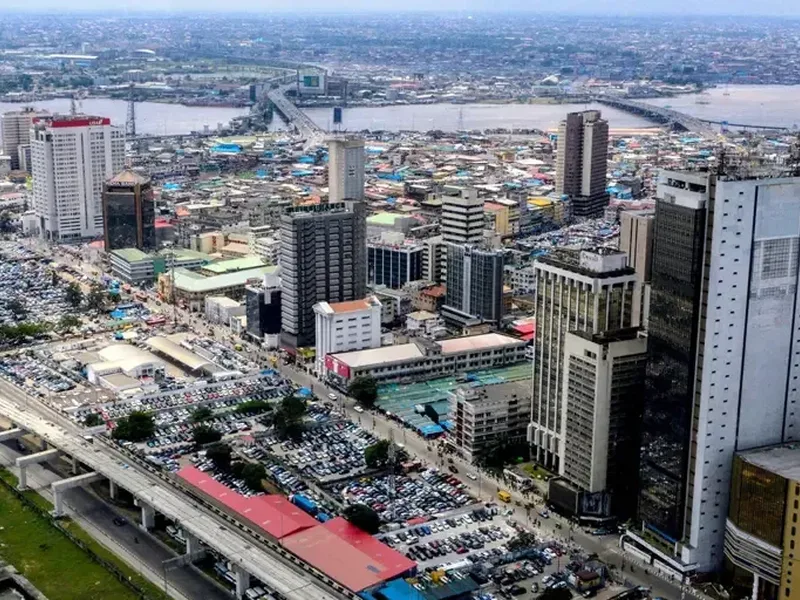
A LinkedIn essay published on 16 August by brand strategist Karen Punch framed the contrast starkly: Lagos built density, speed and proof of scale, while Accra is building a case around predictability and quality of life.
The latest funding data showcase the scale argument; however, it also corrects the idea that Ghana barely registers.
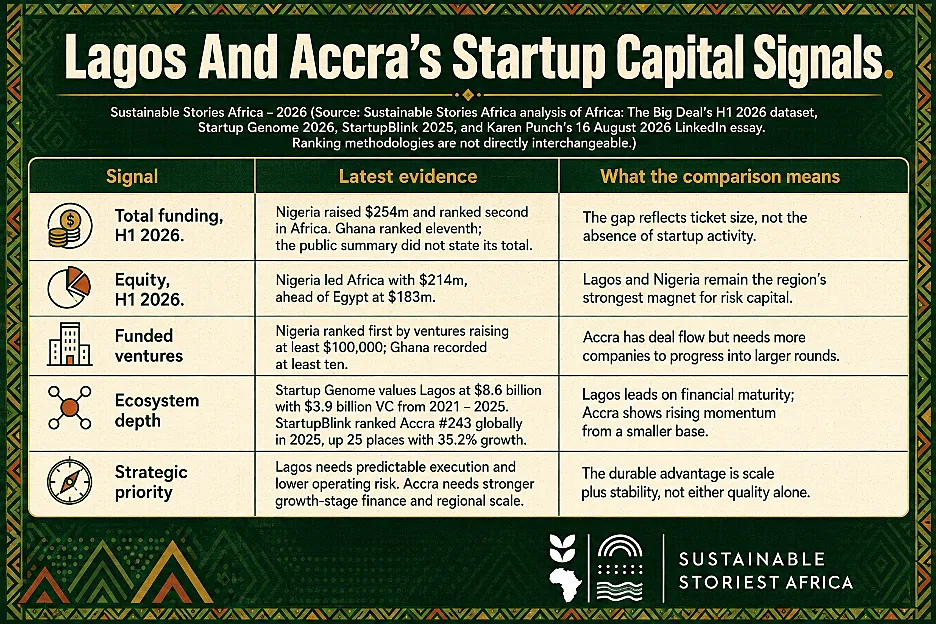
- Africa: The Big Deal tracked $254 million in total startup funding for Nigeria in the first half of 2026, second to Egypt’s $327 million.
- With debt excluded, Nigeria ranked first in equity with $214 million, ahead of Egypt’s $183 million.
- Ghana placed eleventh by total funding but still had at least ten ventures raise $100,000 or more.
That distinction matters. Ghana’s challenge is not an absence of founders or transactions. It is the shortage of larger tickets that can lift a national total, finance expansion and establish repeatable exits.
The Funding Data Needs Careful Reading
Africa's venture market remains concentrated. Africa:
- The Big Deal recorded $1.36 billion announced in H1 2026, broadly level with the prior year.
- Egypt, Nigeria, Kenya and South Africa, the "Big Four", attracted 58% of funding and 110 of 190 ventures raising at least $100,000, excluding grants.
- Nigeria reclaimed first place by number of funded ventures, though no single 30% share held consistently across every metric.
This underscores why headlines demand precise definitions.
- "Funding" can blend equity, debt and grants; "deals" may count companies or transactions; rankings can measure capital, talent, exits or ecosystem quality.
- Under total funding, Egypt led on large transactions; under equity and deal activity, Nigeria led instead.
- Ghana's eleventh-place ranking still reflected a visible early-stage base.
Broader benchmarks confirm differing maturity levels. Startup Genome's 2026 assessment ranked Lagos first in Sub-Saharan Africa, valuing its ecosystem at $8.6 billion, with $3.9 billion in venture capital (2021–2025) and three active unicorns across fintech, logistics and e-commerce.
StartupBlink's 2025 ranking placed Accra 243rd globally, climbing 25 places, a 35.2% growth, making it West Africa's second-ranked city.
- Lagos operates at greater financial depth
- Accra builds momentum from a smaller base.
Lagos And Accra Need Both Advantages
The two cities do not need to choose between scale and stability.
- Lagos can convert its dense market, experienced founders and fintech infrastructure into more durable value if it reduces operating friction, policy uncertainty and infrastructure risk.
- Accra can turn its smaller, rising ecosystem into an investment advantage if stability is matched by companies that can deploy larger cheques and expand beyond Ghana’s domestic market.
For West Africa, the prize is bigger than city rivalry.
- A stronger corridor between Lagos and Accra could help startups test products across two different markets, build regional revenue and become less dependent on a single currency or regulatory regime.
- It could also spread jobs, digital services and climate or health innovation beyond the handful of companies currently able to attract growth capital.
Turn Ecosystem Strengths Into Investable Proof
Nigeria’s task is to make scale more reliable.
- That means predictable regulation, better power and digital infrastructure, clearer foreign-exchange pathways, stronger corporate governance and more local exit channels.
- Investors should be able to see that a company can survive policy shifts and convert a large addressable market into recurring revenue, rather than merely user numbers.
Ghana’s task is to make stability financeable.
- Accra needs deeper seed-to-Series-A pipelines, stronger links between accelerators and institutional investors, better evidence of regional sales, and follow-on capital for firms that graduate from small rounds.
- Public agencies should measure how many funded startups advance to the next stage, rather than only how many join programmes.
Regionally, governments and investors can support cross-border regulatory sandboxes, co-investment vehicles, shared due diligence standards and local-currency instruments.
Founders in both cities should disclose unit economics, governance, workforce impact and material sustainability risks.
Capital is most likely to stay when scale comes with operational proof, and stability comes with growth capacity.
Path Forward – Scale Must Meet Stability Across West Africa
Lagos should use its equity lead to prove reliability, while Accra should use its momentum to produce larger, repeatable rounds.
Both ecosystems need transparent data that separates equity, debt, grants and deal counts.
The long-term winner will not be the city that chooses scale or stability.
It will be the one that combines both and helps founders build across West Africa rather than inside a single national market.