
A Nigerian tax assessment becomes final and conclusive when objection or appeal rights expire unused, or when the relevant amount is agreed or determined through the dispute process.
Once unpaid tax reaches that point, recovery, interest and penalties can follow, making early notice management a core financial control.
Silence Can Convert Assessment Into Debt
FinPolNomics Green Finance originated the Tax & Transfer Pricing Nugget for this explainer, warning that a tax assessment can become final and conclusive when a taxpayer does not object within the required period.
Sustainable Stories Africa applies its Metrics and Insights & Data standards by mapping every route to finality, the consequences of unpaid tax and the controls that prevent a notice from becoming an avoidable debt.
The rule is procedural but commercially significant.
Once the amount is final for the relevant issue, the conversation can move from calculation to collection, with cash, penalties and enforcement exposure at stake.
Finality Arrives Through Several Legal Routes
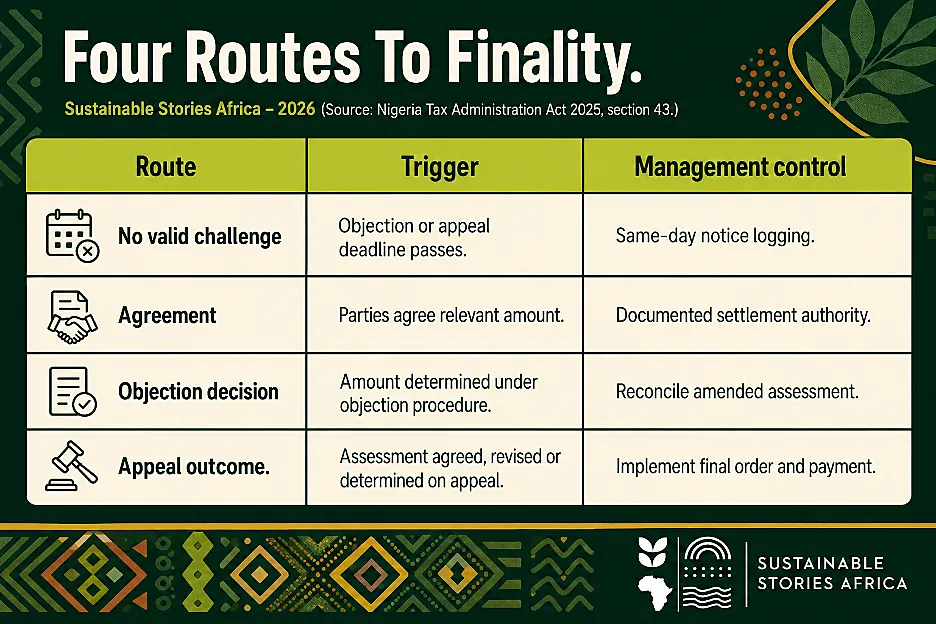
Section 43 of the Nigeria Tax Administration Act 2025 identifies the circumstances in which an assessment becomes final and conclusive as regards the amount of profits or other relevant measure. The most preventable route is failing to lodge a valid objection or appeal within the statutory time.
Finality can also arise by agreement.
- If the taxpayer and authority agree on the relevant profits, income or transaction value, the resulting assessment is settled on that basis.
- The same applies where the amount is determined during the objection process or through an appeal.
This phrase does not mean that every possible legal question in the taxpayer’s affairs disappears forever.
- It applies to the assessment and amount determined under the statutory process.
- The Act also preserves the authority’s ability to make other assessments that do not reopen the same issue on the same facts.
The management message is direct:
- A notice must be reviewed before its response window closes.
- Silence is not a neutral posture.
- It can allow the assessed amount to harden into an enforceable tax debt.
Finality should be recorded at the issue level.
- A single assessment can contain several adjustments, some agreed, and some appealed.
- The case register should show which amount is final, which remains disputed, what payment has been made and which legal step is outstanding.
A single status label can hide material differences.
Tax Recovery Changes The Wider Business Conversation
Once an assessment is final and tax remains unpaid, the authority may proceed with recovery under the administration framework.
- Interest and penalties can increase the amount.
- A dispute that began as a technical difference can therefore become a liquidity and enforcement issue.
Cash planning should begin before finality.
- Where the company disputes an assessment, finance should model the principal, interest, penalties and professional costs under several outcomes.
- Reserves and disclosures should reflect applicable accounting standards and the quality of the company’s position.
Recovery exposure can also affect transactions.
- Lenders, investors and buyers may ask for tax-clearance evidence, dispute schedules, security or price adjustments.
- An overlooked assessment can slow financing or an acquisition long after the original filing year.
Reputation is another dimension.
- Responsible tax conduct does not require a company to accept every assessment.
- It requires timely engagement, honest evidence and compliance with outcomes.
A pattern of unanswered notices suggests weak governance even when the underlying amounts are not large.
Recovery planning should consider operational continuity.
- Enforcement against bank balances or other assets can affect payroll, suppliers and essential services.
- Early engagement and lawful dispute action reduce the risk that a tax matter spills into jobs, production or customer delivery.
That connection makes notice governance part of business resilience.
Payment mechanics deserve final control.
- The company should verify the beneficiary account, assessment reference, tax type, period and allocation of every settlement.
- A payment made with an incorrect reference can leave the official account showing arrears even when cash has left the bank.
- The receipt and portal position should be reconciled promptly, and discrepancies escalated.
Closure is achieved when the legal outcome, ledger, payment and authority record all agree, rather than merely when a transfer is initiated.
A Timely Objection Preserves Strategic Decision Space
The 30-day objection window under section 41 is the main protection against accidental finality.
- Filing a valid objection preserves the opportunity to correct errors, present evidence and narrow issues before the assessment becomes conclusive.
Validity is crucial.
- A placeholder letter that omits specific issues, amounts, requested amendments or admitted positions may not preserve rights.
- Companies should prepare the technical and procedural elements together and retain proof of service.
Where the taxpayer agrees to part of the assessment, the admitted amount should be identified and handled appropriately while the contested portion proceeds.
- Separating agreed and disputed items improves credibility and reduces the risk that an entire liability becomes entangled in one argument.
Escalation should be proportionate.
- Some cases can be resolved through clarification and amended computations; others require formal objection and appeal.
- A written dispute strategy should compare legal strength, evidence quality, cash exposure, precedent and relationship considerations without sacrificing statutory deadlines.
Settlement authority must be explicit.
- An employee who agrees to a figure in correspondence may create expectations beyond their mandate.
- Companies should define who can concede facts, approve amendments, enter settlements and authorise payment.
- Meeting notes should distinguish exploratory discussion from binding agreement.
Design Controls That Prevent Silent Consent
Centralise tax-notice intake across physical mail, registered offices, email and portals.
- A notice should trigger an automated case record with the service date, amount, response deadline, owner and escalation level.
- Backup owners are essential during leave or staff turnover.
Require an early decision memo.
- Within days, not weeks, tax and legal teams should state whether the assessment appears correct, what evidence is needed, what amount is admitted and which route is recommended.
- Management can then approve action with time remaining.
Track every open assessment through objection, agreement or appeal until the final amount is paid and the ledger is reconciled. Closing a legal file without closing the accounting and payment steps can still leave recovery exposure.
Report material cases to the audit committee using a small set of metrics: assessed amount, disputed amount, days to next deadline, probability-weighted exposure, evidence gaps and funding plan. Visibility is the antidote to silent consent.
After a case closes, the company should update tax calculations, provisions, returns, payment records and control documentation.
- Root-cause analysis should identify whether the assessment arose from an interpretation difference, data failure, missed deadline or unsupported position.
- Remediation prevents finality in one year from becoming repetition in the next.
A post-close review should include communication with external stakeholders where material.
- Auditors, lenders or investors may need the final amount, cash effect and control response.
- Disclosure should be accurate and proportionate, avoiding both understatement and unnecessary alarm.
- The company should also update due-diligence repositories so future transactions reflect the closed outcome rather than an obsolete disputed figure.
Institutional memory is strongest when the final resolution is captured where later decision-makers will actually look.
Path Forward – Respond Early Before The Debt Hardens
A final assessment can arise through missed deadlines, agreement, objection or appeal. Each route should be visible, documented and reflected in cash planning.
The safest control is simple: capture every notice immediately, make a reasoned decision and act within time.
Silence can be expensive because procedure determines when recovery begins.
EDITOR’S DATA NOTE
This explainer provides general public-interest information. They are not legal, tax, investment or accounting advice. Readers should verify current law, Gazette orders and NRS guidance and obtain advice for specific facts.
“Final and conclusive” is used in the statutory context of the assessment amount and dispute process. It should not be expanded into a claim that no legal remedy can ever exist in every circumstance.
LEGAL NOTE: General editorial information only. Tax outcomes depend on current law, guidance and specific facts; obtain professional advice before acting.