
A 4% levy on assessable profits now links eligible corporate earnings to education, technology, security and innovation funds.
For businesses, the central challenge is to calculate the same profit base consistently, test exclusions correctly and explain the combined tax burden to boards and investors.
One Levy, Seven Development Funding Channels
FinPolNomics Green Finance originated the Tax & Transfer Pricing Nugget that frames this explainer, presenting Nigeria’s 4% development levy and its seven allocation destinations in a single data-led view.
Sustainable Stories Africa applies its Metrics and Insights & Data standards by tracing the rate, the assessable profit base, the exclusions and the public funds that receive the proceeds.
The levy is more than another line on a tax schedule.
It consolidates development financing around a defined corporate contribution, making the quality of profit calculations and the transparency of public allocation central to the policy’s credibility.
The Levy Connects Profit To Purpose
Section 59 of the Nigeria Tax Act 2025 imposes a development levy of 4% of assessable profits on companies within the corporate income tax framework, subject to statutory exclusions.
- The base is assessable profit, not turnover, cash receipts or accounting profit copied directly from financial statements.
- That distinction determines both the amount paid and the controls needed to support it.
The policy consolidates financing that had previously been spread across several sector-specific obligations.
Instead of treating education, technology and innovation levies as separate compliance islands, the new architecture channels a single levy into seven designated funds.
That may simplify the number of calculations, but it also raises the importance of a single accurate profit base.
For development policy, the design creates a visible bridge between formal-sector profitability and national capability.
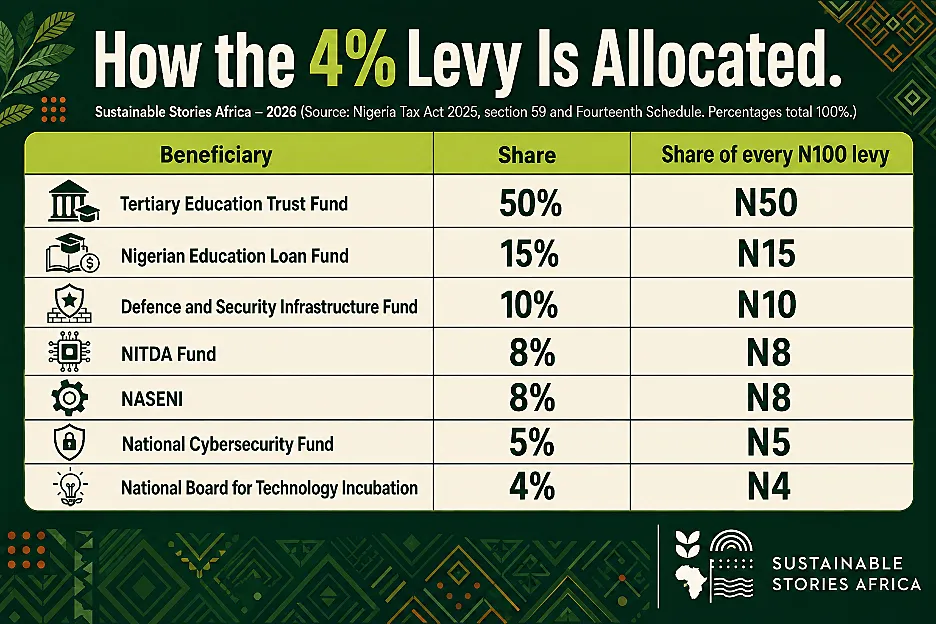
Education finance, digital infrastructure, industrial innovation, cybersecurity and security infrastructure all receive defined shares.
The public-value promise is substantial, but it depends on timely collection, transparent transfers and measurable outcomes at the beneficiary institutions.
A simple illustration shows the scale. If an eligible company has N5 billion of assessable profit, the levy is N200 million before considering any issue that changes the base.
Under the statutory allocation, N100 million of that notional payment corresponds to TETFund, while N30 million corresponds to the Education Loan Fund.
The example does not trace an individual payment through government accounts, but it helps us understand the formula.
Who Pays And Who Stays Outside
The levy does not apply uniformly to every company.
- Small companies and non-resident companies are excluded.
- The Act also prevents the levy from applying to assessable profits already subject to hydrocarbon tax under the relevant chapter.
- These boundaries need entity-level testing because a group can contain companies with different profiles and tax treatments.
Small-company status should be documented against the Act’s conditions rather than inferred from headcount, brand visibility or a single year’s sales.
- A company that grows beyond the qualifying limits can move into the levy net.
- Group restructurings can also shift activities and profits between entities, making periodic classification essential.
Non-resident exclusion does not mean cross-border arrangements are irrelevant.
- Nigerian members of an international group may still be liable, while charges to connected non-residents can affect the assessable-profit base through deductibility and transfer-pricing rules.
- The levy calculation therefore belongs in the wider corporate tax and related-party review.
Hydrocarbon businesses need an equally precise allocation.
- Where a company has multiple activities, finance teams should distinguish profits subject to hydrocarbon tax from other profits rather than applying a broad industry label.
- Clear segment reporting reduces the risk of both duplicate charges and unsupported exclusions.
Group structures create a further control point.
- Liability is determined for each taxable company, while management accounts may present divisions or consolidated groups.
- Tax teams should prevent group-level forecasts from masking entity-level exclusions, losses or profit adjustments.
- The legal entity that earns the assessable profit must remain visible throughout the calculation.
Public Value Needs Clear Measurable Delivery
The allocation formula makes the policy legible.
- Half of levy revenue goes to TETFund, giving tertiary education the dominant share.
- Another 15% supports the Nigerian Education Loan Fund.
- Together, education-related destinations receive 65% of the total, signalling that skills, access and institutional capacity sit at the centre of the levy’s development logic.
Technology and industrial capability receive a combined 20% through NITDA, NASENI and the National Board for Technology Incubation. Those funds can support digital systems, research commercialisation, engineering and enterprise formation.
The sustainability test is whether spending produces durable capacity rather than short-lived projects.
Security and resilience receive the remaining 15% through the Defence and Security Infrastructure Fund and the National Cybersecurity Fund.
Cybersecurity’s 5% share is particularly relevant as digital public services and electronic tax systems expand. Public finance is only as resilient as the systems that hold and move its data.
Because the percentages are fixed, citizens and companies can ask a straightforward accountability question:
- For every N100 collected, did each beneficiary receive and use its statutory share?
- Publishing collections, transfers, project outputs and outcome indicators would turn a tax metric into a development-performance dashboard.
Outcome reporting could use a small common scorecard.
- Education funds might disclose students supported, institutions upgraded and completion rates; technology funds could report deployed infrastructure, commercialised research and surviving enterprises; security funds could report completed assets and service improvements without disclosing sensitive operational detail.
- Comparable annual indicators would allow the public to follow performance over time.
Allocation transparency should follow the same calendar as collection reporting.
- If transfers lag, the public should be able to distinguish timing differences from shortfalls.
- Reconciled reporting by the collecting authority and each beneficiary would make that distinction visible.
Companies Need One Defensible Profit Base
The starting point is a reconciliation from audited profit to taxable and assessable profit.
- Every adjustment should have a legal basis, supporting schedule and accountable preparer.
- The levy is percentage-based; errors in the base flow directly into the liability: a N1 billion overstatement or understatement changes the levy by N40 million.
Tax provision models should show corporate income tax and the development levy separately, then reconcile both to total cash tax.
- This allows the board to see what is driven by profitability, what is driven by disallowances and what reflects the additional 4% charge.
- Investors should not have to infer the new burden from a blended effective rate.
Businesses should also update contracts and forecasts.
- Pricing decisions, project returns and acquisition models that rely on post-tax cash flows need the levy in their assumptions.
- Where the company is close to small-company thresholds, scenario models should show the step-up in obligations when eligibility changes.
Finally, preserve evidence for exclusions.
- A non-resident company, a small company or a hydrocarbon-tax allocation should be supported by current facts and documented analysis.
- A label in a group chart is not a substitute for the statutory test, especially when an assessment can be revisited years later.
Tax teams should not describe the levy as a voluntary sustainability contribution.
- It is a statutory charge with defined beneficiaries.
- Companies may, however, explain it within a broader tax-contribution report alongside jobs, wages, supplier spend and community investment.
- Clear categorisation prevents mandatory payments from being presented as discretionary impact.
Path Forward – Follow The Money Far Beyond Collection
For companies, readiness means accurately computing the 4% charge, forecasting its cash impact and documenting exclusions.
For public institutions, legitimacy requires showing how the seven shares translate into education, security, innovation and digital outcomes.
The levy’s development story will be strongest when collection data and beneficiary performance are reported together.
That is the metric that converts corporate payment into public confidence.
EDITOR’S DATA NOTE
This explainer provides general public-interest information. They are not legal, tax, investment or accounting advice. Readers should verify current law, Gazette orders and NRS guidance and obtain advice for specific facts.
The statutory allocation percentages amount to 100%. This explainer treats the seven destinations as an accountability map, rather than as a tax rule.
LEGAL NOTE: General editorial information only. Tax outcomes depend on current law, guidance and specific facts; obtain professional advice before acting.