
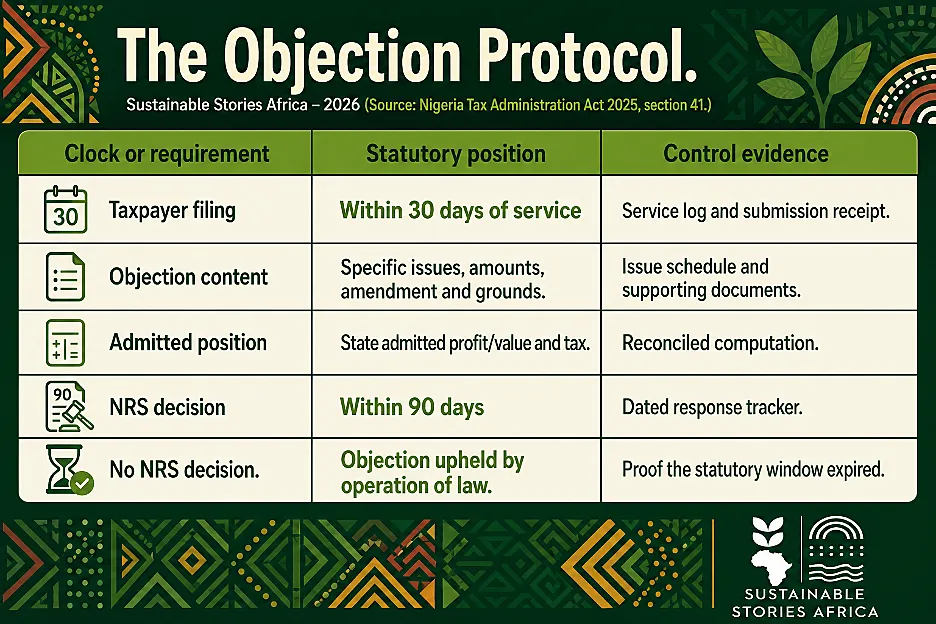
A Nigerian taxpayer generally has 30 days after service of an assessment to file a valid written objection, while the NRS has 90 days to decide.
Silence by the authority within that window can uphold the objection by operation of law, making proof of dates and content decisive.
Two Clocks Govern Every Tax Objection
FinPolNomics Green Finance originated the Tax & Transfer Pricing Nugget for this explainer, reducing Nigeria’s objection procedure to two memorable metrics: 30 days for the taxpayer and 90 days for the revenue authority.
Sustainable Stories Africa applies its Metrics and Insights & Data standards by examining what constitutes a valid objection, how service and response dates should be documented, and when an appeal is the next route.
Deadlines alone do not win disputes. A timely but vague letter can fail the statutory test, while a strong technical argument filed late may lose procedural protection.
Thirty Days Demands Immediate Dispute Triage
Section 41 of the Nigeria Tax Administration Act 2025 allows a taxable person dissatisfied with an assessment to object in writing within 30 days after service.
The starting event is service of the notice, so the company must know when, where and by whom the document was received.
A valid objection must do more than state disagreement.
- It should identify the specific issues or errors, the amounts involved, the amendment sought, the reasons and supporting information, and the profit, income or transaction value the taxpayer admits.
- It should also state the admitted tax payable or explain why none is admitted.
These requirements turn the first month into a compressed exercise of evidence.
- Tax, finance, legal and operational teams may need to reconstruct transactions, calculate the disputed amount and approve a position while ordinary business continues.
A good triage process begins on the day of receipt.
- It logs the notice, confirms the deadline, assigns counsel and subject-matter owners, preserves records and separates undisputed amounts from contested items.
- Delay at the mailroom or executive office can consume a material share of the 30-day window.
Service protocols should cover remote and hybrid work.
- A notice sent to a registered address or portal may start time even when the responsible executive is travelling.
- Businesses should keep registration details current and design alerts that do not depend on one individual opening a mailbox.
Ninety Days Creates Meaningful Public-Sector Accountability
After receiving a valid objection, the NRS has 90 days to respond.
- If it fails to do so within the statutory period, the objection is upheld by law.
- This consequence gives the administrative clock real force and encourages timely decisions.
The taxpayer still needs evidence.
- It should preserve the submission acknowledgement, delivery record, full objection package and a calendar showing the last day of the 90 days.
- Disputes about whether a filing was complete or received can become as important as the underlying tax issue.
Where the parties agree, the assessment can be amended. Where they do not, the authority’s decision should identify the accepted and rejected grounds, and the resulting amount.
A reasoned outcome helps the taxpayer decide whether to settle, refine evidence or appeal.
The 90-day rule also creates a useful institutional metric.
- Publishing aggregate data on objections received, decided within the time and upheld by default would show whether the process is functioning.
- Timeliness is part of taxpayer service as well as enforcement.
Information requests within the 90 days should be handled through a controlled correspondence log.
The taxpayer should answer accurately, record what was supplied and preserve the version sent.
New facts can refine the dispute; however, an untracked exchange can create confusion about the original grounds or amounts.
A Valid Tax Objection Needs Evidential Precision
The strongest objection is structured issue by issue.
- For each item, it states the assessment position, taxpayer position, amount in dispute, legal basis, factual evidence and requested correction.
- A summary table at the front lets the reviewer understand the total before reading supporting schedules.
The facts should be contemporaneous wherever possible.
- Contracts, invoices, bank records, board approvals, correspondence and system extracts generally carry more weight than recollections prepared after the assessment.
- Calculations should be tied to filed returns and accounts, with every difference explained.
Tone matters.
- An objection is not a press release or an accusation; it is a statutory request for reconsideration.
- Clear, respectful language helps the reviewer focus on evidence and law.
- Where the authority has made a valid point, narrowing the dispute can improve credibility.
The company should also plan for the next stage while the objection is pending.
- The Tax Appeal Tribunal operates under the wider dispute-resolution framework.
- Appeal deadlines, payment rules and evidence strategy should be reviewed early so an unfavourable decision does not trigger another rushed response.
Quantification is a discipline in its own.
- Interest, penalties and secondary effects should be separated from the principal tax issue, and every number should be reconciled to the assessment.
- A clear monetary bridge helps decision-makers evaluate settlement and prevents legal arguments from drifting away from the amount actually at stake.
Expert evidence should be commissioned early where valuation, engineering, customs classification or technology facts drive the assessment.
- The expert’s assumptions must match the legal issue and underlying records.
- A polished report built on incomplete data can weaken a case. Internal teams should give experts a documented question, reconcile source information and preserve independence.
The objection should explain how the evidence supports the requested amendment rather than asking the reviewer to infer the connection.
Build A Complete Deadline-Proof Tax Objection File
Centralise receipt of tax notices and train staff to recognise them.
- Each notice should be scanned, logged and escalated the same day, with the original preserved.
- Electronic portals and registered addresses should be monitored by more than a single person.
Use a 30-day reverse calendar.
- Reserve time for technical analysis, evidence collection, financial modelling, executive approval and submission.
- Target an internal filing date several days early to absorb system failures or last-minute questions.
Create a statutory content checklist and have an independent reviewer confirm every element.
- The submission should include a reconciled issue schedule, indexed evidence and proof of authority for the signatory.
- Deliver through an accepted channel and retain proof.
Then start the 90-day response tracker.
- Record correspondence, meetings, information requests and any agreed extensions or procedural developments with advice.
- If the authority does not decide within the statutory window, obtain professional guidance before relying on the deemed-upheld consequence.
Management should also protect business continuity.
- The people preparing the objection are often the same people running periodic compliance.
- A response plan should allocate resources, preserve filing quality and engage external support where complexity or volume exceeds internal capacity.
- One dispute should not create the next compliance failure.
The case team should prepare a one-page decision dashboard for leadership.
- It can show days remaining, principal tax, disputed share, admitted amount, interest exposure, evidence completeness and recommended action.
- Updating the dashboard weekly makes slippage visible and focuses executives on decisions only they can make.
- It also creates a contemporaneous governance trail if stakeholders later ask why the company objected, settled or appealed.
Path Forward – Treat Every Deadline As Substantive Evidence
The objection process protects taxpayers who act quickly and precisely.
Log service, file a complete case within 30 days and preserve proof of every step.
The NRS’s 90-day clock brings reciprocal accountability.
In a time-bound dispute, dates are the basis of administration around the evidence; they are part of the evidence.
EDITOR’S DATA NOTE
This explainer provides general public-interest information. They are not legal, tax, investment or accounting advice. Readers should verify current law, Gazette orders and NRS guidance and obtain advice for specific facts.
The statutory consequence of no decision within 90 days is powerful, but taxpayers should verify that the objection was validly filed and obtain case-specific advice before acting on it.
LEGAL NOTE: General editorial information only. Tax outcomes depend on current law, guidance and specific facts; obtain professional advice before acting.