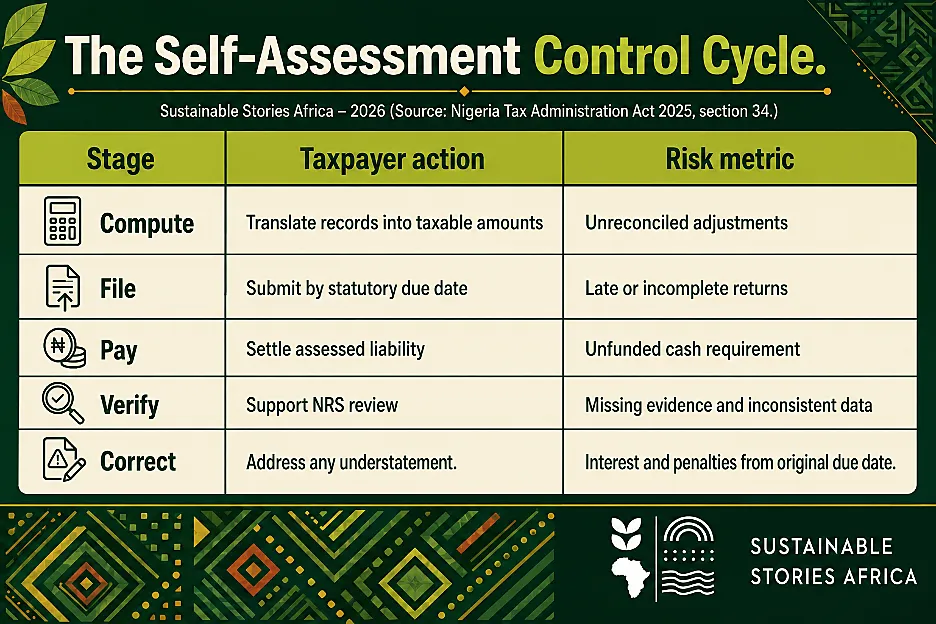
Under Nigeria’s self-assessment regime, taxable persons compute their own liability, file the return and pay by the due date without waiting for the authority’s assessment.
If declared income is understated, outstanding tax, interest and penalties run from the original due date, turning data quality into cash risk.
Accuracy Comes Before Revenue Service Review
FinPolNomics Green Finance originated the Tax & Transfer Pricing Nugget for this explainer, capturing self-assessment in a simple sequence: the taxpayer assesses, files and pays; the revenue authority verifies later.
Sustainable Stories Africa applies its Metrics and Insights & Data standards by examining the timing, evidence and governance behind that sequence, including the cost of an understated return.
Self-assessment is built on trust backed by verification. It can make administration faster; however, it places the first responsibility for a complete and accurate tax position on the person with the books, systems and transaction data.
The Taxpayer Moves First By Design
Section 34 of the Nigeria Tax Administration Act 2025 requires every taxable person to submit a self-assessment return by the due date.
The filing is treated as an assessment when the return reports no tax, a loss, or a negative amount.
Waiting for the Nigerian Revenue Service to calculate a liability is not the default process.
The authority may accept the return, make additions or reject it and issue a best-of-judgment assessment where the facts support that response.
Verification therefore remains real, but it follows the taxpayer’s initial calculation rather than replacing it.
If the taxpayer understates income, the outstanding amount is treated as due from the original return due date. Interest and penalties can also run from that date.
- A correction made months later may repair the figure, but it does not erase the time value and compliance consequences of the initial error.
This architecture rewards accurate, timely data. It also reduces the space for a business to argue that the authorities should have discovered a problem earlier.
The taxpayer controls the records and must make the first defensible call.
Nil and loss returns deserve the same discipline as tax-paying returns because filing them still creates a deemed assessment.
Unsupported losses can affect future periods, group planning and investor expectations.
- A company should document how losses arose, reconcile them to the accounts, and preserve the evidence needed if the authority later reviews the availability of those losses.
Every Return Is A Data Product
A tax return is produced from many systems: sales, procurement, payroll, fixed assets, inventory, banking, contracts and group reporting.
The final form may be short, but the chain of calculations behind it is long. Self-assessment makes the quality of that chain the taxpayer’s responsibility.
Common weaknesses include incomplete interfaces, manual journals without tax tagging, stale master data and adjustments that cannot be traced to source records.
A spreadsheet can produce the correct total once and still be an unreliable control if nobody can reproduce the result later.
The remedy is a return data lineage that shows where each material figure originates, how it is transformed and who approves it.
Automated reconciliations should compare source systems with the general ledger, the ledger with tax schedules and the schedules with the filed return.
Differences need named explanations, not balancing entries.
This approach also improves management insight.
- The same reconciled data can reveal margin changes, inefficient incentives, supplier issues and cash-tax drivers.
- Compliance becomes more useful when the organisation treats the return as a governed analytical product rather than a deadline document.
Data ownership should follow business reality.
- Tax may design the return, but sales owns customer classifications, procurement owns vendor information, payroll owns employee data, and treasury owns payments.
- Each function should certify the inputs it controls.
That distributed accountability is stronger than asking the tax team to correct every source-system weakness at year-end.
Errors Become Cash And Trust Risks
An understatement creates more than a technical adjustment.
- The unpaid amount affects cash forecasts, while interest and penalties increase the eventual cost.
- If the issue appears across several periods, management may need to reassess provisions, disclosures and the reliability of related controls.
The reputational effect can be wider.
- Investors, lenders, customers and public institutions increasingly connect tax conduct with responsible business.
- A company that cannot explain repeated errors may weaken confidence even when it later pays the principal amount.
Overstatements also matter.
- Paying too much can lock up working capital and signal that the business does not understand its tax position.
- The goal is not a conservatively high number; it is an accurate number supported by law and evidence.
Boards should therefore monitor both tax outcomes and control health.
- Useful indicators include late adjustments, manual entries, unresolved reconciliations, filing timeliness, audit queries and the age of open tax positions.
- Trend data is more informative than a single compliance certificate.
Voluntary correction processes should be designed before errors occur.
- The company needs criteria for escalation, materiality, professional advice, amended filings and stakeholder communication.
- A known error should not remain open merely because the route to correction is inconvenient.
- The longer it persists, the more periods, interest and governance questions can accumulate.
Scenario analysis can identify potential errors before they reach the return.
- Tax expense, cash tax, turnover, payroll and major deductible costs should move broadly with the business unless a known rule explains the difference.
- A sharp break from budget or prior year should trigger investigation.
- Analytical review is not proof of correctness, but it is an efficient warning system when detailed data is large.
- Management should record the explanation and evidence for every material variance.
Create A Defensible And Repeatable Filing Rhythm
Begin with a statutory calendar that assigns every return, data feed, review and payment to a named owner.
- The calendar should include internal cut-off dates early enough for challenge and correction, rather than merely repeat the legal deadline.
Use a documented close process.
- Reconcile accounts, review unusual transactions, update tax positions and obtain evidence before the return is signed.
- Material judgments should state the facts, legal basis, financial effect and approving authority.
Run a pre-filing review independent of the preparer.
- The reviewer should test high-risk balances, compare the return with prior periods and business forecasts, and confirm that payment funding is available.
- Where data is estimated, the basis and later true-up process must be explicit.
After filing, archive the signed return, submission confirmation, payment receipt, schedules, source data and approvals as a single indexed record.
Then perform a short lessons review. Self-assessment improves when each cycle strengthens the next one.
Smaller taxpayers need proportionate tools.
- Standard workpapers, guided portals and plain-language NRS instructions can reduce mistakes without demanding enterprise software.
- Professional bodies and business associations can help translate sector practices into repeatable recordkeeping.
- Self-assessment is more inclusive when compliance design recognises differences in capacity.
Tax teams should maintain a filing evidence index that another reviewer can navigate without assistance.
- The index should identify every source file, preparer, reviewer, version and approval date. Where a return is generated through a portal, screenshots or exported confirmations should preserve the submitted position.
This is especially important after staff departures or system upgrades, when informal knowledge disappears, but the deemed assessment remains open to verification.
Path Forward – Own The Number Before Filing Day
Self-assessment moves the first compliance decision to the taxpayer.
That makes reconciled data, independent review and timely funding the core safeguards.
The NRS may verify later; however, interest and penalties can reach back to the original due date.
Accuracy is therefore most valuable before the return leaves the business.
EDITOR’S DATA NOTE
This explainer provides general public-interest information. They are not legal, tax, investment or accounting advice. Readers should verify current law, Gazette orders and NRS guidance and obtain advice for specific facts.
The phrase “NRS verifies later” refers to sequencing, not automatic acceptance. Section 34 allows the authority to accept, adjust or reject the return and make a best-of-judgment assessment.
LEGAL NOTE: General editorial information only. Tax outcomes depend on current law, guidance and specific facts; obtain professional advice before acting.