
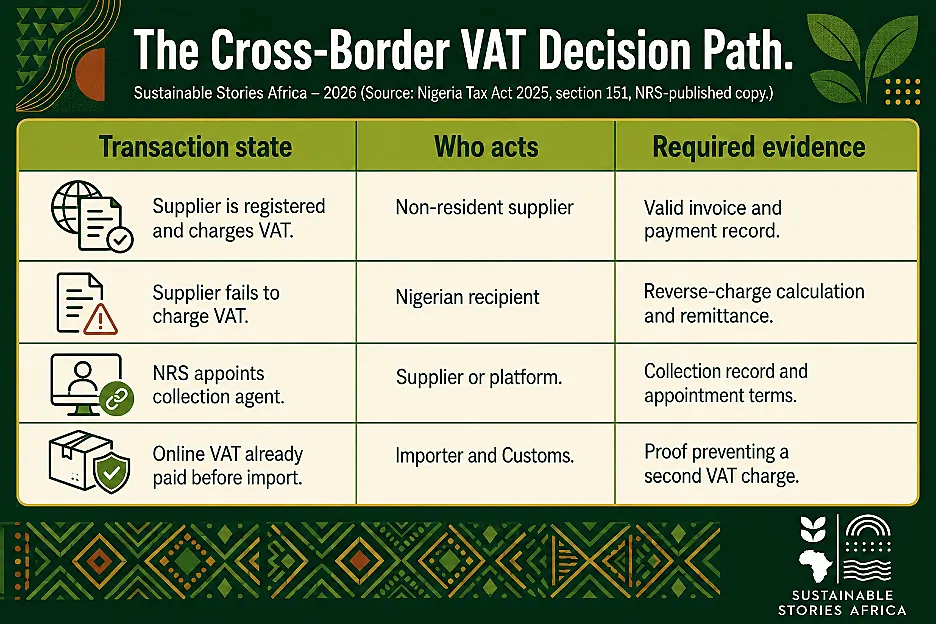
Non-resident suppliers making taxable supplies into Nigeria must register and charge VAT, while Nigerian recipients become the collection backstop when the supplier fails.
The reverse-charge rule makes vendor status, invoice review and proof of remittance critical controls for cross-border procurement and digital services.
Cross-Border VAT Now Has A Backstop
FinPolNomics Green Finance originated the Tax & Transfer Pricing Nugget for this explainer, highlighting how Nigeria’s VAT framework places obligations on non-resident suppliers and Nigerian recipients.
Sustainable Stories Africa applies its Metrics and Insights & Data standards by mapping the registration duty, invoice charge, reverse-charge trigger, collection-agent mechanism and protection against double VAT at Customs.
The policy follows value into the Nigerian market. Where an offshore supplier sells taxable goods or services into Nigeria, distance does not remove the VAT obligation; it changes who must act when the first collection route fails.
Nigeria Follows Consumption Across The Border
The destination principle behind VAT is straightforward: tax should generally arise where consumption occurs.
Digital platforms, cloud services, remote consultancy and cross-border goods can reach Nigerian customers without a traditional physical presence; as such, the law needs a collection mechanism that does not depend on a local storefront.
Under the current NRS-published Nigeria Tax Act, the non-resident supply rule appears in section 151.
- A non-resident person making taxable supplies to Nigeria must register for VAT and include the tax on its invoice.
- The Nigerian Revenue Service may also appoint a non-resident supplier or digital platform as a VAT collection agent.
If the offshore supplier does not charge the VAT, the Nigerian recipient must withhold and remit it through the reverse-charge mechanism.
- The customer is therefore not a passive observer.
- Its accounts payable and tax teams become the statutory backstop for the collection failure.
The FinPolNomics nugget cites section 150, reflecting earlier numbering. The operational message remains sound, but the current legal cross-reference is section 151. That update matters when procedures, opinions and audit files cite authority.
The scope analysis should begin with the supply, not the supplier’s marketing label.
- A foreign company may sell several products with different VAT outcomes, and a platform may act as principal in one transaction but intermediary in another.
- Contract terms, payment flows and customer location evidence determine how the collection rule operates.
The Nigerian Customer Becomes The Compliance Backstop
Reverse charge changes the risk profile of procurement.
- A Nigerian company cannot assume that an offshore vendor’s invoice is complete merely because the commercial team accepted it.
- The buyer must determine whether the supply is taxable in Nigeria, whether VAT was correctly charged and whether the vendor’s status is credible.
This is particularly important for software subscriptions, advertising, professional services, data access and platform fees that may be purchased on corporate cards or by decentralised teams.
Small recurring transactions can aggregate into a material exposure when hundreds of users contract outside the normal vendor-onboarding route.
The remedy is a cross-border spend inventory.
- Finance should classify non-resident vendors by supply type, contracting entity, invoice treatment, payment channel and VAT responsibility.
- Corporate-card feeds and employee-expense systems must be included, because the absence of a purchase order does not remove the tax obligation.
When reverse charge applies, the company should record the calculation, remittance date, payment reference and ledger treatment.
- The control should also address the availability and timing of any input-tax treatment under the wider VAT rules.
- A clear file prevents the same transaction from being taxed twice internally or missed entirely.
Consumer-facing transactions create a different operational pattern from business purchases.
- Where a platform collects VAT from many individuals, the collection mechanism can be efficient, but error resolution must be simple.
- Customers need receipts that identify the tax and a route to correct duplicate or cancelled charges without navigating an unfamiliar foreign tax system.
Intercompany services deserve the same attention as third-party purchases.
- Centralised technology, management support and licensing charges may be invoiced through group systems that were designed for transfer-pricing or consolidation rather than Nigerian VAT.
- The Nigerian entity should validate each charge, apply the reverse-charge analysis and ensure that tax treatment is consistent with the underlying service and contract.
A related-party label does not remove the consumption tax question.
Digital VAT Collection Can Reduce Market Friction
Appointing large platforms or suppliers as collection agents can make compliance easier for consumers and small businesses.
VAT is collected within the transaction flow, rather than relying on every Nigerian customer to identify and reverse-charge each purchase.
The law also addresses double collection for digital or online goods that later meet Customs processes.
- Where VAT has already been paid through the appointed mechanism, and satisfactory proof is provided, the goods should not be subjected to VAT again at Customs.
- The protection depends on evidence moving with the transaction.
That evidence may include an invoice, a platform receipt, a VAT identifier, a collection record or any other document accepted by the relevant authority.
- Import, procurement and tax systems should share the information before goods arrive.
- A proof held in an employee’s email is unlikely to help a clearing agent at the port.
Well-designed digital collection supports revenue without unnecessary duplication. It can also improve data on cross-border consumption.
However, the system must remain accessible to smaller suppliers, clearly explain dispute routes, and protect customer information from misuse.
Revenue authorities also need cross-border data governance.
- Appointment of collection agents should be supported by clear registration, currency, filing and refund procedures.
- Aggregate reporting on registrations, collections and service levels can show whether the regime expands the base without creating disproportionate friction for small suppliers or Nigerian users.
Currency conversion should follow a documented rule where VAT is charged or remitted in naira on foreign-currency invoices.
- The rate source, conversion date and rounding treatment should be consistent across invoices, returns and payment records.
- Small differences multiplied across high-volume digital purchases can become material.
Build A Reliable Cross-Border VAT Control Gateway
Start by updating vendor onboarding.
- Every non-resident supplier should disclose tax residence, Nigerian VAT registration status, Tax ID where applicable, supply type and invoicing method.
- Contracts should state who will charge, collect and evidence Nigerian VAT.
Next,
- Add an invoice decision tree. If VAT is charged, validate the amount and supplier details.
- If it is not charged, route the invoice for a place-of-supply and reverse-charge review before payment.
- High-volume platforms should be tested through automated rules, with manual review reserved for exceptions.
Third,
- Reconcile reverse-charge remittances to the non-resident vendor ledger. Differences can reveal unreviewed card payments, missed subscriptions, credits or duplicate treatment.
- The reconciliation should be reviewed by someone independent of invoice preparation.
Finally,
- Prepare Customs evidence for digital or online goods on which VAT has already been paid. Put the proof into the shipping or clearance pack and retain it with the tax file.
- The goal is a single correct VAT charge, collected through the right route and supported from purchase to import.
Contract renewal is a practical checkpoint.
- The buyer should review VAT clauses, gross-up provisions, pricing currency and evidence obligations before a subscription or service automatically renews.
- If the supplier has not registered, the Nigerian recipient needs enough commercial information and budget authority to operate the reverse charge correctly.
Path Forward – Map Every Offshore Purchase Before Payment
Nigeria’s model gives offshore suppliers the first collection duty and Nigerian recipients the backstop. Businesses should make that decision at invoice intake, not during an audit.
A complete cross-border spend map, tested vendor data and portable proof of VAT payment can prevent leakage, penalties and double taxation while supporting fair competition in Nigeria’s market.
EDITOR’S DATA NOTE
This explainer provides general public-interest information. They are not legal, tax, investment or accounting advice. Readers should verify current law, Gazette orders and NRS guidance and obtain advice for specific facts.
Current-reference correction: the NRS-published Act places the non-resident VAT rule in section 151, not section 150 shown in the nugget artwork.
LEGAL NOTE: General editorial information only. Tax outcomes depend on current law, guidance and specific facts; obtain professional advice before acting.