
Nigeria’s new statutory surcharge is a 5% charge on defined fossil-fuel products, not a broad tax on luxury or premium goods.
Its eventual impact depends on formal commencement, transaction timing, retail-price calculations and exemptions for cleaner or household energy products.
Correcting The Surcharge Story With Evidence
FinPolNomics Green Finance originated the Tax & Transfer Pricing Nugget that prompted this explainer, which describes a new Nigerian surcharge within the 2025 tax reform package.
Sustainable Stories Africa’s Metrics and Insights & Data standards require a material correction: the current NRS-published Act imposes the surcharge on defined fossil-fuel products, rather than on general luxury or high-value goods and services.
The corrected story is still strategically important.
A 5% consumption-linked charge can affect energy pricing, supply chains and transition incentives.
However, the statutory exemptions and commencement mechanism must be read before companies book liabilities or alter prices.
The Tax Base Is Fossil Fuel
Chapter Seven of the Nigeria Tax Act 2025 introduces a surcharge on chargeable fossil-fuel products.
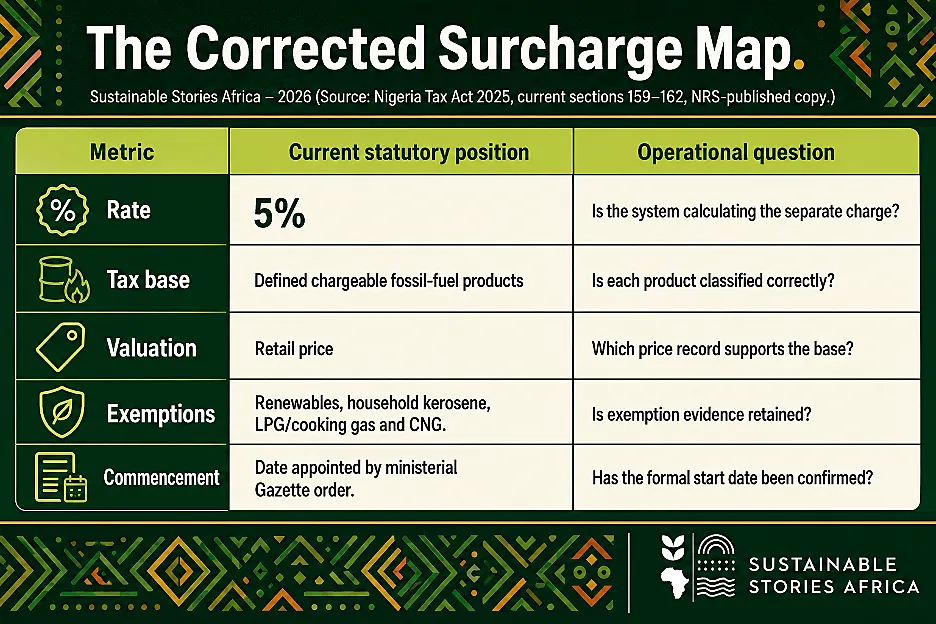
- In the current NRS-published text, section 159 imposes the charge at 5%, while the following provisions define chargeable transactions, administration and exemptions.
- The artwork’s reference to sections 158 – 161 reflects an earlier numbering sequence.
More importantly, the nugget characterises the instrument as a charge on luxury and premium transactions.
That is not the basis in the enacted Act.
- The law focuses on fossil-fuel products supplied or produced in Nigeria.
- Publishing the correction is essential because a luxury-tax narrative would direct compliance teams toward the wrong products, customers and systems.
The transaction trigger is connected to supply, sale or payment, with the relevant point determined by the statutory timing rule.
The surcharge base is linked to retail price.
- These features place the control burden on product classification, point-of-sale data and the sequence of commercial events.
The rate sits in addition to VAT rather than replacing it.
- Businesses therefore need to distinguish the surcharge base from the VAT base and show both clearly in pricing, invoices, ledgers and returns.
- A blended entry may conceal errors and make customer communication harder.
A tax on fossil-fuel products can have effects beyond the first seller.
- Logistics, manufacturing, agriculture and power generation may face higher input costs that appear later in freight rates or product prices.
- Impact analysis should therefore track both direct surcharge collections and indirect cost transmission across essential goods and services.
Clear invoice presentation will matter when the charge starts.
- Customers should be able to distinguish product price, surcharge and VAT, while sellers can reconcile each component.
- Transparency reduces the risk that a statutory charge becomes a hidden margin increase.
Statutory Exemptions Reveal The Policy Direction Clearly
The Act exempts clean or renewable energy products, household kerosene, cooking gas or liquefied petroleum gas, and compressed natural gas.
The list points toward a policy balance: broaden the fiscal signal around fossil-fuel consumption while protecting specified household fuels and alternatives that may support cleaner energy use.
That distinction matters for affordability.
- A uniform surcharge across all energy products could place heavier pressure on households and small businesses.
- Excluding household kerosene, LPG and CNG narrows the burden, although the real distributional outcome will depend on market structure, enforcement and whether price changes are passed through.
For companies with mixed portfolios, exemption governance is central.
- A distributor may sell taxable and exempt products through the same depot, station or enterprise system.
- Product codes, units of measure and pricing tables must distinguish them before the first chargeable transaction occurs.
The environmental signal should also be measured, rather than assumed.
- Policymakers will need data on volumes, prices, household expenditure, fuel switching and revenue.
- If consumers move toward cleaner alternatives without losing reliable energy access, the surcharge can support transition goals.
- If supply constraints block switching, it may operate mainly as a cost increase.
Exemptions can create boundary disputes when products are blended, repackaged or marketed under broad energy categories.
- Technical specifications and regulatory product codes should support the tax classification.
- Commercial names alone may not show whether a product is a taxable fossil fuel or an exempt cleaner alternative.
Formal Commencement Is A Critical Legal Control
The Act does not treat enactment alone as the operational start of surcharge administration.
It provides for commencement on a date appointed through a ministerial order published in the Gazette.
Businesses should therefore verify the formal order and effective date rather than infer liability from commentary, artwork or software updates.
This is a practical cut-off issue.
- Contracts signed before commencement may produce supplies, sales or payments afterwards.
- Finance and legal teams should map the statutory transaction trigger to the formal start date and decide how transition items will be treated.
Pricing communications should be equally disciplined.
- A supplier should not tell customers that a new statutory surcharge applies until the commencement condition is met and its products are within scope.
- Premature collection creates commercial and legal risk; late collection can create an unfunded tax cost.
At the editorial review date, no official Gazette commencement order was identified in the public sources examined.
That is not proof that none exists. Taxpayers should obtain the current Gazette position from the Nigerian Revenue Service or professional advisers before implementation.
The Gazette condition also matters to investors.
- A formally announced start date gives markets time to update contracts, inventories and forecasts.
- Sudden or unclear implementation would increase working-capital pressure and dispute risk.
- Predictable commencement is therefore part of policy quality, not a minor administrative detail.
Inventory held at commencement can create another transition question.
- The company should identify whether the statutory trigger occurred before or after the effective date and preserve batch, purchase and sales records that support the answer.
- A physical stock count, reconciled to product codes and retail prices, can reduce disputes over opening inventory.
- Taxpayers should also document how returns, exchanges and credit notes spanning the start date will be treated.
Prepare Systems Before The Start Date
First,
- Build a product taxonomy.
- List every fuel and energy product, identify the statutory classification, record exemption evidence and assign an accountable owner.
- The taxonomy should feed procurement, inventory, sales and tax engines so the same product is treated consistently.
Second,
- Configure a separate surcharge line.
- The 5% amount should be traceable from transaction to ledger and return. Test retail-price inputs, discounts, bundles, advance payments, credit notes and intercompany movements.
- Exception reports should flag manual overrides and products without classification.
Third,
- Model commercial effects.
- Scenario analysis should show the cost if suppliers absorb the charge, pass it through fully or share it with customers.
- Energy-intensive businesses should model indirect price effects even when they do not sell fossil fuels themselves.
Finally,
- Create a commencement protocol.
- Legal confirms the Gazette order; tax interprets scope; technology activates the configuration; finance reconciles day-one postings; and communications explains the change to customers.
- A controlled activation protects the company from both premature and delayed implementation.
Government should plan a public dashboard before the first collection.
- Useful indicators include taxable volume, exempt volume, revenue, average retail-price movement and adoption of cleaner alternatives.
- Publishing methodology and revisions would help analysts separate the surcharge effect from exchange rates, global oil prices and domestic supply disruptions.
Path Forward – Verify Scope Before Pricing Any Surcharge
The corrected rule is clear in direction: a 5% surcharge on defined fossil-fuel products, with named exemptions and a formal commencement mechanism.
Businesses should verify the Gazette start date, classify products and test systems before changing prices.
Accurate scope is the first sustainability metric because policy cannot work when the wrong transactions are taxed.
EDITOR’S DATA NOTE
This explainer provides general public-interest information. They are not legal, tax, investment or accounting advice. Readers should verify current law, Gazette orders and NRS guidance and obtain advice for specific facts.
Material correction: the current Act targets defined fossil-fuel products, not general luxury or high-value transactions. Current section numbers are 159–162, and commencement depends on a ministerial Gazette order.
LEGAL NOTE: General editorial information only. Tax outcomes depend on current law, guidance and specific facts; obtain professional advice before acting.