Every oil and gas asset has an economic endpoint, but its environmental and financial obligations can continue long after production revenue disappears.
Nigeria's Petroleum Industry Act and supporting regulations require approved decommissioning plans, ring-fenced funding and restoration.
With reported approved liabilities of about $4.42 billion, the quality of cost estimates, escrow arrangements, transaction terms and community participation will determine whether closure becomes restoration or another inherited burden.
Oilfield Closure Begins Before Production Ends
Decommissioning is often imagined as the day a platform is dismantled or a well is sealed.
Nigerian law treats it as a lifecycle obligation that begins while an asset is still operating. Planning, cost estimation and annual funding must start before revenues decline.
This is because closure is most difficult to finance after production has stopped, according to a review by Streamsowers & Kohn.
Section 318 of the Petroleum Industry Act 2021 broadly defines decommissioning and abandonment.
It can include ending operations, plugging wells, shutting installations, removing structures where required, disposing of debris and hazardous materials and restoring affected environments.
The duty is therefore technical, financial, environmental and social at once.
The Nigerian Upstream Petroleum Regulatory Commission oversees upstream activity, while the Nigerian Midstream and Downstream Petroleum Regulatory Authority covers the other parts of the value chain.
Sections 232 and 233 of the Act provide the core architecture for plans, annual funding and regulatory supervision, supported by amended upstream regulations in 2026 and midstream and downstream regulations from 2023.
End-of-Life Costs Now Shape Asset Values
The Streamsowers & Kohn paper reports that regulators have approved 94 decommissioning and abandonment plans since April 2023 with estimated liabilities of about $4.42 billion.
That number signals scale, not certainty. Conceptual estimates can rise when engineers identify well-integrity problems, offshore-vessel needs, hazardous-waste routes or longer monitoring obligations.
Those uncertainties now belong in asset valuation and transaction design.
- A mature field may still produce cash, but its net value can change materially when future plugging, removal, remediation and monitoring costs are recalculated.
Buyers and lenders need more than a headline reserve.
- They need the approved plan, underlying engineering assumptions, contribution history, fund balance, security arrangements and allocation of residual liability.
Divestment does not obscure the physical obligation.
- If an asset moves to a smaller operator with weaker capital or the seller's historic liability is unclear, communities and government can inherit the gap.
- Due diligence must therefore test whether legal transfer, regulatory approval and funding sufficiency move together.
Rules Combine Plans, Funds and Restoration
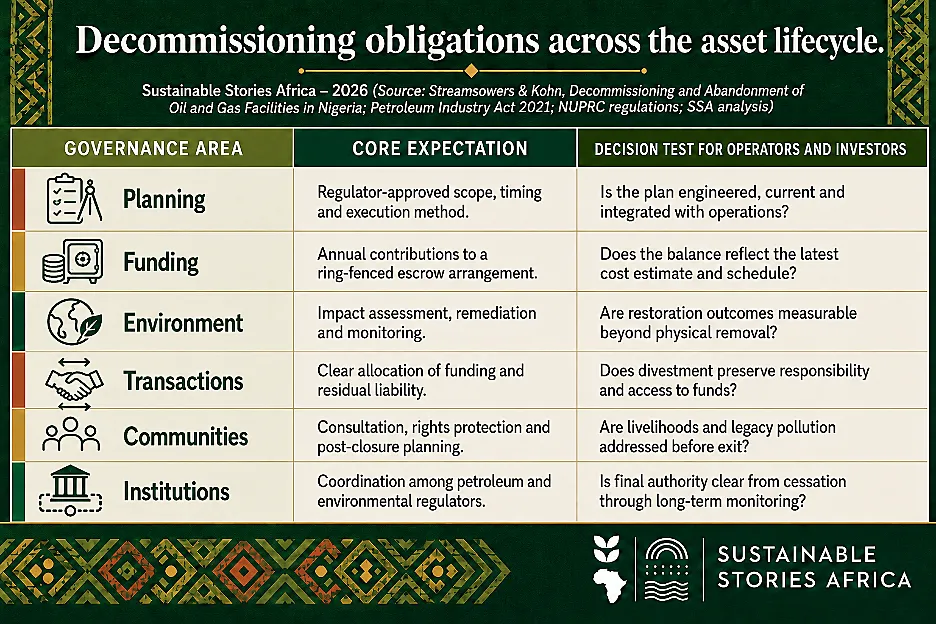
The PIA requires licensees and lessees to prepare regulator-approved plans that set out scope, timing and methods consistent with good international petroleum industry practice.
They must also fund execution through annual contributions to a ring-fenced escrow account at a non-affiliated financial institution accessible to the relevant regulator.
This converts an end-of-life accounting estimate into a present financing obligation.
- It spreads costs across the productive life of the asset and reduces the risk that insolvency, late-stage cash constraints or ownership changes leave government to pay.
- Periodic reviews matter because an escrow balance based on an outdated estimate may create the appearance of readiness without the capacity to execute.
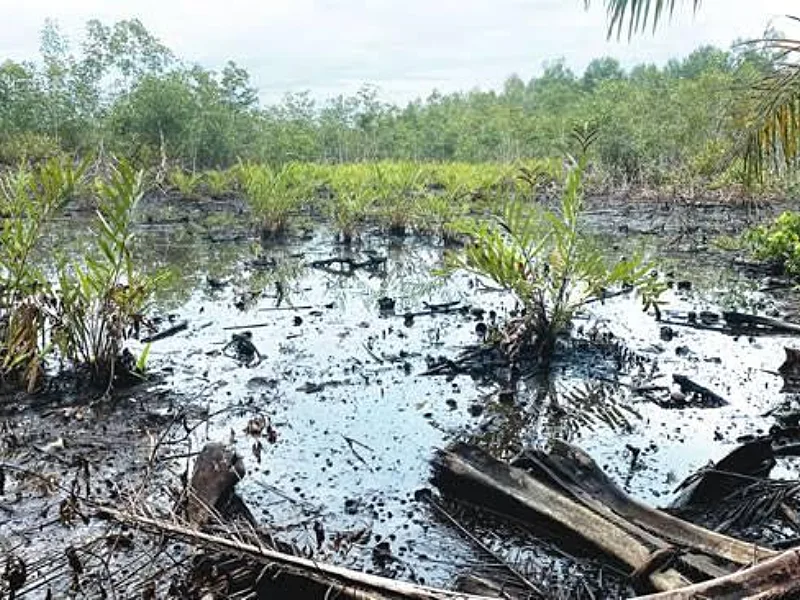
Environmental obligations include impact assessment, remediation planning and post-completion monitoring. Nigeria's history of hydrocarbon pollution makes this central.
- The site is not restored merely because steel has been removed.
- Contaminated soil, residual hydrocarbons, waste, water quality and long-term well integrity must be addressed, with clear handover from petroleum regulation to environmental oversight.
Responsible Closure Can Build Local Value
Good decommissioning is not only a cost; it generates work across engineering, marine services, well plugging, environmental testing, waste management, fabrication and materials recovery.
- The UK's Brent Delta platform illustrates this: over 97% of its material was reportedly recycled, supporting hundreds of local jobs during dismantling.
- Nigerian projects could similarly boost domestic recycling and reduce landfill demand if procurement, quality standards and material tracking are built into planning early.
Responsible closure also reshapes relationships with host communities.
While Chapter 3 of the PIA establishes Host Community Development Trusts during operations, the end of production alters jobs, contracting patterns and local revenue expectations, making advance communication about closure schedules, restoration and land use essential.
Article 24 of the African Charter on Human and Peoples' Rights, as domesticated in Nigeria, reinforces the right to an environment favourable to development, turning decommissioning into a test of genuine ecological and social repair rather than a paper exit.
The paper also links section 86 of the Nigeria Tax Act 2025 to escrow-based deductibility, adding tax-planning implications that operators should verify alongside PIA requirements.
Operators Must Integrate Liability Across Transactions
Boards require annual decommissioning assurance covering engineering estimates, inflation, execution timing, escrow balances, investment returns, regulatory correspondence and environmental commitments.
- Scenario analysis should test cost escalation, accelerated cessation, contractor failure and buyer default.
Asset sales should include a liability map that separates historic contamination, future operational damage, statutory funding, execution responsibility, tax treatment and post-closure monitoring.
- Contractual indemnities are useful only when backed by solvent parties, credible security and enforceable access to funds.
Regulators should publish aggregated data on plans, cost revisions, funded ratios, inspections and completed work while protecting legitimate commercial confidentiality.
- They should also establish a single coordination protocol among NUPRC, NMDPRA and NOSDRA for incident reporting, remediation and the transition to long-term environmental supervision.
A proposed National Commission for Decommissioning of Oil and Gas Installations has been presented as a route to consolidation. The paper warns that a new agency could duplicate existing PIA functions, omit parts of the value chain and create a second funding structure.
Any institutional reform should demonstrate a gap that cannot be enhanced through coordinated implementation or targeted amendment of the PIA.
Path Forward – Closure Governance Must Outlive Production Revenues
Nigeria has moved decommissioning from a distant engineering problem to present-day project governance.
The next test is whether approved plans remain funded, environmental outcomes are verified, and liabilities survive changes in ownership.
Operators should update costs and escrow contributions throughout asset life; regulators should coordinate and disclose performance; communities should participate before closure decisions.
A credible exit is one in which the well is secure, the land is restored, and the financial responsibility never disappears.