Low Earth Orbit satellites are turning space-based connectivity into a retail communications service, capable of reaching people far beyond terrestrial network footprints.
Nigeria already has licensing, security and equipment rules, but direct-to-device services raise new questions about consumer rights, emergency access, local presence, cross-border data and regulatory parity.
A future-ready regime must expand access without creating a lighter accountability track.
Nigeria's Satellite Opportunity Outruns Existing Rules
According to a review by Streamsowers & Kohn of the GSMA-launched playbook, ‘Satellite Regulatory Playbook,’ satellite connectivity is no longer only a wholesale service linking broadcasters, governments and specialist users.
Low Earth Orbit constellations can sell broadband directly to homes and businesses, as well as direct-to-device services that promise links to ordinary phones in places where towers are unavailable, unreliable or uneconomic.
That shift matters in Nigeria, where difficult terrain, infrastructure costs and coverage gaps can leave rural and remote communities on the wrong side of the digital economy.
Satellite services can complement terrestrial networks, strengthen resilience when cables or towers fail and extend emergency communications into hard-to-reach areas.
The regulatory challenge is that a service delivered from space can increasingly look like an ordinary telecommunications service on the ground.
- Consumers still need honest pricing, reliable performance, complaint channels, data protection and emergency support.
- Competitors still need fair market rules. Government still needs enforceable security and public-safety safeguards.
LEO Services Blur Old Regulatory Boundaries
The GSMA Satellite Regulatory Playbook, launched in London on 24 June 2026, advances a technology-neutral principle:
- Comparable services should receive comparable regulatory treatment, regardless of underlying infrastructure.
Developed with Access Partnership, the Playbook draws on GSMA's mobile ecosystem of nearly 800 operators and over 300 related companies.
Crucially, it offers guidance rather than a uniform code, expecting governments to adapt it to national laws, market structures and connectivity priorities.
This flexibility matters for Nigeria, which already regulates commercial satellite activity through the Nigerian Communications Act 2003, the Commercial Satellite Communications Guidelines 2018, and related licensing, consumer, data and cybersecurity rules, as well as a 2020 Draft Commercial Satellite Communications Regulations instrument that signals further reform.
The real question isn't whether Nigeria has rules, but whether frameworks predating mass-market direct-to-device services can govern a borderless retail network with distinctly local consequences.
Notably, the Playbook avoids prescribing spectrum policy, preserving adaptability amid shifting use of licensed, shared and unlicensed bands. However, this leaves regulators with the challenge of aligning access, interference control and international obligations without locking in an obsolete spectrum model.
Eight Pillars Frame a Modern Regime
The Playbook structures regulatory oversight around eight pillars:
- Local establishment.
- National security.
- Consumer protection and operations.
- Infrastructure and facilities.
- End-user terminals.
- Fiscal obligations.
- Emergency services
- Enforcement.
Five broader principles predictability, regulatory parity, harmonisation, consultation and balanced innovation underpin this framework.
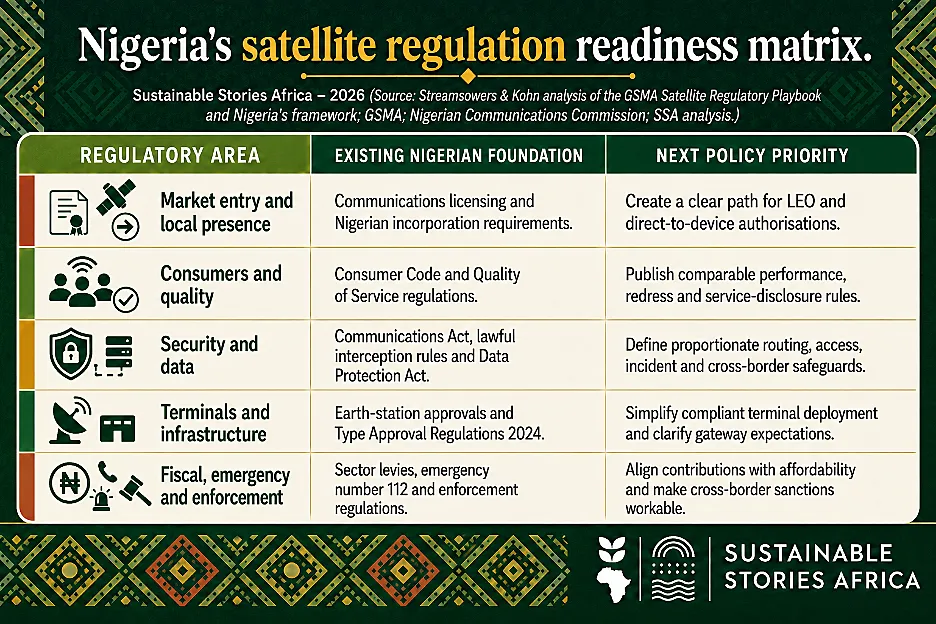
Nigeria already aligns with much of this architecture. Section 31 of the Communications Act mandates authorisation to operate communications systems or services, while licensing rules and satellite guidelines generally require Nigerian corporate presence for relevant licences and earth-station approvals.
Type-approval rules govern equipment before installation or sale, and broader laws address data protection, lawful interception, cybersecurity and consumer rights.
The real gaps emerge in applying these rules to new service models. Satellite operators selling directly to Nigerians may have infrastructure, gateways and decision-making distributed across multiple countries, forcing regulators to clarify local accountability, cross-border data transfers and complaint handling.
Consumer experience should remain the common measure: pricing clarity, verifiable service speeds, functional local complaint escalation and fraud-resistant registration, ensuring equivalent, enforceable protection regardless of network design.
Better Rules Could Widen Reliable Access
The development opportunity is substantial.
- Direct satellite links could connect schools, health facilities, farms, logistics operators and small businesses where terrestrial deployment takes too long or offers weak commercial returns.
- Satellite back-up can also improve national resilience during floods, conflict, cable outages or power disruptions.
Domestic interconnection matters.
- The source paper notes internet exchange points across seven states and argues that satellite operators with local points of presence can exchange Nigerian traffic more efficiently.
- Local peering may reduce latency and international transit costs while improving resilience and regulatory visibility.
It is not the same as a satellite gateway, but it can integrate space-based access with Nigeria's digital ecosystem.
Infrastructure sharing offers another gain.
- Operators can share passive assets such as sites, buildings, power and security while retaining control of active radio systems.
- This can reduce duplication and capital cost, provided sharing remains technically and commercially feasible.
Affordability must remain part of the design.
- The Annual Operating Levy framework can require relevant network operators to pay 2.5% of net revenue.
- Licensing, spectrum, equipment certification, taxes and universal-service contributions can support legitimate public objectives.
However, layered charges should not price the hardest-to-connect communities out of access to the solution.
Nigeria Needs Proportionate Technology-Neutral Oversight Now
The Nigerian Communications Commission should update the satellite framework through a transparent consultation to cover LEO broadband and direct-to-device services.
The process should define when a foreign constellation needs a local entity, which licence applies, how terminals are activated, what service metrics must be disclosed and how complaints are resolved.
Security rules should be technically realistic and rights-respecting.
- They should specify lawful access, cyber-incident reporting, cross-border data conditions and any gateway or routing requirements without mandating architecture that makes service unnecessarily costly or fragile.
- Emergency obligations should explain how satellite users reach 112, how location information is handled and what continuity standards apply where technically feasible.
Regulatory parity should mean equivalent outcomes, not identical engineering.
- A satellite provider should not escape consumer or public-safety duties, but neither should it be forced into rules designed exclusively for tower-based networks.
Periodic fee reviews, regulatory sandboxes and joint work among the NCC, data-protection authorities, security agencies and emergency services can keep oversight aligned as technology evolves.
Path Forward – Connectivity Must Expand With Public Trust
Nigeria can use satellite services to close coverage gaps, strengthen emergency resilience and give underserved communities a faster route into the digital economy.
The opportunity will last only if consumers trust the service and investors understand the rules.
The path forward is a technology-neutral framework with clear market entry, enforceable local accountability, proportionate security, transparent service quality and affordable deployment.
Space may carry the signal, but Nigerian institutions must still protect the people receiving it.