
Nigeria's Supreme Court has drawn a firm institutional line around presidential clemency during a pending death-sentence appeal, insisting that the judicial process must be allowed to finish.
An SSKohn analysis argues that the Constitution contains no express timing restriction.
The disagreement exposes a deeper question: can courts protect appellate authority without narrowing a mercy power deliberately written in broad terms?
Mercy and Appeal Collide Before Court
Maryam Sanda's case placed two constitutional powers on the same track.
- One was the Supreme Court's authority to determine an appeal against a conviction and death sentence.
- The other was the President's power under section 175 of the Constitution to pardon, grant respite, commute punishment or remit a penalty after consultation with the Council of State.
According to the legal paper review by Streamsowers & Kohn, Sanda was convicted of murdering her husband, Bilyaminu Bello, and sentenced to death.
After the Court of Appeal upheld the conviction, the Supreme Court heard her further appeal on 2 October 2025 and reserved judgment for 12 December.
Between those dates, a presidential instrument reportedly commuted the death sentence to 12 years' imprisonment on compassionate grounds.
When judgment was pronounced, the Court dismissed the appeal, affirmed the death sentence and rejected the propriety of granting mercy while the appeal was pending.
That sequence turned an individual criminal case into a wider debate about institutional boundaries.
A Commutation Arrived Before Final Judgment
Precision in constitutional vocabulary shapes how clemency operates.
A pardon removes legal consequences broadly; a respite delays execution; commutation substitutes a lesser punishment; remission cancels all or part of a penalty.
Conflating these forms of mercy obscures whether an executive act touches the conviction, the sentence, the timing of punishment, or all three.
The Court's concern centres on jurisdiction.
An appeal over an affirmed death sentence falls within its constitutional remit, with outcomes ranging from acquittal to retrial or dismissal, none predetermined.
Executive intervention before judgment risks pre-empting this process or signalling that judicial review no longer matters.
The judgment's metaphor of a judicial aircraft in final descent that the executive should not close the airspace before it lands captures a separation-of-powers principle:
- Guilt and conviction validity are judicial questions, while clemency, though executive, acts on judicially imposed punishment.
This distinction reinforces institutional caution, since a premature commutation could extinguish a pending appeal and deny a convict the chance to clear their name or secure a retrial.
Victims and their families also hold a stake in an orderly process.
Even where executive discretion is constitutionally broad, unexplained intervention during a reserved judgment can erode confidence, making reasons, records and notice essential to a defensible mercy system.
The Court Protected Its Judicial Airspace
The SSKohn paper, however, questions whether prudence can become a constitutional prohibition.
Section 175 applies to a person "concerned with or convicted of" an offence and does not expressly say the power is suspended during an appeal.
Its stated procedural condition is consultation with the Council of State, rather than exhaustion of judicial remedies.
The paper's central argument is that commutation changes punishment, not guilt.
- A pending appeal remains live because the appellant may still seek to overturn the conviction, even if the executive has reduced the sentence.
- On that view, mercy and review can operate in parallel: the Court determines legal correctness, while the President acts on compassion, public interest or other considerations outside the judicial record.
The competing positions can be stated without pretending the answer is simple.
The Council of State consultation requirement is central to that balance.
- Consultation should be more than a formal entry on an instrument.
- An advisory record should identify the offence, procedural status, humanitarian or public-interest basis, representations considered and anticipated effect on any live appeal.
Better process cannot answer the constitutional question in itself, but it can reduce the risk that mercy appears arbitrary or politically selective.
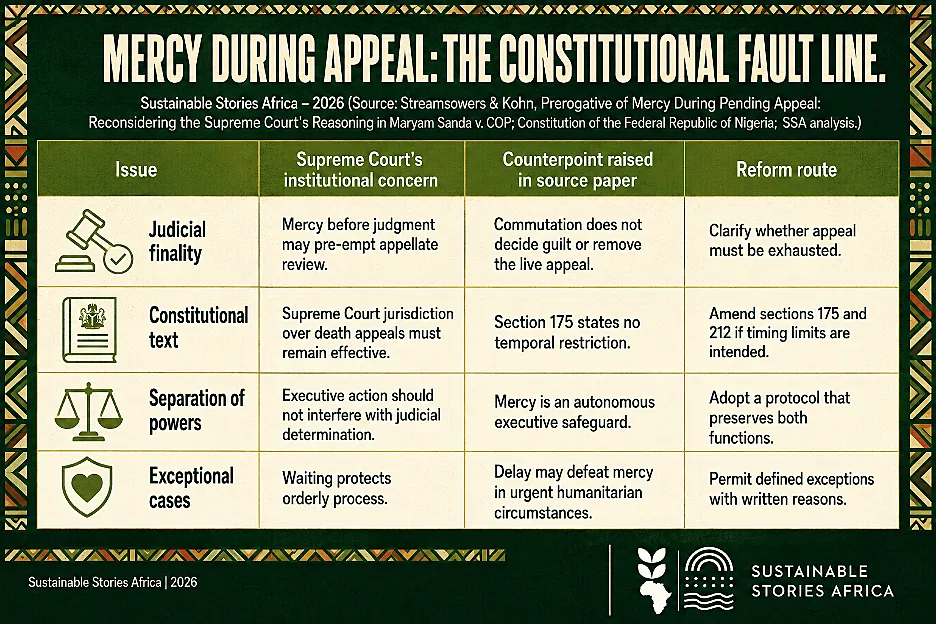
Constitutional Clarity Could Reduce Institutional Conflict
Clear rules would protect more than presidential and judicial prestige.
- They would protect defendants, victims' families and public confidence. A convict should know whether accepting commutation affects an appeal.
- Victims should know whether clemency changes only punishment or also the status of the judicial decision.
- The executive should know when consultation and documentation are sufficient, while courts should know that their jurisdiction cannot be displaced by ambiguity.
A well-designed framework could preserve a general presumption that clemency follows final appeal while retaining narrow exceptions.
Those exceptions might cover terminal illness, manifest humanitarian urgency or an execution risk that cannot await ordinary timelines.
Any departure should be reasoned, published to the extent legally permissible and accompanied by a statement that the pending appeal remains unaffected unless the appellant elects otherwise.
The issue also applies to state governors because section 212 grants a parallel power of mercy for state offences.
A national solution should therefore avoid one rule at the federal level and another across states.
Reform Should Separate Power From Timing
The strongest long-term option is constitutional clarification.
- If Nigeria intends presidential or gubernatorial mercy to wait until appeals are exhausted, the Constitution should say so.
- That would transform judicial caution into a democratically authorised rule and define any exceptions.
Short of amendment, the Presidency, the Council of State, state advisory bodies and judiciary can develop procedural guidelines.
These should require a check for pending proceedings, notice to the relevant court, confirmation that clemency does not determine guilt, and a clear record of whether the convict wishes to continue the appeal.
Advisory bodies need legal expertise, independent documentation and criteria capable of withstanding public scrutiny.
Courts should also distinguish three questions more explicitly:
- Whether clemency is constitutionally valid
- Whether its timing is institutionally improper
- Whether it affects the court's jurisdiction.
Treating those questions as identical risks creating a restriction by inference where the constitutional text remains broad.
Path Forward – Rules Should Protect Mercy and Review
Maryam Sanda's case shows why mercy cannot be administered as a surprise intervention.
The executive safeguard is most legitimate when its procedure is transparent, and its effect on pending litigation is understood.
Nigeria should clarify the timing rule, preserve exceptional humanitarian capacity and protect every appellant's right to judicial review.
The goal is not to make one branch subordinate to another, but to ensure that mercy and justice operate without cancelling each other.