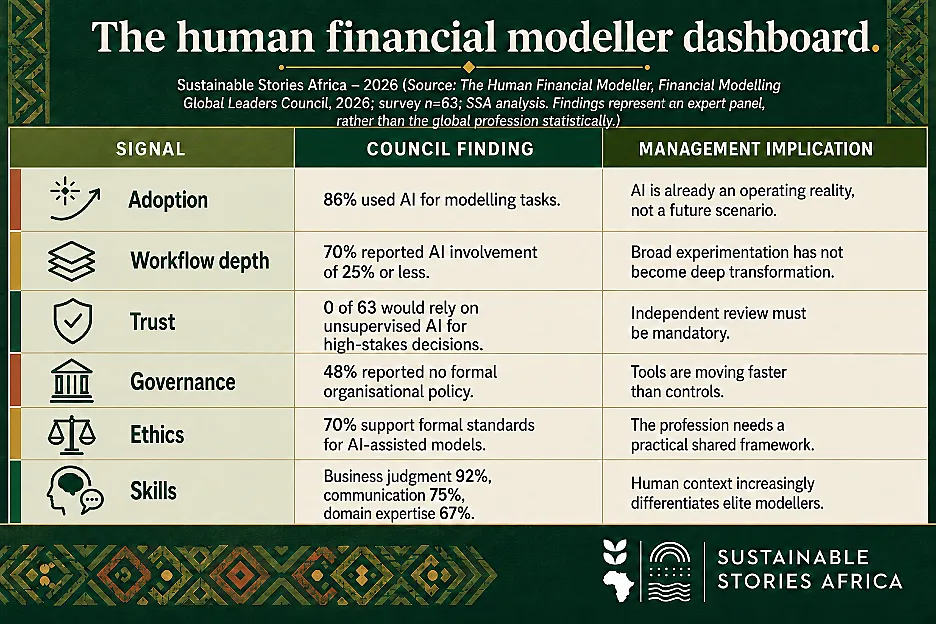
Artificial intelligence has entered financial modelling faster than governance has adapted. 86% of a global expert council used AI for modelling in the past year; however, adoption remains shallow, and productivity gains are limited.
The strongest message is about trust: none of the 63 experts would rely on an AI-generated model for a high-stakes decision without independent human review.
Construction may automate; accountability cannot.
AI Enters Finance Without Taking Control
Financial models influence investments, lending, budgets, infrastructure bids and strategic decisions. As generative AI learns to write formulas, clean data and document logic, the profession faces a question more important than speed: who understands the model well enough to challenge it and accept responsibility for the decision it supports?
The Human Financial Modeller, the inaugural report of the Financial Modelling Global Leaders Council, surveyed 63 professionals across 26 countries and five continents.
All members completed a 30-question survey in May 2026. The panel is highly experienced; 92% have more than a decade in the field; however, it is an expert council, rather than a statistically representative sample of modellers.
Its findings resist both automation hype and professional denial.
AI is already part of the workflow; however, it has not taken the chair.
- Human value is moving away from mechanical construction and towards purpose, assumptions, interpretation, communication and sign-off.
Adoption Is Broad but Productivity Shallow
86% of council members used AI for a modelling task during the previous year.
- The most frequently cited tools included Microsoft Copilot, ChatGPT, Claude and specialist platforms.
16% used AI several times daily
40% used it a few times each week
21% had tried the tools but no longer used them regularly.
The breadth of adoption masks limited integration.
- 43% said AI touched no more than 10% of their workflow
- Another 27% placed involvement between 11% and 25%.
- 4 respondents reported AI involvement between 76% and 100%; however, they were outliers.
Productivity is similarly mixed.
- 30% reported no measurable time savings
- 19% saved less than 10%.
- Only 14% reported savings above 30%
Some experts valued AI differently: not as a shortcut, but as capacity for deeper audits, first-pass reviews and more granular analysis within the same working time.
The report's own production reflected that position.
- AI assisted in survey analysis, drafting and visual concepts
- Humans reviewed and approved every finding, interpretation and conclusion.
Judgment Moves Up the Value Chain
The council ranked six stages of a modelling lifecycle: Scope, Specify, Design, Build, Test and Handover.
- 63% placed Scope, that is, defining the model's purpose, users and decisions, first for human criticality.
- Only one respondent ranked Build first.
- The average ranking put Scope at 1.81 and Build last at 4.86.
AI is expected to help most with formula writing and calculation logic, selected by 62%, and data gathering, cleaning and preparation, selected by 57%.
Those are valuable gains, but they also automate the tasks through which junior analysts traditionally learned how businesses, accounting relationships and model architecture fit together.
The line around responsibility was much firmer.
- 90% said sign-off should never be fully delegated to AI
- 86% said the same about ethical judgment.
- Most strikingly, zero of 63 agreed that they would feel confident using an AI-generated financial model for a high-stakes decision without independent human review.
- 75% strongly disagreed
- 22% disagreed.
- 3% were neutral.
Governance Can Turn Tools Into Trust
The governance gap around AI in model development is no longer theoretical.
- 48% of respondents said their organisations had no formal AI policy
- 19% reported one still in development.
- 16% described their policy as clear and documented.
On review, opinions converge on necessity but diverge on scope:
- 52% wanted full examination of assumptions, accounting treatment and output plausibility for AI-generated or materially altered models
- 27% preferred a risk-based approach tied to use case and materiality.
Accountability remains unresolved. Responsibility splits nearly evenly;
- 25% pointing to the human modeller
- 22% shared accountability
- 21% the organisation
- 19% the model owner or sponsor
- 13% the AI developer.
An even spread that risks leaving plausible errors unowned.
Disclosure is advancing faster: 84% supported at least some user notice when AI substantially shaped a model, and three-quarters expect regulators will eventually mandate formal disclosure.
The dominant risks are human-centred:
- Reduced understanding (59%)
- Hidden logic (51%)
- Automation bias (48%)
- Skill atrophy (46%).
This reflects fear rather than just an AI error, but of diminished capacity to catch it.
Organisations Must Redesign Review and Training
Finance leaders should classify models by decision impact, complexity, data sensitivity, and the degree of AI involvement, with each class assigned a minimum review standard, a model owner, an independent reviewer, sign-off authority, disclosure rule and retained audit evidence.
Full review should remain the default for financing, valuation and public reporting.
Teams also need an AI use register to track the tool, version, instructions, data provided, model components affected and validation performed, while confidential information must stay out of unapproved systems and model logic remain explainable to accountable humans.
Training poses the harder challenge.
- 94% said hand-building remains essential for financial judgment
- 48% wanted juniors to master manual construction before using AI
However, 65% believed AI can already pass a typical entry-level modelling interview task, pointing to a need for apprenticeships blending fundamentals with AI-assisted review.
The profession expects transformation, not disappearance:
- 62% forecast significant AI-assisted modelling within a decade
- 29% forecast a gradual shift
- 5% expect replacement.
Career sentiment is split, with 48% anticipating downward pressure and 37% upward opportunity.
Path Forward – The Future Still Requires Accountable Humans
AI will write more formulas, prepare more data and generate more first drafts.
The durable value of the modeller will lie in defining the question, challenging assumptions, explaining consequences and signing the answer.
Organisations should act now: risk-tier reviews, assign accountability, document AI use and preserve hands-on training.
The model of the future may be built faster, but trust will still depend on a human who understands it and is willing to answer for it.