
Nigeria's transition guidelines explain when the repealed tax laws cease to govern a return, transaction, contract, incentive or dispute and when the four Tax Acts 2025 take over.
The framework reduces uncertainty, but basis-period rules, split contracts, digital filing and statutory savings provisions can still produce conflicting outcomes.
Taxpayers now need evidence capable of showing not only what happened, but precisely when.
Nigeria's Tax Reset Gets Operating Rules
Nigeria's new tax system needed more than commencement clauses. It needed a bridge between transactions completed under the repealed laws and filings, payments or disputes continuing after 1 January 2026.
The General Transition Guidelines for the Tax Acts 2025, issued by the Federal Government on 18 June 2026, attempt to provide that bridge.
The Guidelines cover the implementation of the Nigeria Tax Act 2025, Nigeria Tax Administration Act 2025, Nigeria Revenue Service (Establishment) Act 2025 and Joint Revenue Board (Establishment) Act 2025.
They apply across the Nigeria Revenue Service, state and Federal Capital Territory revenue services and local government structures.
According to a review by Streamsowers & Kohn, their organising principle is prospective application.
- A taxpayer should not face a new burden, penalty, interest charge or filing obligation for an activity completed before commencement. That sounds simple.
- In practice, different taxes attach to different moments: income may be earned in one period and filed in another; a contract may be signed before commencement but executed later; a dispute may concern an old assessment but begin under a new procedure.
Timing Now Determines the Applicable Regime
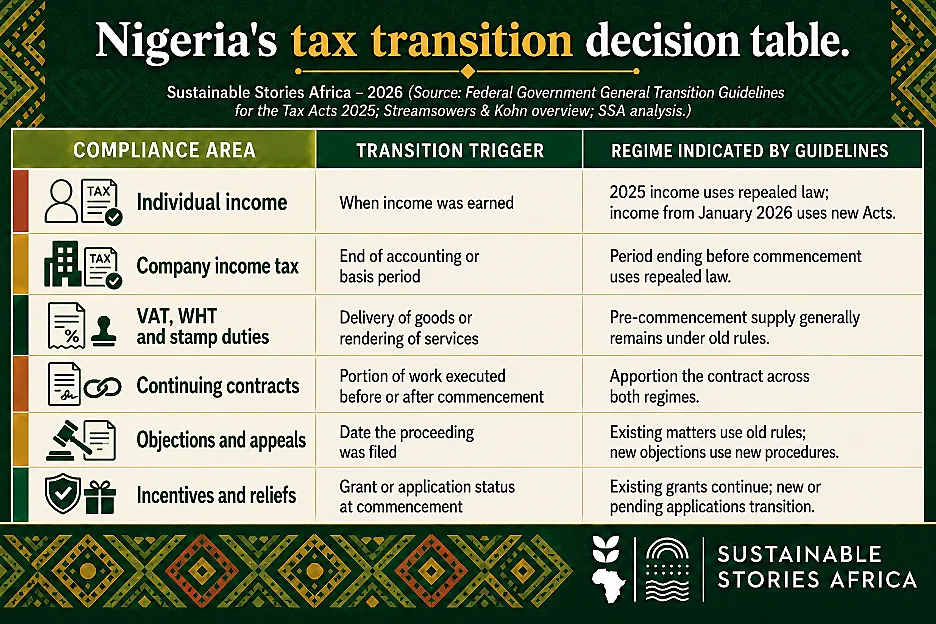
The Guidelines distinguish the due date of a return from the period that creates the liability.
- Returns due before commencement use the old rules and forms.
- Returns due on or after commencement generally move to the new system.
- However, the underlying income or transaction may still belong to the repealed regime.
For employees, PAYE and final filings for 2025 income remain governed by the repealed legislation, even if processed in 2026.
Compensation earned from January 2026 moves to the new rates and structure.
- Individuals under direct assessment follow the same logic.
- 2025 income filed in 2026 stays under the old law, while income earned after January 1, 2026 falls under the Tax Acts.
Companies are tested by accounting or basis period.
- A period ending before 1 January 2026 remains under the repealed legislation.
- One ending on or after that date is governed by the new Acts.
The paper notes that a taxpayer may seek written approval from the relevant authority to use the new rules for a period ending before commencement.
The distinction matters because a filing platform that defaults to the year of assessment rather than the basis period could be computed against the wrong regime, flag a false penalty or force manual workarounds.
Returns, Contracts and Disputes Split Differently
Transaction taxes follow the underlying supply.
- Goods delivered or services rendered by 31 December 2025 remain under the repealed VAT, withholding-tax and stamp-duty rules, regardless of when cash is paid.
- Supplies from January 1, 2026 use the new Acts, except where an advance payment was already made before that date.
Long-running contracts require apportionment.
- If a contract was signed before commencement but work continued after it, the portion executed before the date stays under the old law and the later portion moves to the new framework.
The same evidence may have to support several questions:
- When the obligation arose
- When performance occurred
- When an invoice was issued
- When payment was received.
Disputes create another boundary.
- The Guidelines say pending objections and appeals filed before commencement should conclude under the repealed legislation.
- New objections filed after commencement follow the new procedures even when the assessment year is older.
The SSKohn paper flags a possible inconsistency with statutory savings clauses covering enforcement and legal proceedings.
That tension should be resolved through authoritative clarification, rather than by a case-by-case scenario left to taxpayers and tribunals to reconcile.
Clarity Could Protect Compliance and Cashflow
The Guidelines can reduce disputes by giving taxpayers a consistent way to identify the governing law.
- They preserve existing incentives until expiry.
- Retain old record-keeping duties for the required statutory period and prevent new obligations from reaching backwards.
- Where definitions, circulars or residual rules conflict with the new Acts, the Acts prevail to the extent of inconsistency.
The paper also highlights a taxpayer-protective interpretive principle:
- Where provisions within the new framework are clearly inconsistent, the resolution should favour the taxpayer.
- Broader interpretation should reflect legislative intent, economic neutrality and administrative simplicity.
For businesses, certainty protects cash flow.
- Applying a higher rate, a different deduction rule or a new penalty to the wrong period can distort tax provisions, contract margins and working-capital plans.
- Clear transition treatment also helps investors compare earnings across the reform boundary and gives auditors a defensible basis for recognising current and deferred tax positions.
The benefit depends on administrative systems reflecting the legal logic.
- If electronic forms, schedules and validation rules do not recognise basis periods, apportioned contracts and preserved incentives, written guidance will not prevent operational error.
Taxpayers Need Evidence Systems and Escalation
Companies should build a transition register that maps each tax type, entity, basis period, contract and pending dispute to the applicable regime.
Contracts spanning commencement should be supported by evidence, including milestones, delivery records, acceptance certificates, invoices and payment evidence of reproducible apportionment.
Payroll teams should separate 2025 obligations from compensation earned after January 2026.
Tax and finance teams should reconcile filing-platform outputs with the regime identified in the Guidelines before submission.
- Where the platform produces a different result, taxpayers should preserve screenshots, computations, correspondence and the legal basis for the position taken.
The NRS and other authorities should publish aligned forms, examples and validation rules, together with a penalty-free correction or grace window for genuine transition errors.
A central escalation channel should address system mismatches quickly, and any clarification on disputes should explain how the Guidelines interact with the savings clauses in the Acts.
Path Forward – Implementation Must Preserve Certainty and Fairness
Nigeria's transition rules are valuable because they translate reform into dates, periods and evidence.
They will succeed only if the digital system and administrative practice apply those distinctions consistently across federal, state and local levels.
The next priority is alignment: update filing tools, resolve the dispute-rule tension, publish practical examples and protect taxpayers acting reasonably during the changeover.
A modern tax system earns confidence when its rules are prospective, its platforms are accurate, and its remedies are accessible.