
Nigeria allows qualifying corporate donations in cash or kind to reduce taxable profit, but the deductible amount cannot exceed 10% of profit before tax for the year.
Purpose alone is insufficient: recipient eligibility, valuation and documentary evidence determine whether generosity becomes a lawful tax deduction.
Generosity Works Best With Strong Evidence
FinPolNomics Green Finance originated the Tax & Transfer Pricing Nugget behind this explainer, highlighting the 10% ceiling on qualifying corporate donation deductions and the need for evidence.
Sustainable Stories Africa expands its insight using its Metrics and Insights & Data standards, connecting the percentage cap to recipient eligibility, in-kind valuation, governance and social-impact reporting.
The rule can support responsible corporate giving, but it does not convert every charitable payment into a deduction.
The company must establish that the recipient and purpose qualify, value the donation correctly and retain records strong enough to survive review.
The Donation Deduction Has Clear Guardrails
The Nigeria Tax Act 2025 permits a company to deduct qualifying donations made during a year of assessment, whether the gift is revenue or capital in nature.
The relief covers specified public funds and bodies, approved religious, charitable, educational or scientific institutions in Nigeria, qualifying bodies under diplomatic-immunity legislation, and approved pandemic or disaster interventions.
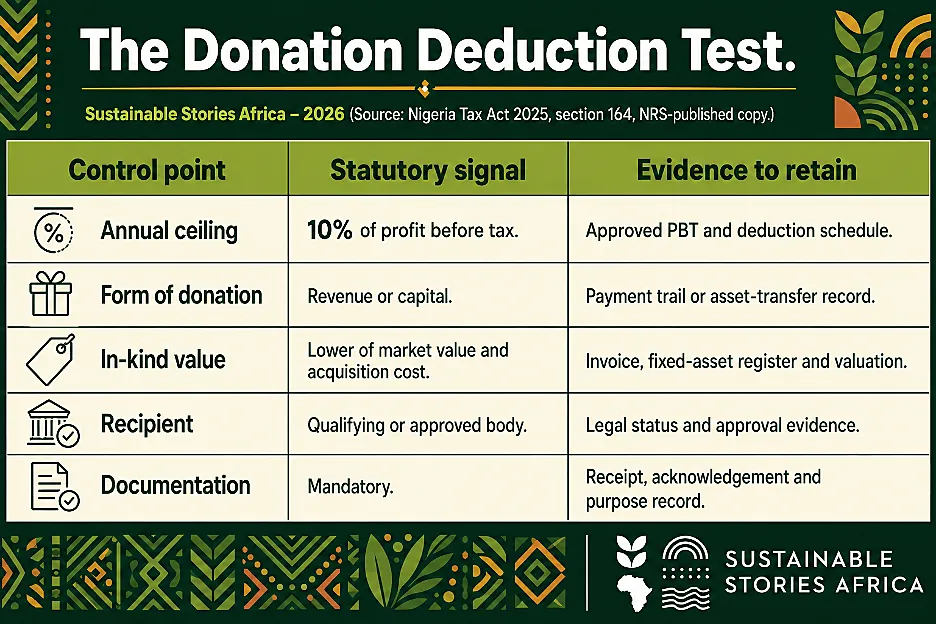
The amount allowed is capped at 10% of the company’s profit before tax for that year.
- The ceiling is annual and company-specific.
- A generous gift does not create an unlimited deduction, and the accounting description of a payment does not decide its tax treatment.
For an in-kind donation, valuation is also constrained.
- The deductible amount is based on the lower of market value and acquisition cost under the statutory rule.
- That prevents a company from claiming an inflated deduction because an asset has appreciated or because an internal valuation is optimistic.
A technical correction is necessary.
- The FinPolNomics nugget cites section 163, reflecting an earlier numbering sequence.
- In the current NRS-published Nigeria Tax Act, the donation provision is section 164.
- The underlying 10% message remains, but publication-quality tax reporting must use the current cross-reference.
The cap also guards the tax base against circular or connected-party arrangements presented as philanthropy.
Governance teams should screen related parties, founder-linked organisations and situations in which the donor receives a commercial benefit.
Where a payment buys advertising, access or services, its treatment may need analysis under ordinary business-expense rules rather than the donation provision.
Recipient Status Determines The Final Tax Treatment
The first due-diligence question is not how worthy the cause appears, but whether the recipient falls within a statutory category.
- A company may support a community initiative for sound social reasons and still fail the tax test if the payment is made to an unqualified intermediary or if approval requirements are not met.
Before payment, the donor should verify the recipient’s legal identity, registration, mandate and any required government approval.
- The beneficiary named in a corporate social-responsibility proposal should match the entity on the bank account and receipt.
- Where an implementing partner sits between the company and final beneficiaries, the agreement should explain the flow of funds and the partner’s role.
Pandemic and disaster interventions require additional care because urgency can weaken normal controls.
- A rapid response should still record the declared event, authorised intervention, recipient, purpose and delivery evidence.
- Emergency does not eliminate accountability; it increases the need for a concise decision trail.
These checks protect both the deduction and the social objective.
- When recipient identity and purpose are clear, stakeholders can see where resources went, auditors can test the claim, and the company can assess whether the contribution produced the intended public benefit.
Cross-border donations deserve separate review because the statutory categories focus on specified Nigerian institutions and approved interventions.
- A global group policy cannot assume that a recipient accepted elsewhere qualifies in Nigeria.
- The Nigerian taxpayer should document the local legal basis even when the group’s foundation selects the programme.
The Annual Cap Shapes Corporate Giving Strategy
A 10% cap encourages planning across the financial year. If profit before tax is N2 billion, the maximum qualifying deduction is N200 million.
- A company can donate more, but the excess does not automatically become deductible under this provision.
- Boards should separate the social value of additional giving from the tax effect.
Profit volatility matters.
- A commitment negotiated early in the year may be affordable operationally but exceed the deduction ceiling if earnings fall.
- Finance teams should model the cap under base, downside and recovery scenarios, while corporate-affairs teams preserve the independence of social priorities from short-term tax optimisation.
The best approach is a board-approved giving framework that distinguishes statutory deductibility, programme impact and reputation.
- Each proposed donation can be scored against recipient qualification, strategic relevance, expected outcomes, evidence quality and the remaining annual cap.
- That makes decisions consistent without reducing community needs to a tax calculation.
Companies should also avoid fragmenting a single programme into multiple payments merely to make it look different. The ceiling applies to the aggregate qualifying amount for the year.
- A consolidated donation register is therefore essential across subsidiaries, business units and foundations whose transactions may affect the same taxpayer.
Multi-year commitments should distinguish the promised total from amounts actually donated in each assessment year.
- The annual deduction follows qualifying donations made in the year and the year’s profit-before-tax ceiling.
- A memorandum of understanding may create social expectations, but it does not by itself establish the timing or amount of the tax deduction.
Turn Every Corporate Donation Into Durable Evidence
A defensible file starts with approval.
- Retain the proposal, due-diligence report, legal basis, delegated authority and conflict-of-interest checks.
- The payment or asset transfer should then be linked to a receipt or acknowledgement that identifies the donor, recipient, amount or asset, date and purpose.
For non-cash gifts, preserve acquisition invoices, asset register extracts, condition reports, transfer documents and the valuation method.
- Where market value is lower than cost, the lower figure drives the deduction.
- Where cost is lower, an external appraisal cannot increase the claim beyond cost.
After delivery, collect outcome evidence proportionate to the programme: beneficiary counts, completion certificates, photographs with appropriate consent, usage data or an independent report.
These materials do not replace statutory proof, but they connect tax relief to real-world impact and discourage donations that exist only on paper.
At year-end, reconcile the donation register to the general ledger, calculate the 10% ceiling from approved profit before tax and identify any non-deductible excess.
- The tax computation should show the treatment transparently.
- A reviewer should be able to move from the return to the payment and from the payment to the public-purpose result.
Impact teams can strengthen the control by agreeing outcome indicators before disbursement.
- The indicators should be proportionate and should not burden small community organisations with corporate-scale reporting.
- A clear baseline, delivery milestone and acknowledgement of funds can often provide enough assurance while preserving the dignity and agency of beneficiaries.
Tax reviewers should sample donations across value, geography and programme type rather than testing only the largest payment.
Repeated small transactions can expose systemic gaps in approval or documentation.
The review result should feed training and future partner selection.
Give Boldly, Document Every Public Benefit
The rule supports corporate generosity without abandoning fiscal discipline.
- Companies should verify recipients before payment, monitor the 10% ceiling throughout the year and value in-kind gifts conservatively.
The strongest donation file answers two questions at once:
- Why the deduction is lawful and what benefit the contribution delivered.
- Evidence is where tax compliance and social credibility meet.
EDITOR’S DATA NOTE
This explainer provides general public-interest information. They are not legal, tax, investment or accounting advice. Readers should verify current law, Gazette orders and NRS guidance and obtain advice for specific facts.
Current-reference correction: the NRS-published Act places deductible donations in section 164, not section 163 shown in the nugget artwork.
LEGAL NOTE: General editorial information only. Tax outcomes depend on current law, guidance and specific facts; obtain professional advice before acting.