
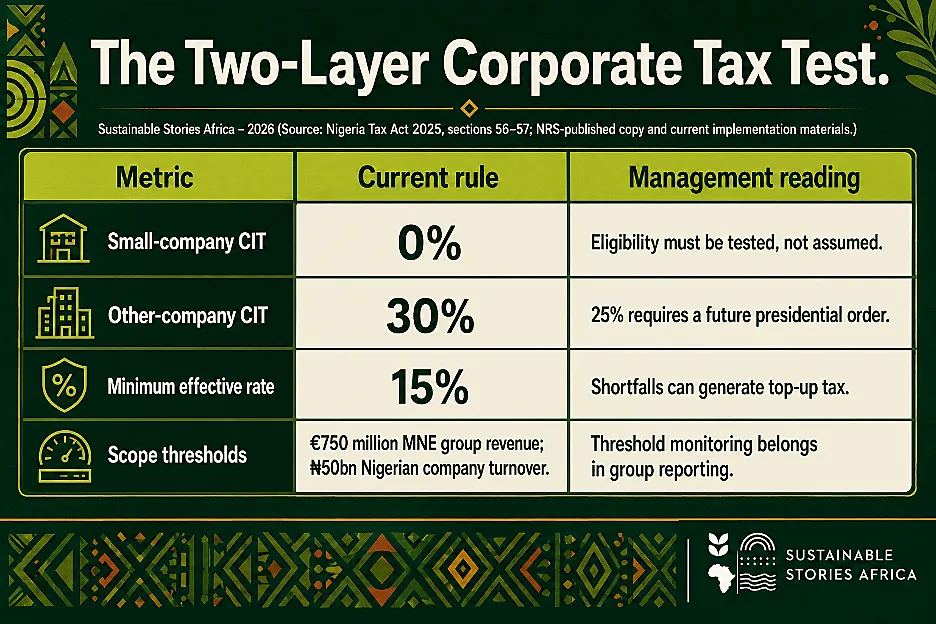
Nigeria’s corporate income tax headline remains 30% for companies outside the small-company category, while a 15% minimum effective tax rule now adds a second test for large groups.
The practical question is no longer only what rate appears on a return, but whether covered taxes reach the statutory floor after accounting adjustments.
Two Rates, One New Compliance Reality
FinPolNomics Green Finance originated the Tax & Transfer Pricing Nugget behind this explainer, distilling Nigeria’s corporate income tax and minimum effective tax rules into a compact visual for business readers.
Sustainable Stories Africa has expanded that nugget through its Metrics and Insights & Data editorial lens: start with the numbers, test them against the current statutory text, then explain what they mean for decisions, controls and long-term resilience.
The result is a two-layer story. Most non-small companies still face a 30% corporate income tax rate.
Large domestic companies and multinational groups must also check whether their effective tax rate reaches 15%, with top-up tax due where it does not.
Headline Rates No Longer Tell Everything
Nigeria’s corporate tax framework now asks two different questions. The first is familiar: what rate applies to taxable profits?
- Under the Nigeria Tax Act 2025, a small company is taxed at 0%, while other companies are taxed at 30%.
- The Act also leaves room for a future reduction of the 30% rate to 25% by presidential order on the advice of the National Economic Council.
- Until such an order takes effect, boards should not build forecasts around the lower figure.
The second question is newer:
- After the group’s covered taxes are compared with its adjusted net income, does the resulting effective tax rate reach 15%?
- This minimum effective tax test is aimed at large economic actors rather than every corporate taxpayer.
- It aligns Nigeria more closely with the global push to reduce incentives for multinational profits to sit in low-tax jurisdictions.
That distinction matters because a statutory rate and an effective rate are not interchangeable.
- A company may nominally fall under the 30% regime yet report an effective rate below 15% after incentives, exemptions, timing differences or accounting adjustments.
- The minimum rule is designed to close that gap with a top-up amount.
The minimum-tax lens can also expose where reported tax outcomes differ across entities that perform similar activities.
That comparison should not substitute for legal analysis, but it can help a group identify inconsistent incentive treatment, incomplete covered-tax data or accounting classifications that deserve review before filing.
Who Enters The Minimum Tax Net
The scope test creates two gateways.
- One captures a constituent entity of a multinational enterprise group with aggregate group revenue of at least €750 million.
- The other captures a Nigerian company with aggregate turnover of at least N50 billion.
- These are scale tests, so tax teams need reliable group-level data before they can decide whether the calculation applies.
The domestic threshold is especially important for fast-growing Nigerian businesses that may not see themselves as multinational.
- A company can cross ₦50 billion through organic growth, inflation-driven price increases, acquisitions or consolidation effects.
- Once it approaches the threshold, the minimum effective tax calculation should move from an annual filing exercise into quarterly forecasting and governance.
For multinational groups, Nigeria’s rule interacts with global minimum-tax architecture, but the Nigerian liability must still be computed using Nigeria’s definitions.
The effective tax rate broadly compares covered taxes with net income.
- Covered taxes include specified corporate taxes and levies; net income is anchored in audited financial statements and adjusted for items such as franked investment income and unrealised gains or losses.
This is why a group’s global tax model cannot simply be copied into a Nigerian return.
Finance, tax and reporting teams must reconcile the local statutory computation to the group model, document differences and preserve a clear audit trail.
Where the ratio is below 15%, the top-up tax is the amount needed to bring the effective rate to the floor.
Currency movements create another monitoring point.
- The multinational threshold is denominated in euros while domestic reporting may be in naira or another functional currency.
- Groups should document the translation approach and use a consistent revenue period so that exchange-rate volatility does not turn the scope decision into an unexplained annual surprise.
The Business Case For Better Data
The rule turns data quality into a tax cost issue.
- If covered taxes are incomplete, entities use inconsistent chart-of-account mappings.
- If excluded income is not properly identified, the effective rate can be misstated.
- An understatement creates exposure; an overstatement can cause unnecessary cash tax or obscure the real economics of an incentive.
Large businesses therefore need a shared data dictionary that links audited accounts, tax computations and group consolidation systems.
Each item in the numerator and denominator should have an owner, a source system and a review control. That may sound technical; however, the connection to sustainability is direct: predictable public revenue and credible corporate reporting both depend on traceable information.
Investment incentives also need a fresh evaluation.
- A benefit that reduces corporate income tax may still be neutralised by a top-up tax.
The correct question is not whether an incentive exists, but whether it reduces the group’s total liability after the minimum effective tax calculation.
Capital-allocation committees should request that after-tax view before approving location, financing or restructuring decisions.
The same discipline improves stakeholder communication.
Investors can better understand why the cash tax rate changes; lenders can model covenant headroom more accurately; and boards can distinguish a temporary accounting swing from a structural minimum-tax charge.
Good tax data becomes part of institutional trust, not merely a filing requirement.
The wider public-interest question is whether the floor raises sustainable revenue without discouraging productive investment.
Government reporting should distinguish ordinary corporate tax from top-up receipts and explain how incentives perform after the minimum rule.
That evidence would help policymakers retain benefits that change real investment behaviour and redesign those that merely lower an accounting rate.
A Practical Readiness Plan For Boards
First, confirm classification.
- Re-test small-company status and map every Nigerian entity against the N50 billion threshold.
- For multinational groups, verify the consolidated revenue test in euros and document the exchange-rate basis used.
- Threshold monitoring should include plausible year-end growth, not only the last audited number.
Second,
- Run a shadow minimum-tax calculation before filing season. Reconcile covered taxes to ledger balances and tax returns, bridge profit before tax to statutory net income, and isolate exclusions.
- A quarterly dry run will reveal missing data, ownership gaps and incentive interactions early enough to fix them.
Third, establish governance.
- The audit committee should receive the headline rate, the computed effective rate, the amount of any top-up tax and the main drivers of change.
- Material assumptions should be approved and retained alongside supporting schedules.
- Transfer-pricing, deferred-tax and incentive teams must be in the same review loop because each can affect the outcome.
Finally, model scenarios.
- A business should understand its position at 30%, at a possible future 25% rate, and under the 15% effective floor.
- Scenario planning does not predict government action; it prevents strategic plans from relying on a rate change that has not yet occurred.
- Cash-flow forecasts should use the law currently in force and label alternatives clearly.
Controls should extend to acquisitions and disposals.
- A transaction can change consolidated revenue, entity scope, deferred-tax balances and incentive assumptions in one reporting period.
- Tax due diligence should therefore include a minimum-effective-tax bridge and a plan for integrating the target’s data into the group calculation from completion.
Path Forward – Build The Minimum Tax Control Room
Nigeria’s two-rate reality rewards companies that connect tax, finance and strategy.
The immediate task is to identify scope, calculate the 15% test using current data and place the result under board-level control.
FinPolNomics supplied the nugget; the enduring metric is the gap between the company’s effective rate and the statutory floor.
Track that gap early, explain it clearly and fund any top-up before it becomes a surprise.