More than 1.65 million applications and N322.69 billion in disbursements show how quickly NELFUND has become part of Nigeria’s higher-education system.
However, the scheme’s defining test will come after graduation: can repayment protect low earners without weakening the revolving fund?
Brookings’ study of America’s shift from ICR and SAVE to RAP offers a useful warning. Income-linked loans succeed only when formulas are fair, rules are simple, and administration earns borrowers’ trust.
Nigeria’s Loan Scheme Faces Repayment Test
Nigeria’s student-loan experiment has moved from promise to national infrastructure in barely two years. A NELFUND status report dated 8 August 2026 recorded 1,659,853 processed applications and total disbursements of N322.69 billion.
Of that amount, N192.89 billion went to 319 institutions for fees, while N129.80 billion went to students as upkeep support. The scale reflects both intense demand and the pressure that rising education and living costs place on households.
For students, however, access is only one part of the experience.
Applicants have also encountered delayed upkeep, varying payment start dates across academic calendars, lengthy school verification and uncertainty over refunds when students paid fees before NELFUND settled the same obligation.
In June 2026, the Fund warned institutions against delaying or refusing those refunds and against arbitrary fee increases.
This is why Brookings’ analysis of US income-driven repayment matters to Nigeria.
- It does not provide a model to copy wholesale.
- It provides a design test: a student-loan system must link payment to real earning capacity, communicate rules clearly and administer millions of individual accounts without turning relief into confusion.
Scale Is Rising Faster Than Certainty
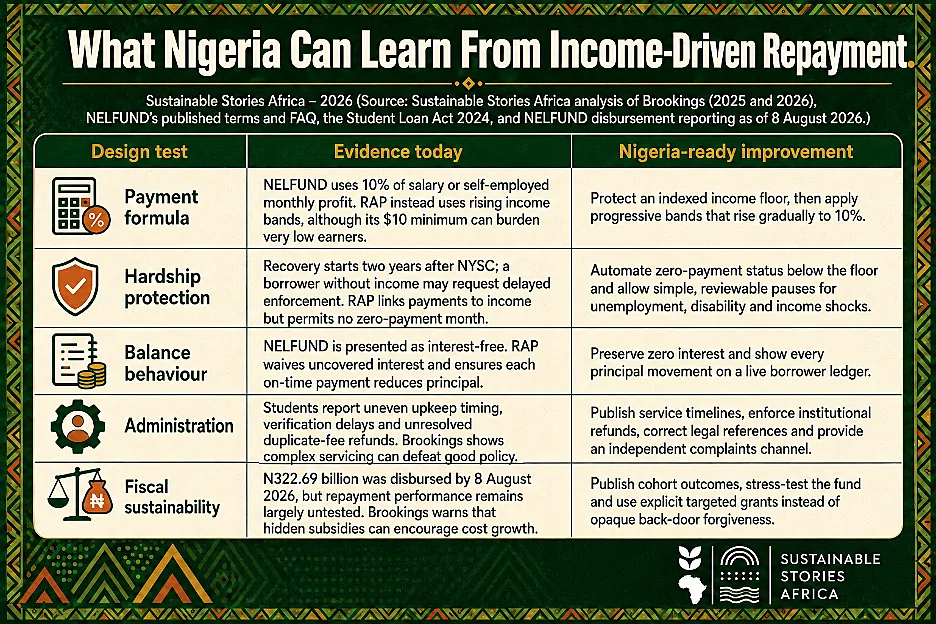
NELFUND’s published repayment structure is already income-linked in a basic sense.
- Recovery begins two years after completion of the National Youth Service Corps programme.
- An employed beneficiary is expected to have 10% of monthly salary deducted at source, while the Fund’s FAQ says a self-employed borrower should remit 10% of monthly profit.
- A beneficiary without income may seek an extension of enforcement, supported by an affidavit.
- The loan is presented as interest-free, and early repayment is allowed.
Those protections are meaningful, but the formula remains blunt.
- 10% of total salary is not the same as 10% of disposable or discretionary income.
- Public-facing terms do not show a protected income floor, progressive repayment bands, an adjustment for dependants or a routine long-term forgiveness horizon.
- A low-paid graduate supporting relatives could therefore surrender the same share as a much higher earner, even though the sacrifice is very different.
The scheme’s repayment performance is also largely untested on a scale.
That is an inference from its timeline:
- Applications opened in May 2024, while recovery begins only after NYSC plus a two-year grace period.
- Nigeria still has time to improve the rules before large cohorts become due; however, that window is narrowing as applications and outstanding balances expand.
Brookings Shows Why Repayment Design Matters
Brookings researchers Sarah Reber and Sarah Turner frame income-driven repayment as insurance against education investments that underperform expected wage returns, allowing payments to scale with earnings across a career.
By December 2025, roughly 12.9 million US borrowers holding about $770 billion in balances had enrolled in such plans, evidence that repayment design now functions as major public-finance infrastructure rather than a niche welfare tool.
The new Repayment Assistance Plan (RAP), launched 1 July 2026, applies a sliding rate to adjusted gross income:
- $10 monthly below $10,000, rising incrementally to 10% above $100,000, with dependent-based reductions and principal-matching incentives for on-time payments. Brookings cautions that RAP is not inherently fairer:
- It removes zero-payment protections, lacks inflation-indexed brackets, and extends forgiveness timelines to 30 years, potentially burdening the poorest borrowers over time.
The sharper lesson is administrative.
- Overlapping US plans, SAVE litigation, and recertification failures eroded borrower trust.
- Nigeria should heed this by maintaining one clear repayment system with published rules before disbursement begins.
- Notably, NELFUND's online terms still reference the repealed 2023 Act rather than the 2024 re-enactment, a minor error signalling broader version-control and communication risks.
Nigeria Already Has One Major Advantage
Nigeria starts with an advantage the US has struggled to replicate: no interest accumulation.
- A borrower facing temporarily low repayment avoids negative amortisation, the discouraging cycle of paying while balances grow.
- Preserving this zero-interest promise should remain non-negotiable, keeping debt comprehensible and shielding graduates during inflation or weak labour markets.
The 2024 Act further eased access by removing the family-income threshold and guarantor requirement, expanding eligible costs beyond tuition to institutional charges and upkeep, and allowing delayed enforcement for beneficiaries without income.
Direct fee payments to institutions, paired with upkeep payments to students, form a sensible control split, though current reconciliation failures show enforcement still needs strengthening.
Smarter repayment design should make access durable, not just easier.
- Brookings warns that generous forgiveness can function as a hidden grant, encouraging excessive borrowing while easing pressure on institutions to control tuition.
Nigeria can avoid this by keeping grants explicit and targeted, toward the poorest students, public-interest fields, or verified hardship cases, while applying transparent, progressive repayment for earners.
This matters because small-balance, non-completing borrowers often default more than high-balance graduates; since NELFUND holds borrowers liable even without graduating, completion support is effectively repayment policy.
Build A Repayment System Around Reality
First,
- NELFUND should replace the flat 10% deduction with progressive bands above a protected income floor, tied to the minimum wage or tax threshold and indexed annually so inflation doesn't erode protection.
- Borrowers below the floor should owe zero without being classified as defaulters, with rates rising gradually toward 10% for higher earners.
Second,
- Income verification must reflect Nigeria's labour market realities. While payroll deduction suits formal workers, profit is harder to measure for freelancers and microbusinesses.
- NELFUND should create simplified self-employed income bands, allow annual reconciliation, and establish an appeal route for income shocks.
- Data matching with tax, identity and payroll systems should remain purpose-limited, secure and compliant with data-protection rules, rather than an opaque collection exercise.
Third,
- Every borrower needs a live ledger tracking institutional fees, monthly upkeep, approval dates, refunds, outstanding principal and repayment triggers.
- A pre-loan calculator should model deductions across income scenarios, while the portal should apply the 2024 Act consistently and issue plain-language annual statements documenting hardship pauses and payments.
Fourth,
- Institutions require enforceable service standards: published verification timelines and fixed refund windows (such as 14 or 30 days) for duplicate payments, with NELFUND publishing unresolved cases and applying sanctions where delays persist.
- Students should not become involuntary lenders due to reconciliation failures between public payment systems.
Finally,
- NELFUND should publish cohort data spanning application time, disbursement, completion, employment, income bands, repayments and write-offs, alongside independent actuarial reviews testing fund sufficiency.
- Linking outcomes to institutions would expose where high fees yield weak returns.
Path Forward – Protect Borrowers While Preserving The Fund
NELFUND should keep its zero-interest promise while replacing the flat 10% rule with protected, progressive, inflation-indexed repayment and automatic hardship pauses.
A clear borrower ledger, verified income data and enforceable refund timelines would make the scheme easier to trust.
Before the first major cohorts enter repayment, Nigeria should publish regulations, test the formula with graduate earnings data and create an independent appeals channel.
The goal is simple: access today without unaffordable deductions tomorrow.