
The Basel Committee's current credit-risk principles preserve a 25-year-old framework; however, it sharpens its links to modern governance, expected losses, concentration controls, counterparty risk, stress testing and supervisory reporting.
For African banks, the message is practical: strong models do not compensate for weak approval discipline, poor portfolio data, connected lending or delayed action on deteriorating exposures.
Why Credit Governance Matters Again
Credit losses rarely begin with the accounting entry that finally records them.
They usually begin earlier, in an overly optimistic growth target, a weak borrower assessment, an exception that becomes routine or a concentration that the board sees too late.
The Basel Committee on Banking Supervision's revised Principles for the Management of Credit Risk return attention to those decisions.
The attached February 2025 document was the consultation draft.
The Committee closed that consultation and issued the current guidelines on 30 April 2025.
The final framework keeps the original four-part architecture:
- An appropriate credit-risk environment; a sound credit-granting process; effective administration, measurement and monitoring; and adequate controls. Supervisory responsibilities sit across those pillars.
The update is deliberately limited.
- Basel did not create a new credit-risk regime.
- It removed obsolete or duplicated material, aligned language with the current Basel Framework and connected the principles to more recent work on governance, expected credit losses, non-performing and forborne exposures, risk-data aggregation, stress testing, climate-related financial risk and counterparty credit risk.
Twenty-Five Years Changed Banking's Risk Landscape
The original principles were published in 2000.
- Since then, banks have expanded across borders, moved more exposures off balance sheet, relied more heavily on internal ratings and automated decisions, and navigated repeated sovereign, commodity, pandemic and market shocks.
- Credit risk is still the possibility that a counterparty fails to meet an obligation, but its transmission across portfolios is faster and more interconnected.
That is why the framework begins above the credit desk.
- Boards are expected to approve and review the credit-risk strategy and significant policies at least annually.
- The strategy should cover risk tolerance, sustainable returns, market conditions, macroeconomic factors and forward-looking information.
- Remuneration should not reward short-term profit that depends on breaching policies or exceeding limits, and conflicted directors should not override established approval processes.
Sixteen Principles Reinforce Four Control Pillars
The first pillar assigns implementation to senior management.
- Policies should cover the bank's target markets, portfolio mix, pricing and non-price terms, limits, delegated authorities, exceptions and early identification of problem exposures.
- International lending requires attention to country and transfer risk, including contagion, contract enforceability and the practical ability to realise collateral.
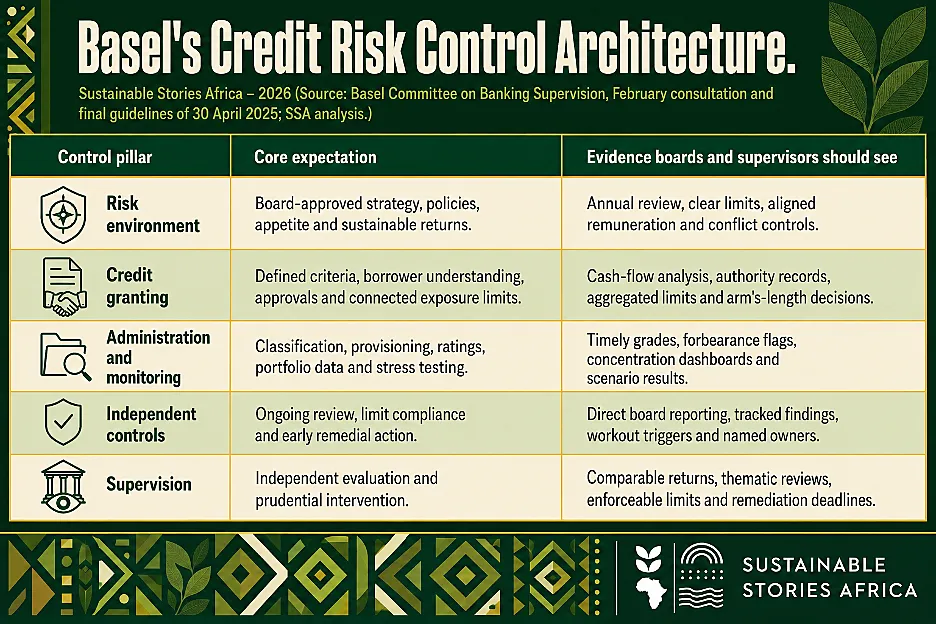
The credit-granting pillar demands clear criteria and a thorough understanding of the borrower, the purpose and structure of the facility, the source of repayment and the risk-return relationship.
- Limits must aggregate comparable exposures across banking and trading books, on and off the balance sheet, for individual counterparties and connected groups. New facilities, amendments, renewals and refinancing require defined approval processes.
- Related-party lending must remain at arm's length and receive heightened monitoring.
The administration and monitoring pillar is where governance becomes data.
- Banks need systems for ongoing administration; grading and classification of all exposures, including forborne and off-balance-sheet positions; robust provisioning; internal ratings proportionate to the business; and management information capable of identifying concentrations.
- They must also assess individual and portfolio exposures against current and forward-looking macroeconomic conditions and under stress.
The control pillar requires;
- Independent, continuing assessment of the credit-risk process, direct communication of findings to boards and senior management, compliance with prudential and internal limits, and early remedial action on deteriorating credits.
- Supervisors, in turn, should independently evaluate the entire framework and use reporting and prudential limits where necessary.
Old Rules Gain New Operational Weight
The value of the update is not novelty but in its coherence.
- A bank may already have policies on expected credit losses, large exposures, stress testing and counterparty risk. Basel's cross-references show how those requirements should be met within one operating system.
- A rating downgrade should affect provisioning, limits, monitoring frequency, stress scenarios and escalation - not sit in a separate risk report.
That integrated approach can improve both resilience and capital allocation.
- Better portfolio data allows management to distinguish profitable risk-taking from hidden concentration.
- Early remediation preserves more options than a late workout. Independent review reduces the chance that revenue pressure becomes an unwritten exception policy.
- Boards receive information in a form that supports decisions rather than retrospective explanation.
A useful control chain begins with a single obligor and ends at the portfolio.
- The bank should know who ultimately owes it money, which counterparties are connected, what collateral is realistically recoverable, how exposures behave under stress and whether total risk remains within appetite.
- If that chain breaks between business units, subsidiaries or data systems, a formally approved limit can still conceal the bank's true exposure.
African Banks Face a Practical Test
African banking systems face a distinctive implementation challenge.
- Borrower data can be incomplete, collateral enforcement slow and macroeconomic conditions volatile.
- Banks may carry material sovereign, sector, foreign-currency or connected-counterparty concentrations.
- Climate shocks can affect agriculture, infrastructure and household cash flows at the same time, turning apparently diversified loans into correlated exposures.
The correct response is not to copy complex models developed for deeper markets.
- It is to apply proportionality without diluting control.
- Banks need reliable borrower identification, cash-flow-based underwriting, group-wide exposure aggregation, realistic collateral haircuts, sector and geographic concentration limits, and stress tests that reflect local inflation, currency, commodity, climate and political risks.
Supervisors should ask for evidence.
- Board minutes should show challenge and approval.
- Exceptions should be measurable and time-bound.
- Internal ratings should influence decisions.
- Forbearance should not hide deterioration.
- Management information should be reconciled to finance and regulatory returns.
- Remedial plans should have named owners and triggers.
Smaller banks and fast-growing digital lenders may need simpler tools, but they still need complete control logic.
- A spreadsheet-based concentration report that is reconciled, reviewed and acted upon can be safer than a sophisticated dashboard built on incomplete data. Proportionality should reduce unnecessary complexity;
- it should never remove independent challenges, exposure aggregation or timely recognition of deterioration.
Supervisors Must Turn Principles Into Practice
Regulators can translate the framework into thematic reviews of underwriting, related parties, risk data quality, concentration and problem-loan management.
Banks should map each principle to a policy owner, control evidence, reporting frequency and remediation deadline.
Internal audit should test whether the process works at transaction and portfolio levels, not merely whether a policy exists.
Boards should also treat climate and digital credit as credit-risk questions.
- Climate exposure belongs in borrower assessment, collateral values and portfolio stress. Automated lending belongs within product approval, model governance, monitoring and fair-treatment controls.
The framework is broad enough to cover both when institutions connect new risks to the core disciplines rather than creating isolated compliance projects.
Path Forward – Stronger Decisions Before Defaults
The revised principles should become a decision architecture: clear appetite, disciplined origination, complete exposure data, forward-looking monitoring, independent challenge and early remediation.
For African banks and supervisors, success will be visible before loss ratios move: fewer undocumented exceptions, faster concentration reporting, credible stress responses and boards that challenge growth plans against sustainable risk capacity.